

Says Domestic Investors Remain Bourse’s Biggest Players
Caption: Kwairanga in a chat with members of the Brazilian team
The Nigerian Exchange Group Plc, on Saturday in Lagos said the visit is coming almost exactly one year after a delegation from the NGX Group board paid a study visit to Brazil, stressing the need to take the relationship to the next level.
Given that the Nigeria’s capital market has undergone significant transformation in recent years, he said the relation between both countries “should be defined by greater investment, deeper capital flows and stronger private-sector collaboration.”
According to him, the Nigerian capital market has “witnessed stronger performance, deeper investor participation, increased use of technology and reforms that continue to improve market efficiency, transparency and accessibility.”
The NGX Group, Kwairanga continues, sees itself “as a platform for capital formation, wealth creation and economic development, connecting businesses with long-term capital and connecting investors with opportunities that drive sustainable growth,” rather than just operating an exchange.
The NGX Group, he stressed, believes the Nigerian market offers multiple pathways for productive partnerships such as equity listings, debt capital markets, infrastructure financing or innovative investment structures, between both countries.
More importantly, the NGX Group chairman added that “these partnerships should be built around long-term value creation.
“By combining Brazil’s industrial expertise and investment experience with Nigeria’s market opportunities and entrepreneurial energy, there is tremendous potential to unlock mutually beneficial ventures across agriculture, infrastructure, energy, manufacturing, technology and other strategic sectors.”
He urged the visitors to dialogue freely, ask questions, share perspectives and challenge his team where necessary, adding the interaction also offer opportunities for the Nigerian team to learn from Brazil’s experiences and identify practical areas where institutions and private sectors of both nations can partner more closely.
Such relationships, he continued, are “developed over time through trust, consistency and a willingness to explore opportunities together with the possibility that it becomes stepping stopping to a stronger economic partnership between Nigeria and Brazil.
Also speaking at the event, Temi Popoola, chief executive of the NGX Group, said domestic investor participation on the nation’s bourse has grown steadily from 46% in 2015, compared to the foreign investment component, first to the near equilibrium achieved in 2018 when it rose to 49%, and then 51% in the following year.
Ever since, Nigerian investors have consistently remained the dominant players in the market, situation analysts link to a blend of micro-economic factors which together continue to engender investor confidence.
In a presentation on Saturday in Lagos when board and management of NGX Group received a Brazilian Business delegation with interest in exploring opportunities within Nigeria’s capital market and broader investment landscape, Temi Popoola, its chief executive noted that domestic participation in the market peaked at 89% in 2023.
The following year, the foreign investor participation surged to 15.25%, leaving the domestic component at 84.75%; before sliding to 77.79%, after which it has risen to 87.93% year to date in 2026.
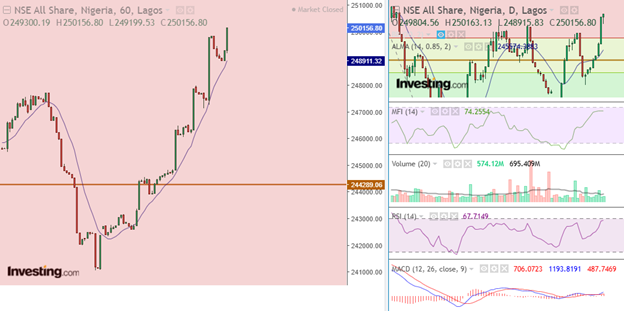
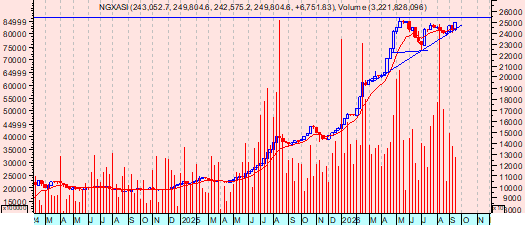
Popoola noted that the Nigerian Exchange with 139 listed companies, currently has a composite All=Share index has grown by 158.29% since 2021. With 157 fixed income securities, 12 Exchange Traded Funds and four index futures (derivatives), he said the bourse today boasts of N215.09 trillion (about US$157.58 billion) in total market capitalization.
The Exchange, he continues has recorded 126.07bn shares turnover valued at N6.10tr in 8.58m deals year-to-date, translating to N41.22bn average daily traded value.
Year-to-date, he told the visitors that the Nigerian equities market has returned 57.58%, just as it has gained N59.11tr in investors wealth as at August 6, 2026
The growth drivers, he said, include the successful banking sector recapitalization flagged off in 2024 which compelled banks to raise their capital threshold significantly, followed by the digital economy with the ICT and fintech expansion, power and upstream investment. Other include infrastructure financing using bonds and public-private sector partnership funding development; deepening demand by domestic pension institutions, as well as the easing inflation that is now supporting spending.
Highlighting the investment opportunities and outlook on the Nigerian Exchange, Popoola said the country “remains one of Africa’s most compelling long-term investment destinations, supported by structural reforms, demographic strength and an increasingly sophisticated capital market.
The best performing sectors since the beginning of this year, he said, are oil & gas, which has returned 98.8% on the average (boosted by the strong +127.88% YTD growth in the share price of Aradel Holdings Seplat Energy (+106.20%), industrial goods, 85.79%, banking 67.9%, and consumer goods, 13.41%.
Going into the future, Popoola told the Brazilian delegation that continued domestic liquidity will support equity valuations, just as the banking recapitalisation and infrastructure financing stimulate new listings, while product innovation across fixed income, ETFs and derivatives will broaden participation in the market.
The delegation was led by Roberto Giannetti da Fonseca, Managing Director of APEX Brasil, Floriano Pesaro.