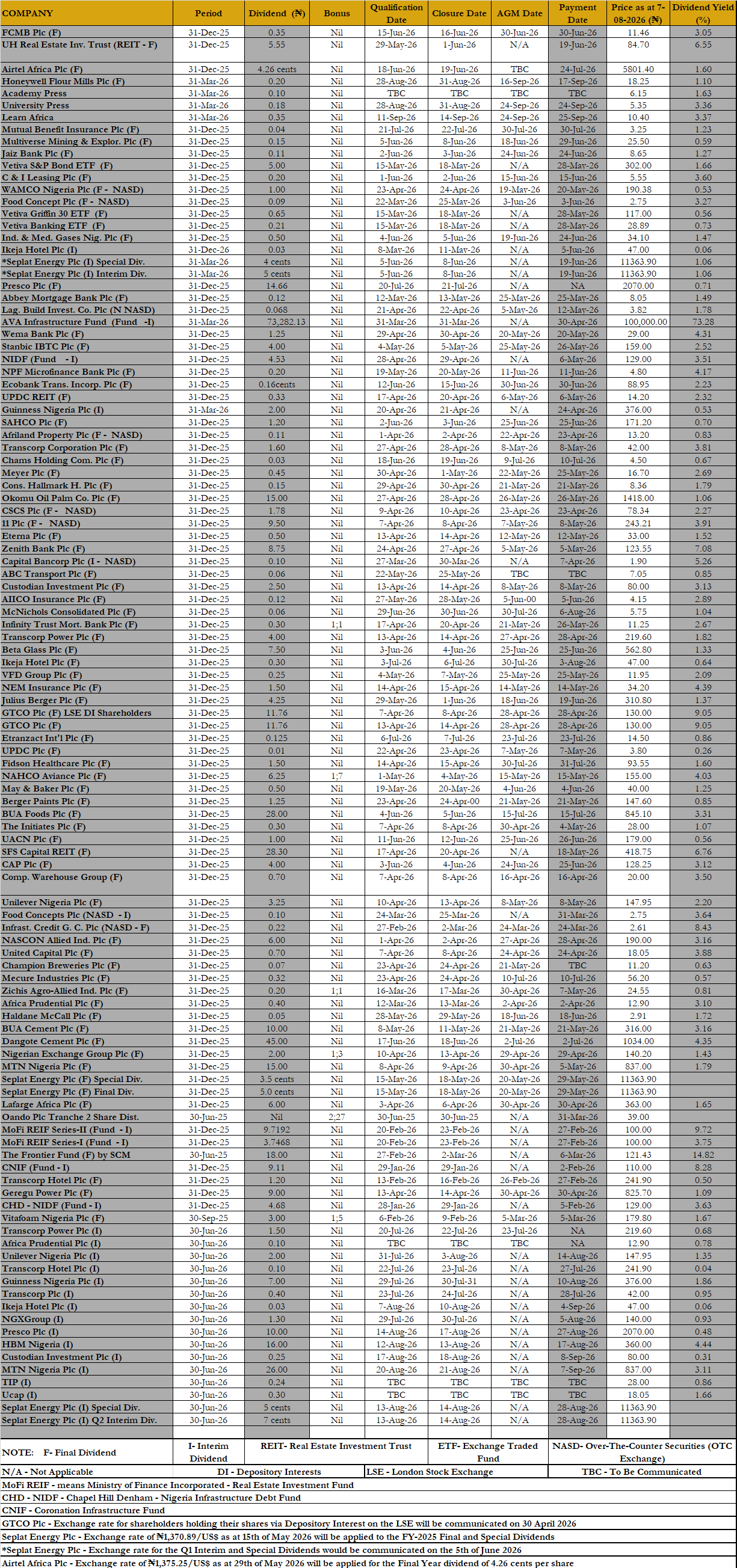

Market Update For August 28, 2026
The Nigerian equities market ended the week on a stronger note, with the Nigerian Exchange (NGX) staging a broad-based recovery on Friday, August 28, 2026, as renewed buying interest in selected heavyweight stocks helped reverse recent losses. This has been attributed Thursday’s official confirmation by the global index provider, FTSE Russell that the status of Nigeria’s capital market will be upgraded from “Unclassified to “Frontier Market” when trading opens on Monday, September 21, 2026.
The rebound also suggests that some investors are beginning to see value following the market’s recent weakness, particularly in fundamentally strong counters. The improved participation across several stocks also points to easing selling pressure, although sentiment remains cautious amid elevated valuations and uncertainty around domestic and global economic conditions.
Large-cap stocks were central to the recovery, with gains across banking, energy and industrial counters providing support for the benchmark. The broader advance was also encouraging, as the session was not driven entirely by a handful of index-heavy stocks.
Friday’s recovery marked a positive shift after the recent selling pressure on the domestic bourse. Investors appeared more willing to accumulate selected stocks at lower price levels, particularly companies with strong earnings prospects and attractive valuations.
The improvement in market breadth was another positive signal. A broader participation in the recovery suggests that investors are gradually becoming more confident, although the market still requires follow-through buying in subsequent sessions to confirm a sustained reversal.
The strong year-to-date performance of the NGX remains a factor influencing investor behaviour. After substantial gains earlier in the year, some investors have continued to lock in profits, creating intermittent selling pressure across several counters.
This has resulted in a more selective market, where investors are increasingly focusing on earnings quality, dividend prospects, valuation and sector-specific catalysts rather than simply chasing broad market momentum.
The performance of large-cap stocks remains critical to the direction of the NGX because of their significant weighting in the benchmark index.
Banking stocks continue to attract considerable attention as investors assess earnings growth, capital positions, dividend prospects and the impact of monetary-policy conditions. Strong corporate results and expectations of resilient profitability could continue to support demand for leading financial stocks.
Energy-related stocks are also important to the market, particularly given the influence of crude oil on Nigeria’s fiscal position, foreign-exchange earnings and broader economic outlook.
Friday’s gains in selected heavyweight counters therefore provided meaningful support to the overall market and helped improve investor confidence going into the new trading week.
Oil Market
The global oil market provided a mixed backdrop for Nigerian equities as crude prices fell on Friday and remained on course for a significant weekly decline.
Brent crude traded around $89.18 per barrel, while West Texas Intermediate (WTI) stood at approximately $82.52. Brent was heading for a weekly decline of about 5.5%, while WTI was set to fall roughly 5.2%.
The decline came as traders assessed increased crude flows through the Strait of Hormuz against continued uncertainty surrounding U.S.-Iran diplomacy. The strategic waterway remains a critical route for global oil shipments, meaning developments around its accessibility continue to influence crude prices.
Signs of additional crude volumes moving through the Strait have eased some supply concerns and reduced part of the geopolitical premium previously supporting oil prices. However, the situation remains fluid, with diplomatic efforts continuing to restore normal shipping activity.
The United States has also increased pressure on Iran through additional sanctions, while Tehran has rejected the measures. Any deterioration in the geopolitical situation could quickly disrupt crude flows and push prices higher, while further progress on reopening the shipping route could place additional pressure on prices.
For Nigeria, the direction of crude prices remains particularly important. Oil revenue continues to influence government finances, foreign-exchange inflows and external-sector stability. Sustained crude prices around current levels could remain supportive, provided production and export volumes are maintained.
However, a prolonged decline in oil prices could put pressure on government revenue and foreign-exchange earnings, particularly if weaker prices are accompanied by lower domestic oil production.
Technical Analysis
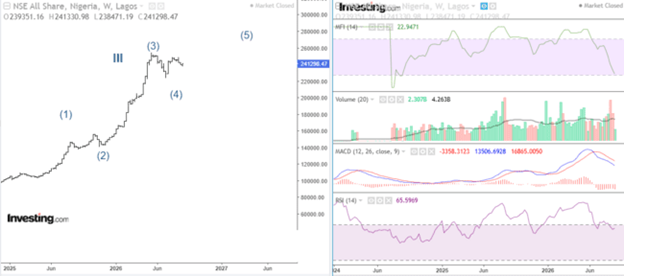
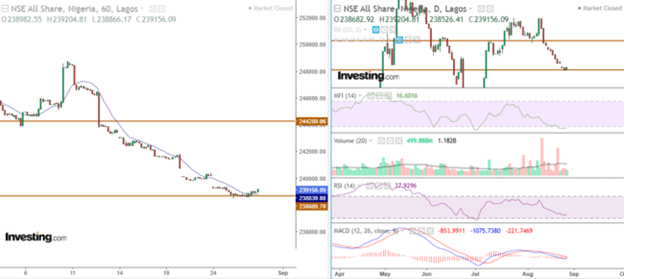
From a technical perspective, Friday’s rebound improved the short-term structure of the NGX. The All-Share Index recovered above the 240,000-point psychological level, making this area an important near-term support zone.
The next significant resistance area is around 241,000–242,000 points. A sustained break above this region, particularly on stronger trading activity, would provide greater confirmation that the market is establishing a new upward move.
Momentum could strengthen further if large-cap stocks continue to attract buying interest and market breadth remains positive. Increasing turnover alongside a rising index would also provide stronger evidence of institutional participation.
However, the recovery remains vulnerable to renewed profit-taking. Failure to sustain levels above 240,000 points could lead to another period of consolidation and potentially expose the market to renewed selling pressure.
The coming sessions will therefore be important in determining whether Friday’s performance represents the beginning of a broader recovery or simply a temporary rebound following the recent decline.
Market Outlook
The near-term outlook for the NGX remains cautiously bullish. The combination of improved breadth, renewed demand for heavyweight stocks and the recovery above the 240,000-point level provides a constructive signal.
Nevertheless, investors are likely to remain selective as they weigh domestic monetary conditions, exchange-rate developments, inflation, corporate earnings and global market risks.
The banking sector should remain a major driver of market direction because of its substantial representation on the exchange, while energy stocks could respond to changes in crude prices and expectations for Nigeria’s external position.
Oil prices will remain an important external variable. Continued weakness in crude could weigh on sentiment toward Nigerian assets if it becomes persistent, while stable or stronger oil prices could provide additional support for government revenues and foreign-exchange liquidity.
Interest-rate expectations will also influence investor allocation between equities and fixed-income assets. Attractive yields in the fixed-income market could continue to compete with equities for investor funds, particularly where valuations appear stretched.
Corporate earnings and company-specific developments should therefore remain important catalysts. Investors are likely to favour businesses with strong balance sheets, sustainable earnings and clear growth prospects.
Looking Ahead
The next few trading sessions will determine whether the NGX can build on Friday’s recovery. A sustained move above the 241,000–242,000 resistance zone would strengthen the bullish case and could encourage additional buying.
Conversely, failure to maintain the 240,000 support level would weaken the recovery and could return the market to a consolidation or corrective phase.
Overall, Friday’s performance represents an encouraging improvement in market sentiment, but confirmation is still required. Continued buying interest, stronger turnover and sustained positive breadth will be key to determining whether the market can extend its rebound into the coming week.
At the close of trading, the NGX All-Share Index gained 1,710.98 points, or 0.90%, to 240,867.07 points, while market capitalisation increased by ₦1.10 trillion to ₦155.55 trillion. The market’s year-to-date performance improved to 55.06%. Total volume stood at 351.02 million shares, with ₦25.07 billion worth of transactions executed across 35,651 deals. Market breadth was positive, with 36 stocks advancing against 22 decliners, while three stocks closed unchanged. Among the major market movers, ZENITHBANK recorded the highest volume with 38.41 million shares, while TRANSCOHOT led by traded value. The top gainers were SEPLAT, up 10.00% to ₦12,320.60; TRANSCOHOT, up 9.76% to ₦265.50; OMATEK, up 9.49% to ₦1.50; DAARCOMM, up 9.42% to ₦1.51; and UPL, up 8.57% to ₦5.70. The top losers were TOTAL, down 10.00% to ₦576.00; HMCALL, down 8.78% to ₦3.74; ETRANZACT, down 8.62% to ₦13.25; AUSTINLAZ, down 7.41% to ₦2.50; and AVACAP, down 7.14% to ₦6.50.