
Market Update For August 20, 2026
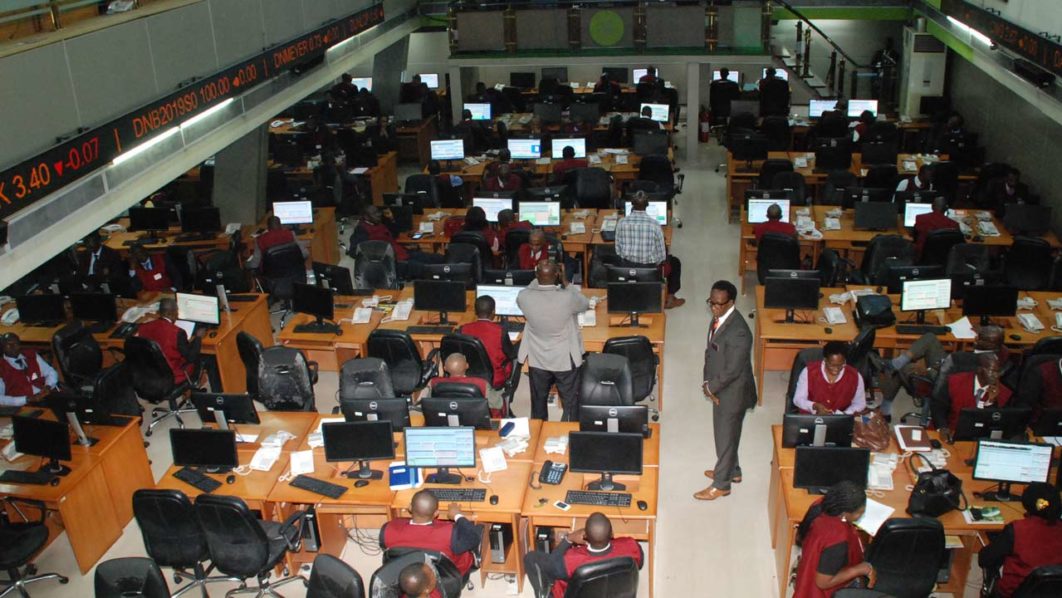
The Nigerian equities market extended its recent decline on Thursday, August 20, 2026, as persistent profit-taking across selected large-cap stocks continued to weigh on investor sentiment. The session was characterised by broad-based selling, elevated trading activity and significant pressure on some of the market’s most influential counters.
The latest decline comes after a period of strong gains on the NGX, during which the benchmark index reached elevated levels and delivered substantial returns to investors. The subsequent pullback suggests that some investors are increasingly locking in profits, particularly in stocks that have recorded significant price appreciation over the course of the year.
The weakness was not confined to a single sector. Major oil and gas, banking and insurance-related counters recorded declines, placing additional pressure on the broader market. The performance of heavyweight stocks remains particularly important because of their significant influence on the All-Share Index.
Among the notable decliners, ARADEL fell 5.40%, while OANDO declined 3.68%. The banking segment also struggled, with UBA shedding 2.17%, while ACCESSCORP, WEMABANK, ZENITHBANK and GTCO recorded smaller losses of 0.74%, 0.68%, 0.48% and 0.23%, respectively.
Market breadth remained firmly negative during Thursday’s session, reinforcing the bearish tone. More stocks closed lower than higher, indicating that the decline extended beyond the major index constituents.
The dominance of losers suggests that the market is currently experiencing a broader risk-off phase rather than a decline caused solely by isolated movements in a few large-cap stocks. This is important from a technical perspective because sustained negative breadth often makes it more difficult for the benchmark index to recover quickly.
Nevertheless, there were pockets of buying interest. HMCALL, TRANSEXPR and MCNICHOLS recorded strong gains, showing that investors continued to search for opportunities in selected counters despite the broader weakness.
The divergence between the broader market and individual stocks highlights the importance of stock selection in the current environment. Investors appear to be favouring counters with specific catalysts while reducing exposure to stocks where profit-taking has become more pronounced.
Trading activity increased considerably during the session, with investors exchanging approximately 2.86 billion shares in 34,410 deals, valued at ₦24.66 billion.
However, the headline volume was heavily influenced by activity in FTGINSURE. The stock accounted for approximately 2.56 billion shares, representing the overwhelming majority of total market volume.
Such concentration means that the increase in aggregate market volume should be interpreted with caution. While higher turnover generally suggests stronger participation, a large proportion of activity concentrated in one counter does not necessarily indicate broad-based accumulation across the market.
ARADEL recorded the highest transaction value at approximately ₦6.23 billion, despite closing lower. This combination of high value traded and a negative price movement could indicate significant repositioning among investors.
The elevated activity also suggests that market participants remain active despite the ongoing correction. Investors are not completely withdrawing from the market; rather, they appear to be reallocating funds between stocks and sectors as they respond to changing valuations and market conditions.
Profit-taking remains one of the major factors influencing the current market direction. After the substantial gains recorded by the NGX earlier in the year, investors who entered positions at lower levels have greater incentives to realise profits.
This behaviour is particularly common when an index reaches elevated levels without a corresponding acceleration in new positive catalysts. Investors may choose to secure gains while waiting for stronger earnings visibility or more attractive entry points.
The pressure on large-cap stocks therefore deserves close monitoring. If the weakness remains limited to profit-taking and the affected stocks eventually attract renewed buying interest, the market could stabilise. However, continued selling in heavyweight stocks could prolong the correction and push the ASI towards lower technical support levels.
Technical Analysis
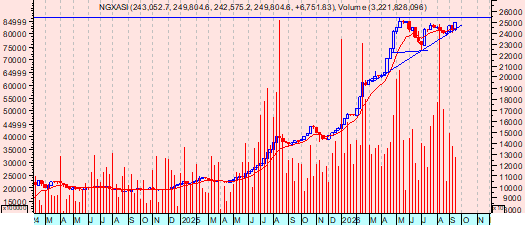
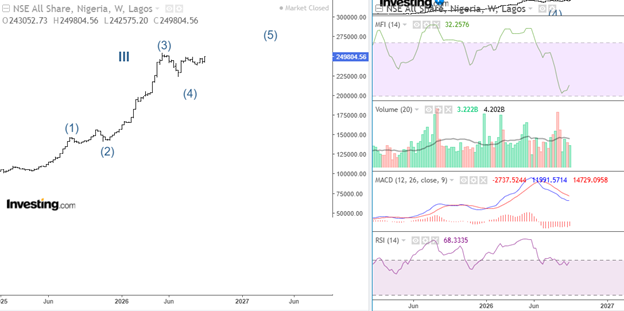
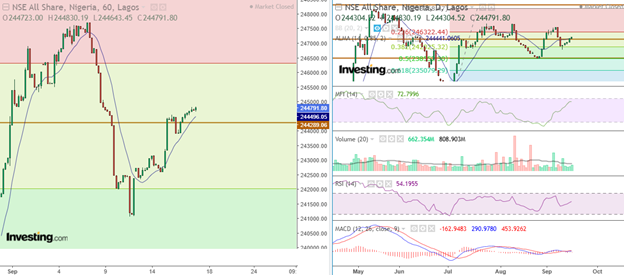
From a technical standpoint, the NGX All-Share Index remains under short-term bearish pressure. The recent decline has weakened momentum and suggests that sellers currently have greater control of the market.
The 240,000-point level is a critical psychological and technical area to watch. Holding above this level could encourage bargain hunting and provide a base for a technical rebound. However, a decisive break below the zone, particularly on strong volume and weak breadth, could signal the possibility of a deeper correction.
On the upside, the 243,000–245,000-point region represents an important resistance area. A sustained move back above this zone would strengthen the case for a recovery and indicate that buyers are beginning to regain control.
The market’s technical structure therefore remains cautious. Investors should watch the interaction between price, volume and breadth rather than relying solely on the index movement. A recovery accompanied by stronger breadth would provide a more credible bullish signal than a rebound driven by only a few large-cap stocks.
Outlook
The short-term outlook remains cautious, with the NGX likely to remain volatile as investors balance profit-taking against opportunities created by lower prices.
The market’s strong YTD performance means that there is still considerable room for investors to realise gains. Consequently, selling pressure could persist, particularly in stocks that have significantly outperformed their historical levels.
However, the correction could also create opportunities for long-term investors. Stocks with strong earnings growth, sustainable dividends, healthy balance sheets and attractive valuations may begin to attract selective buying as prices adjust.
The direction of the broader market will also depend heavily on the performance of large-cap stocks. A stabilisation in banking, oil and gas and other heavyweight counters could provide the catalyst for a recovery in the ASI.
Investors are therefore expected to remain selective, focusing on company fundamentals rather than broad market momentum. Corporate earnings, liquidity conditions, interest rates, exchange-rate developments and foreign investor activity will remain key factors to monitor in the coming sessions.
Oil Prices
The global oil market delivered a positive signal for Nigeria on Thursday, with crude prices climbing to their highest levels in more than three weeks.
The increase was largely driven by renewed concerns about supply disruptions linked to ongoing tensions in the Middle East. Brent crude futures for October delivery rose $2.19, or 2.39%, to $93.81 per barrel, while U.S. West Texas Intermediate for September gained $2.33, or 2.89%, to $86.83 per barrel.
Both benchmarks reached their highest levels since July 24, extending their gains for a fifth consecutive session. The sustained increase in crude prices reflects growing concerns about the potential impact of geopolitical tensions on global oil supply.
For Nigeria, higher crude prices could provide support for foreign exchange earnings, fiscal revenues and external reserves, assuming production and export volumes remain stable. The development could also support sentiment toward oil and gas companies listed on the NGX.
However, the oil price rally is being driven largely by geopolitical uncertainty, which introduces a significant risk factor. A prolonged conflict could support prices but simultaneously increase volatility across global markets and weaken broader investor risk appetite.
For Nigerian equities, the performance of oil-related stocks could therefore remain closely linked to both crude prices and company-specific production and earnings developments.
The continued decline in major banking stocks is an important development for the market. Financial institutions remain among the most actively traded and influential stocks on the NGX, meaning sustained weakness in the sector could continue to weigh on the index.
At the same time, the decline in ARADEL and OANDO comes despite stronger international crude prices. This divergence indicates that local stock prices are currently being influenced by more than just commodity prices. Investors are also considering valuation, earnings expectations, company-specific developments and the extent of previous price gains.
The strong performance of MCNICHOLS and TRANSEXPR, meanwhile, demonstrates that buying interest remains available in selected stocks. This selective rotation could become more prominent if investors begin moving funds from expensive or overextended counters into stocks with stronger relative value.
In the current environment, investors may need to adopt a more defensive and selective approach. The broad market correction does not necessarily imply that all stocks are becoming less attractive.
Rather, the divergence between gainers and losers suggests that stock selection will remain critical. Investors with a medium- to long-term horizon may focus on companies with strong earnings visibility, manageable leverage, healthy cash flows and sustainable dividend prospects.
Short-term traders, meanwhile, may need to pay closer attention to support and resistance levels, trading volume and market breadth before taking aggressive positions.
The most important signal to watch in the coming sessions will be whether the ASI can defend the 240,000-point region. A successful defence could trigger bargain hunting, while a sustained break below the level could extend the current correction.
The NGX closed at 240,042.91 points, down 0.29%, while market capitalisation declined by ₦437.03 billion to ₦154.98 trillion. Total transaction value stood at ₦24.66 billion, with 2.86 billion shares traded in 34,410 deals, while the market’s performance moderated to a 54.25% YTD return. Market breadth remained negative at 15 gainers against 32 losers, with two stocks unchanged, confirming the dominance of sellers. FTGINSURE was the major market mover by volume, accounting for about 2.56 billion shares, while ARADEL recorded the highest traded value at approximately ₦6.23 billion. The top gainers were HMCALL (+9.38% to ₦3.85), TRANSEXPR (+8.90% to ₦3.06), MCNICHOLS (+8.33% to ₦5.20), CUTIX (+2.56% to ₦2.40) and VERITASKAP (+1.52% to ₦1.34). The top losers were INTENEGINS (-9.85% to ₦4.30), WAPIC (-9.84% to ₦2.20), FTGINSURE (-9.76% to ₦1.85), AVACAP (-7.89% to ₦7.00) and ZICHIS (-7.36% to ₦17.00).