
Market Update For August 27, 2026
The Nigerian equities market returned to positive territory on Thursday, August 27, 2026, bringing an end to an 11-session losing streak as renewed buying interest in major banking stocks helped the benchmark index recover some of its recent losses.
The recovery came against the backdrop of Nigeria’s confirmed reclassification to Frontier Market status by FTSE Russell, effective September 21, 2026. The development could improve the country’s visibility among global investors and support renewed interest in Nigerian equities over the medium term. However, Thursday’s session showed that investors remain selective, with selling pressure still evident across a large portion of the market.
The rebound was largely driven by heavyweight banking stocks, which provided enough support to lift the benchmark despite the broader weakness in market breadth. FIRSTHOLDCO, ACCESSCORP and UBA were among the strongest performers, while GTCO and ZENITHBANK also closed higher.
The banking sector’s performance was particularly significant because of its substantial influence on the NGX All-Share Index. Buying interest in these liquid large-cap counters helped reverse the direction of the benchmark after more than two weeks of consecutive declines.
However, the broader market did not fully participate in the recovery. The number of declining stocks remained significantly higher than gainers, indicating that Thursday’s positive index movement was largely concentrated in a few influential counters rather than representing a broad-based improvement in investor sentiment.
Trading activity remained relatively strong during the session, although volume moderated compared with the previous trading day. A total of 489.33 million shares valued at ₦34.92 billion changed hands across 39,939 deals.
ZENITHBANK emerged as the most actively traded stock by volume, with 69.48 million shares exchanged. The bank also dominated value turnover at approximately ₦8.20 billion, underlining the strong investor interest in banking stocks.
ACCESSCORP and GTCO also recorded notable trading activity, further highlighting the concentration of market interest around large-cap financial institutions.
The strong turnover in banking stocks suggests that investors are continuing to reposition within the market rather than exiting equities altogether. With the market having experienced a prolonged correction, some investors may also be taking advantage of lower prices in fundamentally stronger counters.
Nevertheless, the relatively high level of activity should be interpreted alongside the weak breadth. Strong turnover accompanied by widespread declines can sometimes indicate distribution, while improving breadth alongside rising turnover would provide a more convincing signal of renewed accumulation.
The performance of the banking sector was the major positive feature of Thursday’s session. FIRSTHOLDCO advanced 4.65%, ACCESSCORP gained 4.36%, while UBA rose 3.85%. GTCO and ZENITHBANK recorded smaller gains of 0.31% and 0.08%, respectively.
These gains helped cushion declines across other segments of the market and demonstrated the continued importance of financial stocks in determining the direction of the NGX.
Investors are likely paying close attention to the banking sector as the recapitalisation process and broader developments within Nigeria’s financial system continue to shape expectations. Large banks with strong liquidity and market visibility remain particularly attractive to investors seeking exposure to the domestic economy.
The performance of the sector will therefore remain critical to the market’s near-term direction. Sustained gains in banking stocks could help the ASI consolidate above recent lows, but a broader recovery will require participation from other sectors.
Technical Analysis
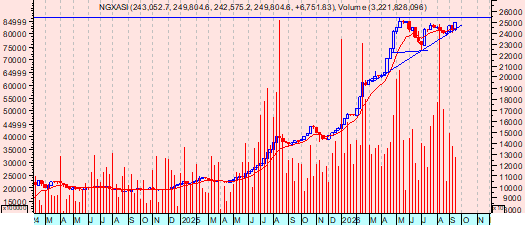
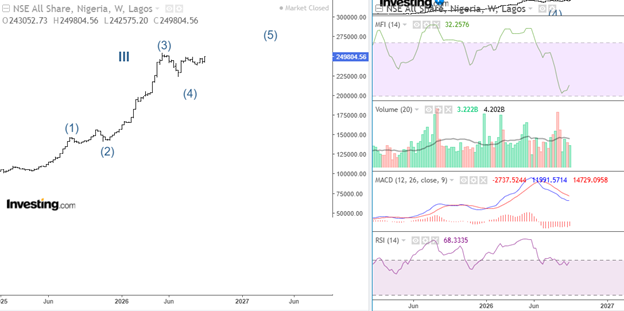
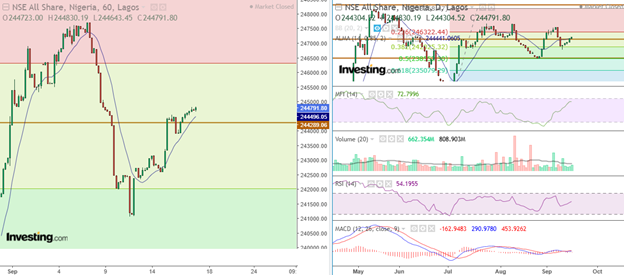
From a technical perspective, Thursday’s positive close represents an encouraging first step following the extended decline, but it is still too early to classify the move as a confirmed trend reversal.
The ASI recovered from Wednesday’s level and closed above the 239,000-point mark. The immediate support zone remains around 238,700 points, which corresponds closely with the recent market low. Holding this level could encourage buyers to build positions and create room for a stronger rebound.
On the upside, the 240,000–242,000-point region remains an important resistance area. A decisive move above this zone, particularly if supported by higher turnover and improving market breadth, would strengthen the technical outlook and signal that buyers are gradually regaining control.
A failure to break above resistance could result in another period of consolidation or renewed profit-taking. Similarly, a break below the 238,700-point support level would weaken the recovery narrative and increase the risk of another leg lower.
The current technical structure therefore points to early stabilisation rather than a confirmed bullish reversal. Investors should watch price action over the next few sessions for confirmation.
One of the biggest weaknesses of Thursday’s session was the negative market breadth. Despite the ASI closing higher, 39 stocks declined compared with only 23 gainers, while five stocks remained unchanged.
This divergence is important because it shows that the headline index did not accurately reflect the performance of the average stock on the exchange.
A healthy market recovery is normally accompanied by broader participation, with gains spreading across sectors and a growing number of stocks advancing. Thursday’s narrow leadership suggests that investors remain cautious and are concentrating their positions in a relatively small number of large-cap names.
The performance of smaller and mid-cap stocks will therefore be worth monitoring in the coming sessions. A significant improvement in breadth would provide stronger evidence that market sentiment is turning positive.
FTSE Russell Reclassification Adds Medium-Term Catalyst
The confirmation of Nigeria’s return to Frontier Market status is another development that could influence investor sentiment.
FTSE Russell’s decision, which takes effect on September 21, could improve the visibility of Nigerian equities among international investors and potentially increase the market’s attractiveness to investors seeking exposure to frontier economies.
The reclassification may also encourage greater attention from global funds that benchmark against frontier-market indices. However, the eventual impact will depend on the extent to which foreign investors increase their allocation to Nigerian assets.
For the domestic market, the development comes at a time when investors are already assessing valuation opportunities following the recent decline. If foreign participation increases alongside stronger domestic institutional demand, liquidity could improve and provide additional support for the market.
However, the catalyst should be viewed from a medium-term perspective rather than as an immediate guarantee of a sustained rally.
Oil Market
Brent crude futures rose $1.16, or 1.32%, to about $89 per barrel on Thursday, while West Texas Intermediate gained $0.52, or 0.63%, to $82.75.
The increase followed three consecutive sessions of declines as traders assessed the possibility of diplomatic progress between Iran and the United States and the potential implications for Middle Eastern oil supplies.
The market had previously priced in the possibility that a diplomatic breakthrough could lead to an increase in oil flows from the region. However, uncertainty remained after Washington confirmed that it was not currently engaged in negotiations with Tehran, although it maintained that all options remained available.
The absence of clear progress, combined with continued restrictions on regional flows, helped push crude prices higher as traders reassessed the potential supply outlook.
For Nigeria, the oil price movement is particularly relevant. Higher crude prices can support government revenue, foreign-exchange earnings and external reserves, provided oil production remains stable. Stronger oil prices can also improve investor confidence in the country’s external position and provide some support for the naira.
At the same time, elevated geopolitical tensions present a two-sided risk. While supply disruptions can push crude prices higher, prolonged instability can increase global inflation, raise energy costs and trigger volatility across international financial markets.
Consequently, investors in Nigerian equities will continue to monitor both crude prices and domestic oil production levels as key indicators of the country’s external and fiscal outlook.
Although Thursday’s rebound is encouraging, the market remains in a delicate position. Investors have just witnessed an extended period of losses, meaning confidence is unlikely to return fully after a single positive session.
The negative breadth reinforces this cautious view. While large-cap banking stocks were able to push the index higher, the weakness in other counters indicates that many investors are still reluctant to take aggressive positions.
The next few sessions will therefore be important in determining whether the market can sustain the recovery. If banking stocks maintain their upward momentum and other sectors begin to participate, the market could gradually regain lost ground.
Conversely, if the rebound remains concentrated in a few heavyweight stocks while the majority of equities continue to decline, the recovery could struggle to gain momentum.
Investors should also watch trading volume closely. Rising prices supported by increasing volume would generally provide stronger confirmation of renewed buying interest, while a price recovery accompanied by falling participation could suggest limited conviction.
Outlook
The NGX is showing its first meaningful sign of relief after 11 consecutive sessions of losses, but the broader outlook remains cautiously optimistic rather than decisively bullish.
The immediate focus will be on the 240,000–242,000 resistance zone and whether the ASI can break above it with stronger market participation. A successful breakout could open the door to further recovery, while failure to overcome resistance may lead to continued consolidation.
The 238,700-point region remains the key downside level to watch. Holding above this support would help preserve the current recovery attempt, while a break below it could revive bearish sentiment.
The banking sector is expected to remain a major driver of the index, given the strong performance of large-cap financial stocks during Thursday’s session. Meanwhile, the Frontier Market reclassification could provide a medium-term catalyst if it attracts increased foreign investor participation.
Oil prices will also remain critical. Continued strength in crude could support Nigeria’s external position and improve investor confidence, while further escalation of geopolitical tensions could increase volatility across global and domestic markets.
Overall, Thursday’s session represents a welcome pause in the NGX’s recent sell-off, but confirmation of a sustainable recovery will require stronger market breadth, sustained buying interest and a decisive break above key technical resistance.
Market Summary: The NGX All-Share Index (ASI) gained 521.89 points, or 0.22%, to close at 239,204.81, while market capitalisation increased by ₦337.03 billion to ₦154.47 trillion. Total value traded stood at ₦34.92 billion, with 489.33 million shares exchanged across 39,939 deals. The market recorded a positive index performance, although underlying sentiment remained cautious. Market breadth was negative, with 23 stocks gaining, 39 declining and five unchanged. Market movers: ZENITHBANK led trading by volume with 69.48 million shares, while ACCESSCORP and GTCO also recorded strong activity. Top gainers: OMATEK (+9.60%) to ₦1.37, WAPIC (+5.00%) to ₦2.10, FIRSTHOLDCO (+4.65%) to ₦135.00, GUINEAINS (+4.05%) to ₦0.77 and UBA (+3.85%) to ₦45.85. Top losers: FIDSON (-9.98%) to ₦75.80, LEARNAFRCA (-9.84%) to ₦8.70, INTENEGINS (-9.84%) to ₦2.84, FTGINSURE (-9.69%) to ₦1.77 and LEGENDINT (-9.64%) to ₦3.75.