

AXA Mansard Insurance Plc is a diversified Nigerian insurance company and a member of the global AXA Group. It operates across several major insurance and financial-protection segments, giving it exposure to both individual and corporate customers.
Current price: N12
Rating: Buy
Price projection: N20 and N24
Technical Analysis
In this report, we shall use the following tools and analysis methods:
Elliott’s wave theory to understand the overall market sentiment
Fibonacci tools to determine support and resistance levels
The Relative Strength Index and volume to evaluate the market’s strength
The Money Flow Index to determine the market liquidity
Moving average and MACD to understand the nature of the trend
Top-down analysis to know the best investment position
Elliott wave analysis
Weekly chart: Market overview
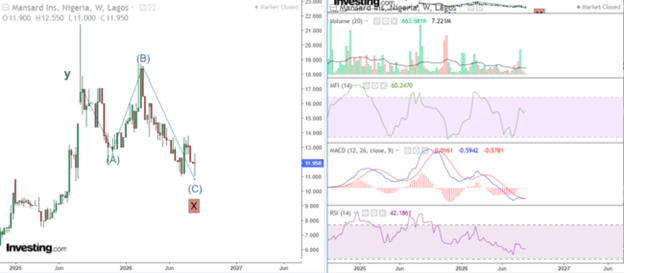
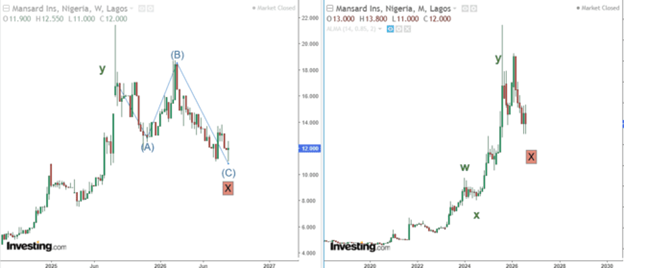
Mansard is within the final phase of its expanded flat correction. Thus, traders should expect a recovery phase. The bearish volume remains low due to its sentiment exhaustion. Also, MACD sustained its bearish divergence signal. Money flow and RSI regained strong momentum, aligning with the recovery sentiment.
Daily chart: Trading opportunity
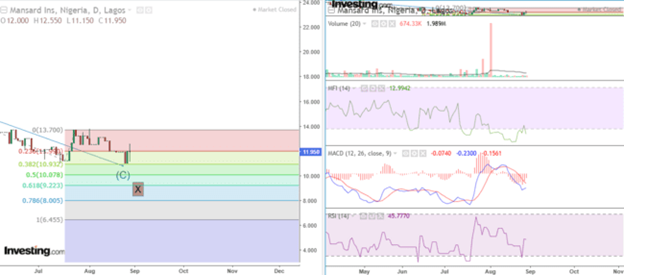
On the daily chart, traders should watch for support at N9 and N8, with prices projecting to N20 and N24. The stock’s liquidity, volume, and momentum remain low due to the deep corrective phase. Notably, MACD sustained its bearish divergence signal, preparing investors for an upcoming markup phase.
Fundamental Analysis Overview
Short-Term Outlook: Moderately Positive
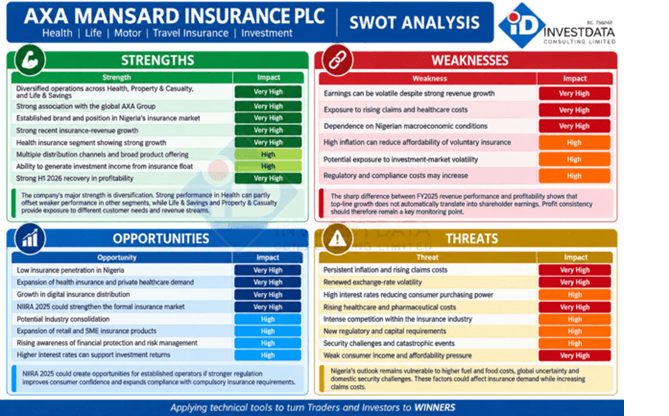
AXA Mansard’s latest H1 2026 performance is encouraging. Insurance revenue increased 19% to ₦96.5 billion, gross written premiums rose 17% to ₦134.9 billion, and profit after tax increased 14% to ₦7.8 billion.
This creates a more positive fundamental backdrop for the stock than a simple reading of the FY2025 bottom-line result might suggest.
Medium-Term Outlook: Positive but Dependent on Execution
The company’s medium-term prospects could benefit from:
Insurance-market growth
Health-insurance expansion
Digital distribution
Regulatory reforms
Higher financial-market yields
Greater insurance awareness
Potential industry consolidation.
However, management’s ability to convert premium growth into sustainable earnings will be critical.
Major Risks for Investors
The most important factors to monitor are:
Claims ratio and underwriting profitability;
Healthcare-cost inflation;
Investment income and interest-rate movements;
Exchange-rate stability;
Implementation of NIIRA 2025 and any associated capital requirements;
Consumer purchasing power and insurance affordability;
Whether H1 2026 profit momentum is sustained into the full year.
SWOT analysis