
Nigerian equities returned to positive territory on Thursday last week, after an 11-session losing streak, breaking out the 240,000 and 241,000 psychological lines despite the shortened trading week due to Tuesday’s public holiday. The benchmark NGX All-Share Index (ASI) gained 1,947.31 basis points, or 0.81% during the week to close at 241,298.47 points, while market capitalisation rose by 0.84% to ₦155.83 trillion.
The recovery was driven by renewed buying interest in banking, oil and gas and value stocks following the confirmation by FTSE Russell of Nigeria’s removal from the “Unclassified” to Frontier Market status. Despite the rebound, the market remained down 1.62% for August and may end on that side of the divide, depending on how much recovery happens at Monday’s session, the last trading day of August. Year-to-date and quarter-to-date returns, however remains positive at 55.06% and 5.18%, respectively.
The NGX’s rebound on Thursday and Friday was also enhanced by the August 28, 2026, official upgrade of Nigeria’s sovereign credit outlook from “Stable” to “Positive” by Moody’s Ratings, while affirming its long-term issuer rating at B3. This has created a clear pathway for Nigeria to achieve a formal rating upgrade to B2 within the next 12 to 18 months, provided the current macroeconomic improvements are sustained. Investors and traded are also position for the influx of interim dividend paying company results, particularly the Tier-1 banks, all of which have presented their audited financial results to the Central Bank of Nigeria (CBN), their primary regulator, for approval before being released through the NGX Limited portal in the coming days.
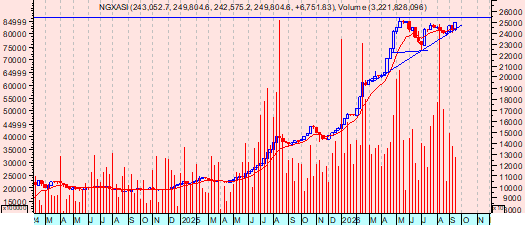
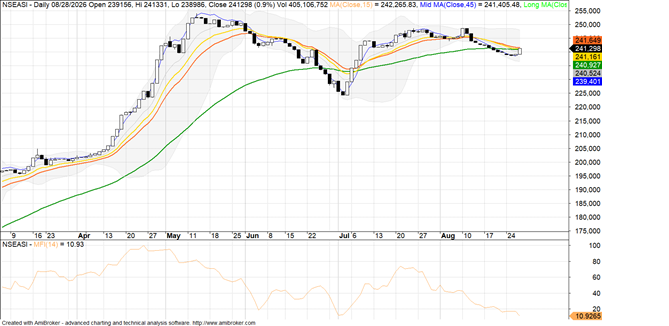
Trading activities and volume of transactions slowed down during the week as investors exchanged 2.51 billion shares worth ₦123.22 billion in 173,561 deals, compared to 6.24 billion shares valued at ₦157.76 billion in 186,496 deals the previous week. The chart below reveals the daily index action for the week.
NGXASI Daily Index Action
Trading began on Monday with continued selling pressure as investors stayed cautious ahead of the holiday. The ASI fell 0.11% to 239,085.17 points, while market capitalisation declined by ₦137.12 billion. Volume increased 60.49% to 668.72 million shares valued at ₦23.83 billion. FTGINSURE led volume, while FIRSTHOLDCO recorded the highest traded value. RTBRISCOE emerged as the top gainer, while INTENEGINS suffered the biggest loss.
The market resumed on Wednesday with another decline as investors took profits in large-cap stocks. The ASI dropped 0.17% to 238,682.92 points, while market capitalisation fell by ₦259.76 billion. Trading volume increased 9.67% to 733.35 million shares valued at ₦34.52 billion across 49,210 deals. FTGINSURE remained the most traded stock by volume, while FIRSTHOLDCO led by value. NEIMETH recorded the strongest gain, while FIDSON fell 10% to lead the losers.
On Thursday, the market ended an 11-session losing streak as buying interest in major banks lifted the ASI by 0.20% to 239,156.09 points. Market capitalisation increased by ₦305.56 billion. Volume dropped 31.83% to 499.96 million shares worth ₦35.15 billion, with ZENITHBANK leading both volume and value. OMATEK was the top gainer, while FIDSON recorded the biggest decline. Market breadth remained negative, with 39 losers against 19 gainers.
The recovery gathered pace on Friday, with heavyweight stocks pushing the ASI up by 0.90% to 241,298.47 points. Market capitalisation jumped by ₦1.38 trillion, while year-to-date return improved to 55.06%. Market breadth turned positive, with 33 gainers against 19 losers. Trading volume rose 21.04% to 605.17 million shares valued at ₦29.87 billion. JAIZBANK led volume, while TRANSCOHOT recorded the highest traded value. SEPLAT, TRANSCOHOT and FIRSTHOLDCO were the strongest gainers, while TOTAL recorded the biggest loss.
The sectorial performance was largely positive, led by Oil & Gas, whose index climbed 4.54%. The Banking Index gained 2.89%, while the Commodity Index rose 3.31%. In contrast, Consumer Goods and Insurance declined 0.67% and 0.63%, respectively.
Overall, the week marked a clear turnaround for the NGX, although August performance remained negative as investors continued to balance renewed optimism with profit-taking and weakness in several sectors.
NGX Week-on-Week Comparative Analysis
The NGX recorded a clear turnaround in the week ended August 28, 2026, after a difficult week ended August 21. The ASI moved from a 1.35% decline to a 0.81% gain, closing at 241,298.47 points, compared with 239,351.16 points previously. Market capitalisation also increased from ₦154.53 trillion to ₦155.83 trillion. Trading activity weakened, with volume falling from 6.24 billion shares to 2.51 billion shares, while turnover declined from ₦157.76 billion to ₦123.22 billion, partly due to the shortened trading week.
Market sentiment improved after the NGX broke its 11-session losing streak, supported by renewed buying interests in banking, oil and gas, and commodity stocks. Sector performance also strengthened. Oil & Gas gained 4.54%, Banking rose 2.89%, and Commodities increased 3.31%, compared with the broad-based weakness recorded in the previous week.
Overall, the week ended August 21 was dominated by selling pressure and declining prices, while last week marked a return to positive territory and improved investor confidence. However, the lower trading activity suggests that investors remain cautious and selective.
Technical Analysis View
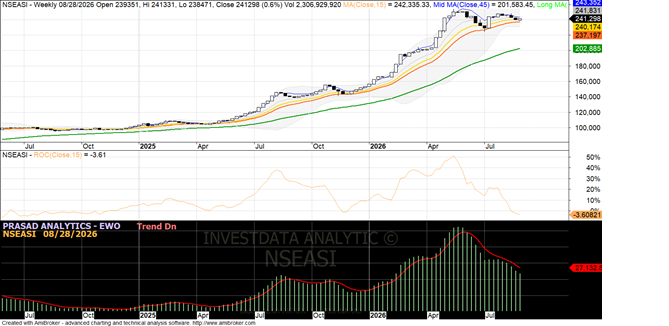
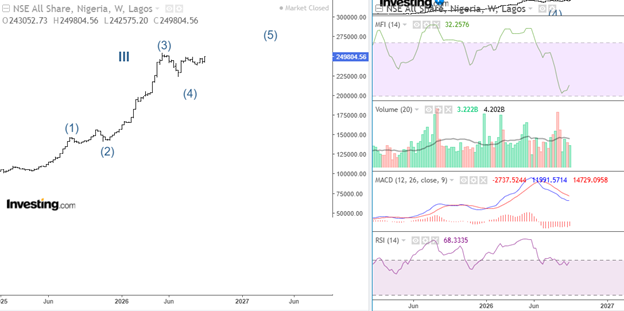
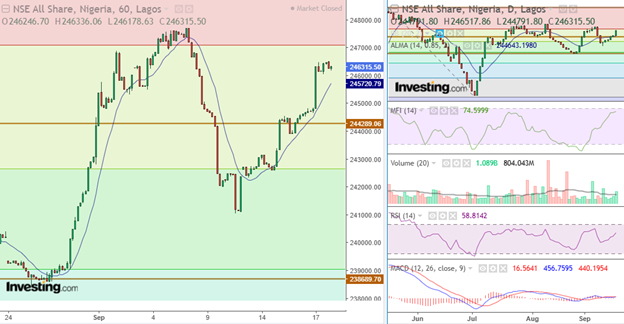
The NGX All-Share Index showed signs of recovery after an 11-session losing streak, rebounding from 238,682.92 points on Wednesday to 241,298.47 points by Friday. The move suggests that selling pressure is easing, with buyers defending the 238,700–239,000 support area. The index now faces immediate resistance around 243,000 points. A sustained break above this level could strengthen the recovery and push the market toward 245,000–248,500 points. However, failure to clear the resistance could trigger renewed profit-taking. Improved market breadth on Friday, also supported the recovery. Strong performances from banking and oil and gas stocks further strengthened market sentiment, although the rally still requires confirmation from sustained volume and value growth.
University Press Plc
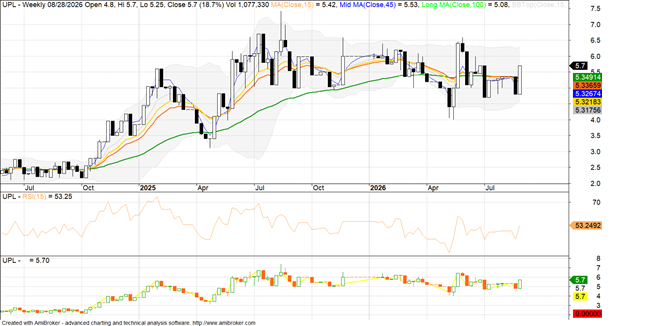
The week’s strongest performer was University Press which gained 18.75% to close at N5.70. FirstHoldCo followed with an 11.58% rise to N145.00 per share, while Seplat Energy advanced 10.00% to N12,320.60 each. Red Star Express climbed 9.86% to N16.15, and Transcorp Hotels completed the top five gainers, rising 9.76% to N265.50.
Int’l Energy Insurance Plc
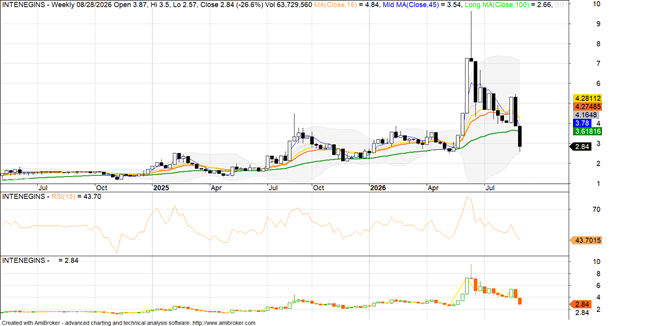
On the laggards side, International Energy Insurance recorded the biggest decline, falling 26.61% to N2.84. Fidson Healthcare dropped 17.69% to N77.00, while Caverton Offshore Support Group declined 15.15% to N4.20. Zichis Agro Allied Industries fell 14.71% to N14.50, while Austin Laz & Company fell 11.97% to N2.50
Market Outlook
The short-term outlook for the NGX has improved to cautiously bullish, following the end of the 11-session losing streak. Holding above 239,000 points could encourage further buying interest, while a decisive break above 243,000 would provide stronger confirmation of a sustained recovery. On the downside, a break below 238,700 points could expose the market to renewed selling pressure. Overall, banking and oil and gas stocks are likely to remain important drivers, while investors may continue to favour fundamentally strong and undervalued stocks as sentiment gradually improves.
Trending in the Economy: Nigeria’s three tiers of government shared a record N3.0tn in August, up 18% from the previous month, as stronger oil and tax revenues boosted allocations. The Federal Government received N1.1tn, states N943bn and local governments N674bn, while oil-producing states got N243bn.
The country’s external debt service fell 31% year-on-year to $954.1m in Q1 2026, driven by lower repayments to multilateral and bilateral lenders. Non-market payments dropped 53% to $452.2m, while market-related payments rose to $501.8m, mainly due to First Abu Dhabi Bank facility charges. The government is also considering a Eurobond, although Middle East tensions could increase borrowing costs.
Global Market and Oil: Global financial markets came under pressure on Friday as investors reassessed the outlook for U.S. monetary policy following comments from Federal Reserve Chair Kevin Warsh at the central bank’s annual economic symposium in Jackson Hole. Warsh signalled that the Federal Reserve could have more work to do if policymakers are not convinced that underlying inflation is moving sustainably back toward the 2% target. He also noted that financial conditions did not appear particularly restrictive, reinforcing concerns that interest rates may need to remain higher for longer.
The comments triggered a sharp shift in expectations for the Fed’s September meeting. Markets increased the probability of a rate hike to 55.7% from 35.4% on Thursday, according to CME Group’s FedWatch tool. The move reflected growing concern that persistent inflation could limit the central bank’s ability to ease monetary policy. Warsh’s remarks came as several Fed officials have already expressed concerns about sticky inflation. His comments were closely watched because he had previously avoided providing clear forward guidance on the direction of interest rates.
The prospect of tighter monetary policy weighed on risk assets, particularly smaller companies and technology stocks, which are generally more sensitive to higher borrowing costs and tighter financial conditions. On Wall Street, the Dow Jones Industrial Average declined 9.45 points, or 0.02%, to 53,559.99. The S&P 500 fell 19.23 points, or 0.25%, to 7,711.76, while the Nasdaq Composite dropped 138.93 points, or 0.52%, to 26,402.42. The Russell 2000 was among the weakest performers, falling 1.4%, while the technology sector also declined 1.4%. The sharper losses reflected investors’ sensitivity to the possibility of higher interest rates, which can weigh particularly heavily on smaller companies and high-growth technology stocks.
The broader global equity market also weakened. The MSCI global equities index fell 1.54 points, or 0.13%, to 1,153.16. However, European stocks bucked the trend, with the pan-European STOXX 600 finishing 0.51% higher. The reaction was more pronounced in the U.S. Treasury market, where short-term yields surged as traders adjusted their expectations for Fed policy. The two-year Treasury yield, which is highly sensitive to changes in interest-rate expectations, climbed 12.79 basis points to 4.36%, from 4.232% at the previous close.
The 10-year Treasury yield also moved higher, rising 5.6 basis points to 4.728%, while the 30-year Treasury yield increased 2.19 basis points to 5.2129%. The rise in Treasury yields reflected the market’s interpretation of Warsh’s comments as hawkish. Investors appeared to place greater emphasis on the Fed’s determination to bring inflation under control, particularly if price pressures remain above the central bank’s target.
Currency markets also responded strongly. The U.S. dollar gained against major currencies as expectations of higher U.S. interest rates increased the appeal of dollar-denominated assets. The Dollar Index, which measures the greenback against a basket of major currencies, advanced 0.61% to 99.71, putting it on course for its strongest daily performance in roughly 2½ months.
The euro weakened 0.61% to $1.158, while the dollar strengthened 0.45% against the Japanese yen to 160.11. The move highlighted the close relationship between interest-rate expectations and currency valuations, as higher U.S. yields can increase demand for the dollar.
The cryptocurrency market also came under pressure amid the broader risk-off sentiment. Bitcoin fell 3.34% to $77,413.77, extending losses as investors reassessed the outlook for liquidity and interest rates.
Commodity markets were similarly affected. Oil prices ended slightly lower on Friday and recorded their first weekly decline in three weeks. Traders weighed the implications of the Fed’s policy outlook alongside reports of a possible agreement concerning shipping through the Strait of Hormuz, a major global oil transit route. U.S. crude settled 13 cents, or 0.16%, lower at $83.40 a barrel, while Brent crude declined 39 cents, or 0.43%, to $89.31 a barrel. The precious metals market recorded significantly steeper declines. Spot gold fell 3.19% to $4,454.52 an ounce, while spot silver dropped 4.3% to $66.28 an ounce.
Overall, Friday’s market moves reflected a broad reassessment of the U.S. interest-rate outlook. Rising Treasury yields, a stronger dollar and weakness across equities, cryptocurrencies and precious metals showed that investors were quickly adjusting positions to the possibility of tighter monetary policy. The key focus going forward will remain inflation data and further guidance from Federal Reserve officials. If inflation continues to prove persistent, markets could maintain expectations for higher rates, potentially putting additional pressure on rate-sensitive equities and other risk assets. Conversely, signs of easing price pressures could reverse some of Friday’s moves and restore expectations for a less restrictive Fed stance.