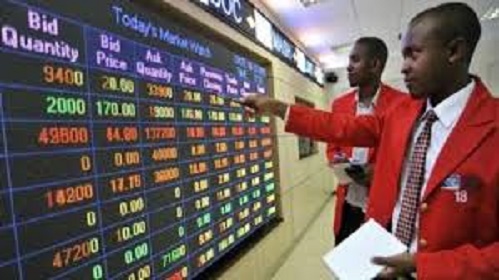

It was a bearish week on the Nigerian Exchange, with four trading sessions of down market and a lone green day, a major highlight of which was the low traded volume and negative market internals. This reflected selloffs in highly capitalised stocks and positioning in low cap companies, following which the bourse entered into a maturing phase. This calls for a change in trading and investing strategies to prepare for wealth shift come 2027.
Weekly Trading Activity
Investors traded 2.366 billion shares worth ₦106.363 billion in 159,759 deals, compared with 8.029 billion shares valued at ₦185.358 billion in 160,836 deals in the previous week. This represented declines of 70.53% in volume, 42.62% in value and 0.67% in deals. The Financial Services sector dominated trading with 1.717 billion shares worth ₦67.579 billion in 74,214 deals, accounting for 72.57% of volume and 63.54% of value. Consumer Goods followed with 174.538 million shares valued at ₦9.052 billion in 20,668 deals, while Services recorded 158.306 million shares worth ₦1.378 billion in 8,975 deals.
Access Holdings, FCMB Group and NEM Insurance recorded combined transactions of 613.658 million shares valued at ₦12.994 billion in 8,726 deals, representing 25.93% of total volume and 12.22% of market value.
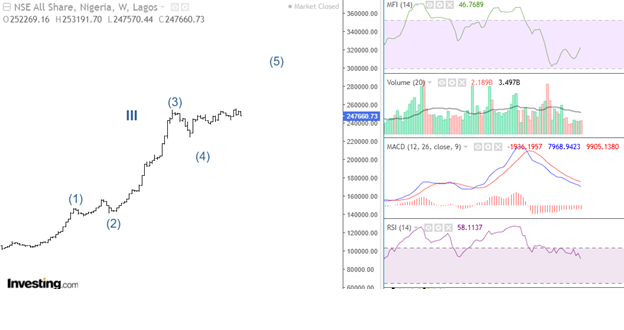
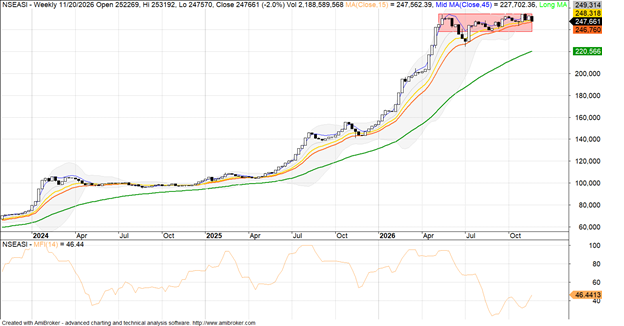
The benchmark NGXASI declined 1.83% in the period at 247,660.74 points, while market capitalisation settled at ₦160.804 trillion. The NGX Insurance, Consumer Goods and Growth indices gained 2.47%, 2.35% and 1.10%, respectively, while other major sectoral indices closed lower. Market breadth weakened, with 39 equities gaining against 43 in the previous week, while 43 declined compared with 39 previously. Unchanged stocks remained at 64.
Week-to-date, the NGX 30 has lost 1.95%, the Banking Index has decreased by 2.75%, the Pension Index decreased by 2.36%, the Insurance Index inclined by 2.47%, the Consumer Goods Index increased by 2.35%. However, the Oil and Gas Index recorded a negative return of 3.75%. Year-to-date, the All-Share Index has gained 59.15%, NGX 30 is up by 60.69%, the Banking Index has increased by 51.71%, the Pension Index increased by 72.27%, the Insurance Index declined by 7.61%, the Consumer Goods Index increased by 1.32%. However, the Oil and Gas Index recorded a positive return of 113.92%.
Meanwhile, the week’s trading started on a positive note Monday, gaining 0.21% as NGXGROUP advanced 10%, while RTBRISCOE led the losers. The All-Share Index (ASI) closed at 252,809.78 points, adding ₦351.06 billion to market capitalisation and lifting YTD return to 62.46%. Market breadth stood at 34 gainers against 27 losers. Trading volume dropped 81.78% to 673.68 million shares worth ₦26.15 billion in 38,218 deals, with ACCESSCORP leading activity at 203.62 million shares valued at ₦5.49 billion.
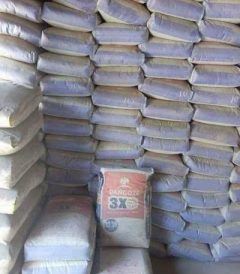
On Tuesday, the market retraced southward, as profit taking and selloff hit high cap stocks that weigh on the composite index that declined by 1.38% to 249,318.65 points, as capitalisation shed ₦2.27 trillion and YTD return fell to 60.22%. DANGCEM lost 9.99% to lead decliners, while CADBURY topped gainers. Market breadth remained positive at 26 advancers against 24 decliners. Trading volume fell 16.27% to 564.06 million shares worth ₦22.77 billion in 31,041 deals. NEM led volume, while STANBIC recorded the highest traded value of ₦3.73 billion.
The negative trend continued at midweek, as the benchmark index NGX ASI dropped by 0.40% to 248,329.65 points, wiping ₦642.15 billion off market capitalisation and reducing YTD return to 59.58%. ARADEL fell 9.99% to lead losers, while MCNICHOLS topped gainers. Market breadth stood at 26 advancers against 27 decliners. Trading volume dropped 20.02% to 451.10 million shares worth ₦26.59 billion in 32,491 deals, with FIRSTHOLDCO leading activity at 62.65 million shares valued at ₦6.67 billion.
The losing streak was extended on Thursday, as the NGXASI slipped 0.02% to 248,286.56 points. Capitalisation declined by ₦27.98 billion, while YTD return eased to 59.55%. INTBREW lost 4.50% to lead decliners, while SOVRENINS topped gainers. Market breadth was 19 advancers against 26 decliners. Trading volume fell 17.54% to 372.03 million shares worth ₦14.37 billion. TRANSEXPR led volume, while GTCO recorded the highest traded value of ₦2.09 billion.
The last trading day of the week closed in the red by 0.25% at 247,660.74 points, with market capitalisation shedding ₦406.34 billion and YTD return easing to 59.15%. FIRSTHOLDCO led losers, while MAYBAKER topped gainers. Market breadth weakened to 14 advancers against 36 decliners. Trading volume declined 17.85% to 305.63 million shares valued at ₦16.55 billion, with FIDELITYBK leading volume and GTCO recording the highest traded value of ₦2.46 billion.
LivingTrust Mortgage Bank Plc
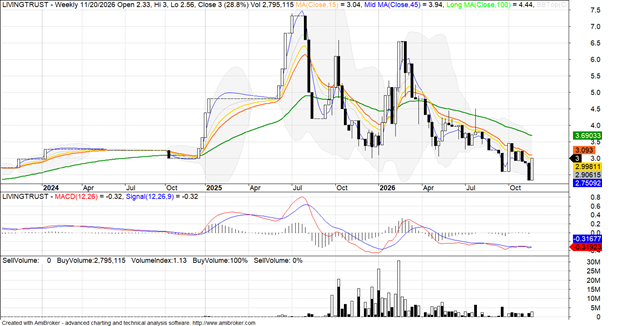
LivingTrust Mortgage Bank led the gainers’ chart, rising 28.76% from ₦2.33 to ₦3.00, representing a gain of ₦0.67. Chellarams followed with a 20.62% increase from ₦9.70 to ₦11.70, adding ₦2.00. International Breweries gained 20.24%, rising from ₦8.40 to ₦10.10, while Regency Alliance Insurance advanced by 18.75% from ₦0.64 to ₦0.76. Critical Minerals Financing Corp rounded off the top five, gaining 17.33% from ₦3.00 to ₦3.52.
Meyer Plc
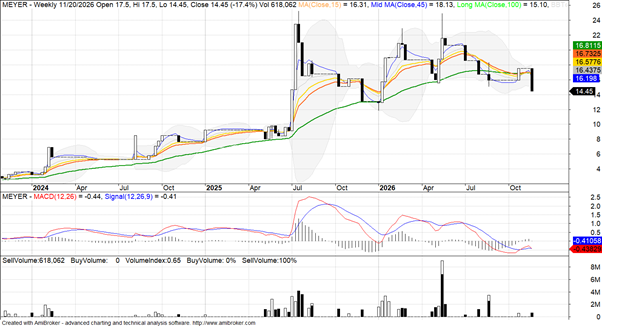
On the decliners’ chart, Meyer Plc recorded the largest loss, shedding 17.43% from ₦17.50 to ₦14.45, a decline of ₦3.05. R.T. Briscoe Nigeria Plc followed with a 16.94% drop from ₦9.15 to ₦7.60, losing ₦1.55. Lasaco Assurance declined by 10.00% from ₦1.90 to ₦1.71, while Aradel Holdings fell by 10.00% from ₦1,296.00 to ₦1,166.40, representing a loss of ₦129.60. Dangote Cement completed the top five losers with a 9.99% decline from ₦1,469.90 to ₦1,323.00, shedding ₦146.90.
NGX Weekly Comparative Analysis
The Nigerian stock market reversed the previous week’s gains, as the NGX All-Share Index declined by 1.83% to 247,660.74 points, compared with a 1.36% gain recorded in the week ended November 13, 2026. Market capitalisation fell by ₦2.992 trillion to ₦160.804 trillion from ₦163.796 trillion, while YTD returns dropped to 59.15% from 62.11%.
Trading activity weakened significantly, with volume declining by 70.53% to 2.366 billion shares from 8.029 billion shares. Transaction value fell by 42.62% to ₦106.363 billion from ₦185.358 billion, while deals decreased marginally by 0.67% to 159,759 from 160,836. The Financial Services sector maintained its dominance, contributing 72.57% of total volume compared with 60.45% previously. However, its traded volume declined to 1.717 billion shares from 4.854 billion shares. Access Holdings, FCMB Group and NEM Insurance led trading activity, replacing Linkage Assurance, Livestock Feeds and First Holdco.
Market breadth weakened, with 39 gainers against 43 previously, while losers increased to 43 from 39. Unchanged stocks remained at 64. Overall, the market shifted from positive momentum to bearish sentiment, driven by profit-taking and reduced trading activity. Going forward, investors are expected to remain cautious and selective, focusing on fundamentally strong stocks as the market searches for support.
Technical Analysis and Outlook
The NGX All-Share Index sustained its bearish momentum during the week, declining 1.83% to 247,660.74 points after failing to maintain its position above the 250,000 psychological thresholds. The persistent decline reflects increased profit-taking and selling pressure, particularly in heavyweight stocks. Weakening market breadth, with 43 losers against 39 gainers, further confirms the cautious market sentiment. Trading activity also slowed considerably, suggesting reduced investor participation amid prevailing uncertainty. However, gains in the Insurance, Consumer Goods and Growth indices indicate selective bargain-hunting opportunities across sectors.
Market Outlook
The market’s direction from Monday, November 23, 2026, will depend largely on the strength of bargain hunting, corporate earnings expectations and investors’ response to prevailing macroeconomic conditions. The 247,000–245,000 region represents an immediate support zone, while 250,000 remains the first major resistance level. A sustained recovery above this resistance could improve market sentiment, while a break below support may trigger further losses. Investors are expected to remain selective, favouring fundamentally strong stocks with attractive valuations and earnings prospects.
Trending in the Economy: Nigeria’s headline inflation eased to 14.06% in October from 14.63% in September, according to the National Bureau of Statistics, while food inflation declined to 19.13% from 19.59%, signalling a gradual slowdown in rising prices.
Meanwhile, crude oil production averaged 1.51 million barrels per day (mbpd), slightly above Nigeria’s 1.50mbpd OPEC quota, despite a 1.7% monthly decline. Total crude and condensate output also fell to 1.69mbpd, highlighting ongoing production challenges. Sustained investment and improved security remain key to boosting output.
Global Market and Oil: Global stock markets recorded significant losses on Friday as technology shares tumbled, triggering a shift towards safe-haven assets. Japan and South Korea declined by more than 5%, while Taiwan’s stock market plunged 17% for the week, its steepest weekly decline since 1990. On Wall Street, semiconductor stocks fell 10.7% on Friday, bringing their weekly losses to 17.1%. Newly listed Anthropic also came under pressure, dropping as much as 14.5% during its first full trading session before closing 9.1% lower at $88.30, slightly above its $83 initial public offering price. Consumer staples was the only S&P 500 sector to finish in positive territory.
The Dow Jones Industrial Average declined 949.73 points, or 1.93%, to 48,147.33. The S&P 500 shed 265.44 points, or 3.70%, to 6,910.39, while the Nasdaq Composite plunged 1,261.47 points, or 5.28%, to 22,617.73.
MSCI’s global equity index dropped 34.89 points, or 3.30%, to 1,021.91, taking its weekly decline to 8.1%, the largest since early 2020. In Europe, the STOXX 600 fell 2%, while emerging-market stocks declined 3.10%. MSCI’s Asia-Pacific index excluding Japan lost 3.27%, while Japan’s Nikkei 225 dropped 5.06%.
Investor sentiment weakened amid growing concerns about technology stock valuations, borrowing costs and corporate profitability. The CBOE Volatility Index (VIX), which measures expected market volatility and demand for protection against further S&P 500 losses, closed at its highest level since April 2025.
The flight to safety supported government bonds, with the US 10-year Treasury yield falling 10.43 basis points to 4.948%, its largest single-day decline since October 22. The 30-year yield dropped 6.81 basis points to 5.3329%, while the two-year yield declined 13.21 basis points to 4.647%, despite markets pricing in a possible Federal Reserve rate hike at its next policy meeting.
In the currency market, the dollar index was broadly stable after reaching a 19-month high on Thursday, supported by expectations of tighter US monetary policy following stronger-than-expected inflation data. It slipped 0.05% to 103.90, while the euro declined 0.05% to $1.0961. Against the Japanese yen, the dollar weakened 0.67% to 158.60.
Crude oil prices recovered towards the close as concerns over possible attacks and supply disruptions linked to the US-Israeli conflict with Iran supported prices, alongside buying ahead of the Thanksgiving holiday. US crude gained 1.49% to $83.67 per barrel, while Brent crude advanced 0.68% to $92.61 per barrel.
Elsewhere, precious metals and industrial commodities remained under pressure. Spot gold declined 2.81% to $3,520.09 per ounce, reaching a 14-month low after recording its largest weekly decline in eight months. Silver fell 4.22% to $40.95 per ounce, while copper dropped 2.9% to $12,162.50 per tonne.
Market Outlook
Global markets are likely to remain volatile in the near term as investors reassess technology valuations, interest-rate expectations and corporate earnings prospects. Further weakness in semiconductor and artificial intelligence-related stocks could extend the broader sell-off, while rising demand for government bonds signals continued caution. Oil prices may remain sensitive to geopolitical developments and potential supply disruptions, while the dollar could find support from expectations of tighter US monetary policy. Investors are likely to favour defensive sectors and quality assets until market confidence improves and clearer signals emerge on inflation, monetary policy and corporate profitability.