

Period Under Review: -First Quarter 2026
Current Share Price: N1,275.80 per share
Latest Final Dividend: N23.00
Latest Interim Dividend: N10.00
Estimated Beta Value: 1.82x
Estimated Fair Value: N1,550.50
Analyst: Jeariogbe Tunde Segun
The Company
Aradel Holdings Plc traces its origins to March 25, 1992, when it was incorporated as Midas Drilling Fund, with the vision of creating an indigenous, publicly owned oil and gas investment company that would enable ordinary Nigerians participate in the nation’s petroleum industry.
In 1996, the company changed its name to Niger Delta Exploration & Production Plc (NDEP) to reflect its growing focus on oil and gas exploration and production. Founded by the late Chief Godwin Aret Adams, a former Group Managing Director of the then Nigerian National Petroleum Corporation, now Nigerian National Petroleum Company Limited (NNPCL), alongside other experienced professionals, the company aimed to promote indigenous participation in Nigeria’s energy sector.
Its growth accelerated after securing the Ogbele Marginal Field in Oil Mining Lease (OML) 54, becoming the first Nigerian indigenous company to negotiate a marginal field farm-out agreement with the NNPC/Chevron Joint Venture. Over the years, Aradel expanded beyond crude oil production by investing in mid and downstream operations.
In 2010, NDEP commissioned Nigeria’s first privately operated mini refinery at the Ogbele Field, followed in 2012 by the country’s first indigenous-owned gas processing plant. These milestones transformed the company into a fully integrated energy business with operations spanning exploration, production, refining, gas processing, and energy distribution.
In May 2023, NDEP adopted the name Aradel Holdings Plc to reflect its broader strategic vision of becoming a diversified and sustainable energy group with interests extending beyond traditional oil and gas into cleaner energy solutions. The rebranding also signified its evolution from a purely exploration and production company into a holding company overseeing multiple subsidiaries across the energy value chain.
In October 2024, Aradel Holdings Plc was listed on the Main Board of the Nigerian Exchange Limited, marking a significant milestone in its corporate history, besides strengthening its position as one of Nigeria’s leading indigenous integrated energy companies.
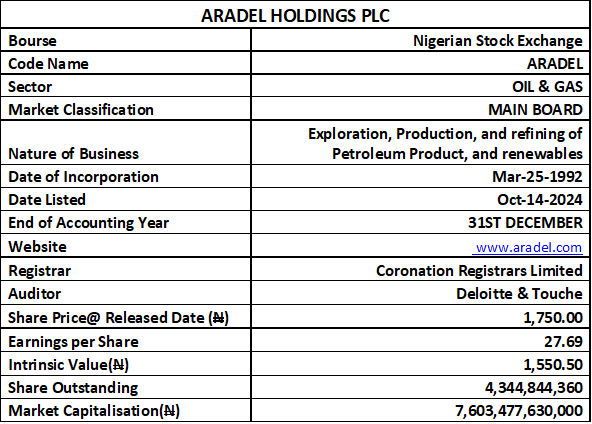
Statement of Comprehensive Income Analysis
Aradel Holdings Plc delivered an exceptional financial performance in 2026, with turnover rising by 264.5% from ₦199.87 billion in the first three months of 2025 to ₦728.52 billion. Despite a significant 290.4% increase in the cost of sales, the company recorded a remarkable 486.7% increase in operating profit which stood at ₦372.92 billion, indicating that the strong revenue growth more than offset the higher production costs. This reflects a robust operational expansion and improved earnings generation during the period.
The company’s profitability, however, was pressured by a substantial rise in operating expenses, depreciation, and finance costs. Operating expenses increased by 478.5%, depreciation rose by 598.8%, while finance costs surged by 1,774.7%, resulting in a net finance loss of ₦89.08 billion. Nevertheless, profit before tax (PBT) grew by 322.5% to ₦283.84 billion, and profit after tax (PAT) increased by 251.8% to ₦120.29 billion, demonstrating the company’s ability to maintain strong profitability despite the higher financing and operating costs. The negative total comprehensive income of ₦111.37 billion suggests the presence of significant unrealized losses, or adverse movements in other comprehensive income, which investors should examine further.
From an investment perspective, Aradel Holdings Plc remains fundamentally attractive due to its outstanding revenue growth, strong operating performance, and substantial increase in net earnings. However, the sharp rise in finance costs and the negative total comprehensive income warrant careful monitoring, as they could affect future earnings quality and shareholder value should they persist. Overall, the results indicate a company with strong growth prospects, making the stock attractive for medium- to long-term investors, provided management continues to improve cost efficiency, reduce financing expenses, and address the factors responsible for the negative comprehensive income.
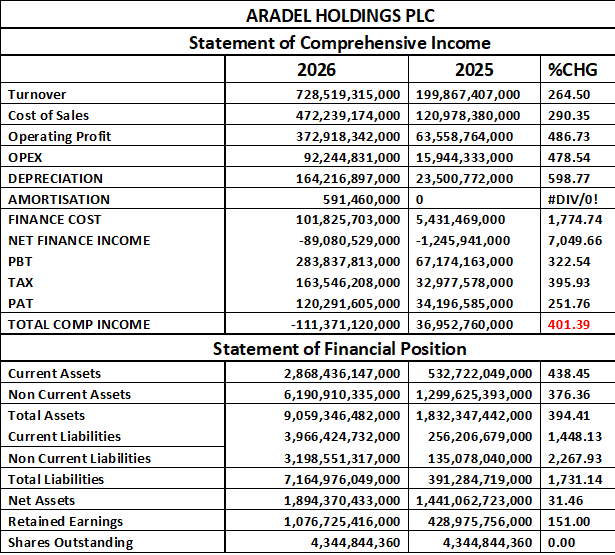
Statement of Financial Position
Aradel Holdings Plc recorded a remarkable expansion in its financial position in 2026Q1. For example, total assets increased by 394.4% from ₦1.83 trillion to ₦9.06 trillion, driven by strong a growth in both current assets (438.5%) and non-current assets (376.4%). This significant increase reflects the substantial investment in the company’s operations and asset base, positioning Aradel for future production growth and enhanced revenue-generating capacity. The expansion demonstrates management’s commitment to strengthening the company’s long-term operational capabilities.
The rapid growth in assets was, however, largely financed through increased liabilities. Total liabilities surged by 1,731.1% to ₦7.16 trillion, with current liabilities rising by 1,448.1% and non-current liabilities increasing by 2,267.9% compared with the 2025 year-end. While this indicates a more leveraged capital structure, net assets still improved by 31.5% to ₦1.89 trillion, just as retained earnings grew significantly by 151.0% to ₦1.08 trillion. This reflected the company’s ability to retain profits and strengthen shareholders’ equity despite the higher debt obligations. The number of shares outstanding remained unchanged, indicating that the growth in equity was achieved without shareholder dilution.
From an investment perspective, Aradel Holdings Plc continues to exhibit strong growth potential, supported by its expanding asset base and rising retained earnings. Nevertheless, the sharp increase in liabilities suggests that investors should closely monitor the company’s debt management, liquidity position, and ability to generate sufficient cash flows to service its obligations. Overall, the balance sheet portrays a growth-oriented company with improving shareholder value, making the stock attractive for medium to long-term investors, provided management maintains prudent leverage and sustains its strong earnings performance.
Financial Strength/ Solvency Ratio
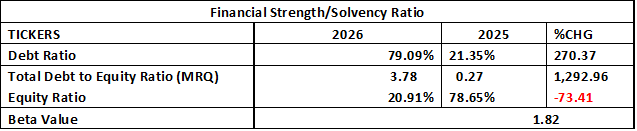
Aradel Holdings Plc’s solvency position weakened considerably in 2026Q1 following th4 increase in debt ratio to 79.09% from just 21.35% in 2025Q1, indicating that a significantly larger proportion of the company’s assets is now financed by debt. Similarly, the debt-to-equity ratio rose sharply from 0.27x to 3.78x, reflecting a substantial increase in financial leverage. Consequently, the equity ratio declined from 78.65% to 20.91%, suggesting that shareholders’ equity now accounts for a much smaller proportion of the company’s asset base than in the corresponding period of last year.
From an investment perspective, these ratios indicate that Aradel has adopted a more aggressive financing strategy to support its rapid expansion. While the increased leverage introduces higher financial risk and greater exposure to interest rate and refinancing pressures, the company’s strong earnings growth provides some comfort regarding its ability to service these obligations. The Beta value of 1.82 further suggests that the stock is more volatile than the overall market, making it more suitable for investors with a moderate to high risk tolerance. Investors should closely monitor the company’s debt management and cash flow generation to ensure that the higher leverage continues to support sustainable long-term growth.
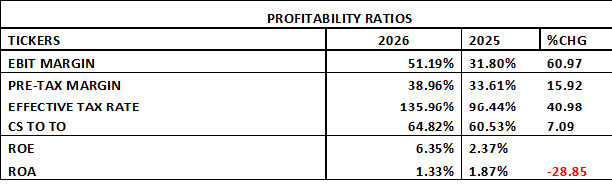
Profitability Ratio
Aradel Holdings Plc recorded a notable improvement in profitability during the 2026Q1. The EBIT margin increased from 31.80% in 2025 to 51.19%, indicating stronger operating efficiency and a greater ability to convert revenue into operating profit. Similarly, the pre-tax profit margin improved from 33.61% to 38.96%, reflecting enhanced earnings performance despite higher operating and finance costs. However, the cost of sales to turnover ratio increased slightly from 60.53% to 64.82%, suggesting that production costs consumed a larger share of revenue during the year.
The company’s returns to shareholders also improved with Return on Equity (ROE) rising significantly from 2.37% to 6.35%, demonstrating a better utilization of shareholders’ funds to generate profits. Conversely, Return on Assets (ROA) declined from 1.87% to 1.33%, indicating that the substantial expansion in the company’s asset base did not translate into a proportional increase in earnings. In addition, the effective tax rate increased sharply to 135.96%, which weighed on net profitability and warrants further analysis to understand the underlying tax adjustments or one-off charges.
From an investment perspective, the profitability ratios present a generally positive outlook. The strong improvement in operating margins and ROE highlights Aradel’s enhanced earnings capacity and value creation for shareholders. Nevertheless, the decline in ROA and the unusually high effective tax rate suggest that management must improve asset utilization and address tax-related pressures to sustain long-term profitability. Overall, the company’s profitability profile supports a positive medium- to long-term investment outlook, provided it continues to strengthen operational efficiency while improving returns on its expanded asset base.
Efficiency Ratios
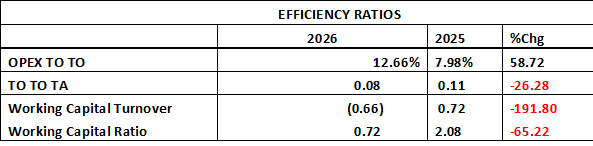
Aradel Holdings Plc’s efficiency ratios indicate mixed operational performance in 2026Q1. The Operating Expenses-to-Turnover ratio increased from 7.98% to 12.66%, suggesting that operating expenses grew faster than revenue, resulting in higher operating cost intensity. In addition, the Total Asset Turnover ratio declined from 0.11x to 0.08x, indicating that the company’s significantly expanded asset base generated relatively lower revenue per naira of assets. The Working Capital Turnover also deteriorated from 0.72x to -0.66x, reflecting negative working capital and reduced efficiency in utilizing short-term resources.
From an investment perspective, these ratios suggest that while Aradel has successfully expanded its operations, the efficiency of asset utilization and working capital management weakened during the quarter. The Working Capital Ratio declined from 2.08x to 0.72x, falling below the benchmark of 1.0 and indicating tighter short-term liquidity. Going forward, management should focus on improving asset productivity, controlling operating expenses, and strengthening working capital management to support sustainable growth. Overall, the efficiency indicators warrant cautious monitoring, although the company’s strong earnings growth provides confidence that these challenges can be addressed over the medium to long term.
Investment/ Valuation Ratios
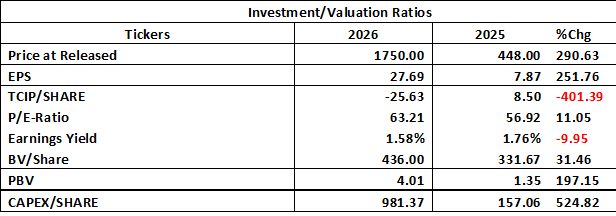
Aradel Holdings Plc delivered a strong improvement in shareholder earnings during 2026Q1, as Earnings Per Share (EPS) increased significantly from ₦7.87 to ₦27.69, reflecting the substantial growth in the company’s profitability. The market price of the stock also appreciated sharply from ₦448.00 to ₦1,750.00, demonstrating strong investor confidence in the company’s growth prospects. In addition, Book Value per Share increased by 31.46% to ₦436.00, indicating an improvement in the company’s underlying net asset value available to shareholders.
Despite the positive growth in earnings and Book Value, the valuation ratios suggest that the stock is trading at a relatively expensive level. The Price-to-Earnings (P/E) Ratio increased from 56.92x to 63.21x, while the Price-to-Book Value (PBV) ratio rose from 1.35x to 4.01x, implying that investors are paying a substantial premium for the company’s shares. Consequently, the Earnings Yield declined slightly from 1.76% to 1.58%, indicating a lower earnings return relative to the market price. Furthermore, Total Comprehensive Income per Share turned negative at -₦25.63, reflecting the negative other comprehensive income reported during the year, although this did not affect the company’s strong earnings performance.
From an investment perspective, Aradel Holdings Plc remains an attractive growth stock with improving earnings, increasing book value, and significant capital investment, as evidenced by the sharp rise in Capital Expenditure per Share from ₦157.06 to ₦981.37. However, the current valuation multiples suggest that much of the company’s growth expectations may already be reflected in the share price. Therefore, while the stock remains suitable for medium- to long-term investors seeking exposure to a high-growth energy company, potential investors should be mindful of the premium valuation and monitor future earnings growth to ensure it continues to justify the current market price.
Final Investment Verdict
Based on the comprehensive analysis of Aradel Holdings Plc’s Statement of Comprehensive Income, Statement of Financial Position, Financial Strength, Profitability, Efficiency, and Investment/Valuation Ratios, the company delivered an impressive first-quarter performance characterized by exceptional revenue growth, robust operating profit, and a significant increase in earnings per share. The company also expanded its asset base considerably and strengthened retained earnings, demonstrating management’s commitment to long-term growth through strategic investments. These are strong positive indicators that support future earnings potential.
However, the analysis also highlights several areas of concern. The rapid expansion has been financed largely through debt, resulting in a sharp increase in leverage and weaker solvency ratios. Liquidity and efficiency indicators deteriorated, with the working capital ratio falling below the ideal benchmark and asset turnover declining. Furthermore, the unusually high effective tax rate, rising finance costs, and negative total comprehensive income suggest that investors should monitor the sustainability of future earnings and the company’s ability to manage its growing financial obligations.
Investment Recommendation: BUY (with Moderate Risk)
Aradel Holdings Plc remains fundamentally strong, supported by outstanding revenue and earnings growth, improving profitability, expanding assets, and increasing shareholder value. Although the stock appears relatively expensive based on its valuation multiples and carries higher financial risk due to increased leverage, its growth prospects outweigh these concerns for investors with a medium- to long-term investment horizon. Existing shareholders are advised to hold and accumulate on price weakness, while new investors may buy with the expectation of sustained earnings growth, provided the company continues to improve debt management, liquidity, and operational efficiency.
Final Recommendation: BUY – Suitable for medium- to long-term investors seeking capital appreciation. While the company’s aggressive expansion has increased financial risk, its strong earnings momentum and growth trajectory make it one of the more attractive investment opportunities, provided management maintains prudent debt management and improves operating efficiency.