

Period Under Review: FULL YEAR 31ST MARCH 2026
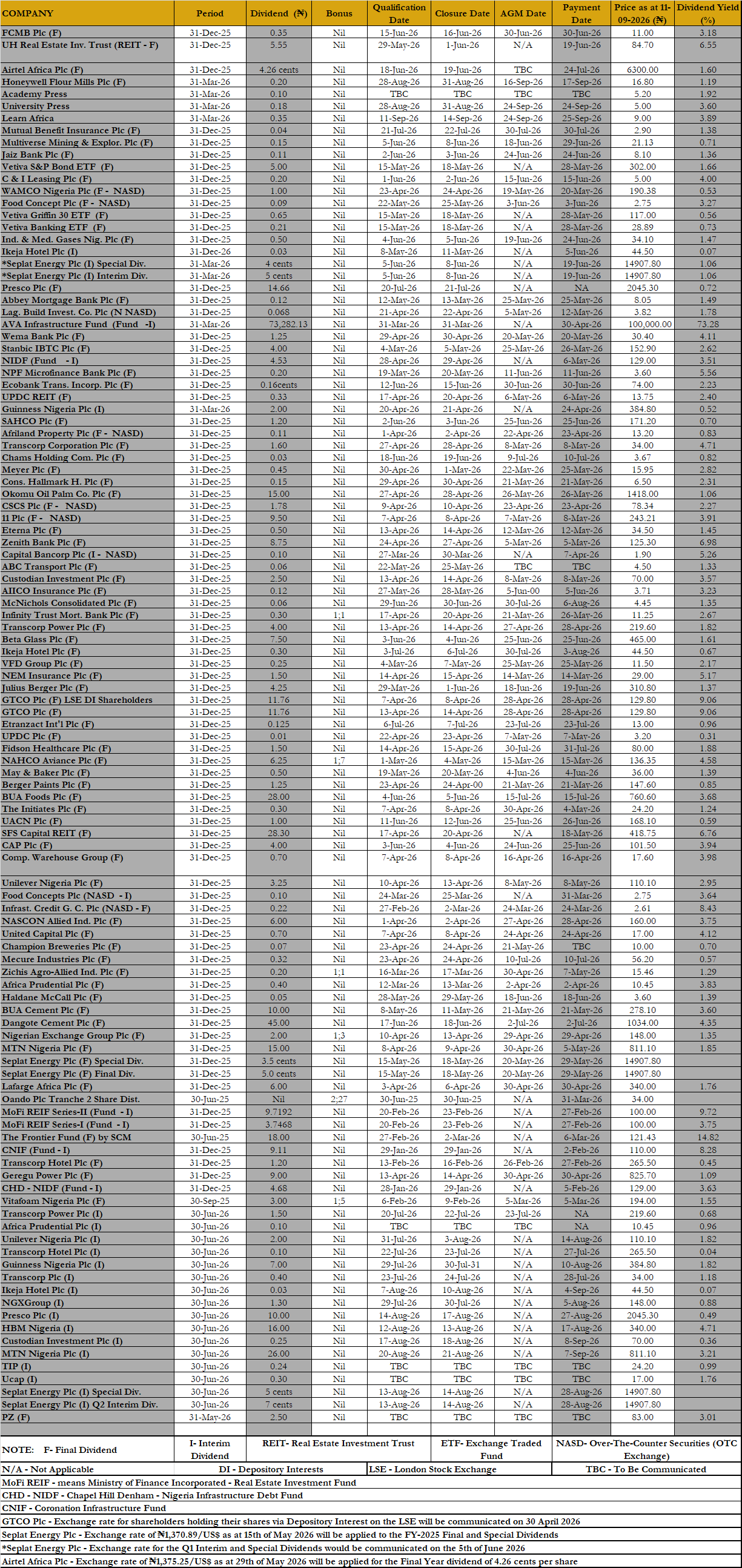
Current Share Price: N18.35
Price At Release Date: N18.45
Latest Final Dividend: N0.20
Latest Interim Dividend: NIL
Estimated Beta Value: 0.84x
Estimated Intrinsic Value: N23.80
Rating: Buy-Long Term View
Analyst: Jeariogbe Tunde Segun
The Company
Honeywell Flour Mills Plc traces its roots to 1983 when it was incorporated as Gateway Honeywell Flour Mills Limited through a partnership involving the Ogun State Government and the Honeywell Group. The company was established to participate in Nigeria’s growing flour milling industry and later became a key player in the production of wheat-based food products. Following a change in ownership structure, the company was renamed Honeywell Flour Mills Limited in 1995, marking the beginning of its expansion under the Honeywell brand.
Commercial operations commenced fully in 1998 with the commissioning of a 200-metric-ton-per-day milling plant in Apapa, Lagos. Since then, the company has expanded its product portfolio beyond flour to include semolina, whole wheat meal, pasta, noodles, and other food products. Its strong brand recognition and growing market presence helped it become one of Nigeria’s leading food manufacturing companies. In 2008, the company was converted into a public limited liability company, and its shares listed on the Nigerian Stock Exchange (now Nigerian Exchange Limited) in 2009.
A major turning point in the company’s history occurred in 2021 when Flour Mills of Nigeria Plc agreed to acquire a majority stake from the Honeywell Group. Regulatory approvals were obtained in 2022, leading to the completion of the acquisition and the integration of Honeywell Flour Mills into the FMN Group. The transaction created one of Nigeria’s largest food manufacturing platforms, combining two iconic brands with the objective of strengthening food security, expanding production capacity, and enhancing competitiveness within the Nigerian food industry.
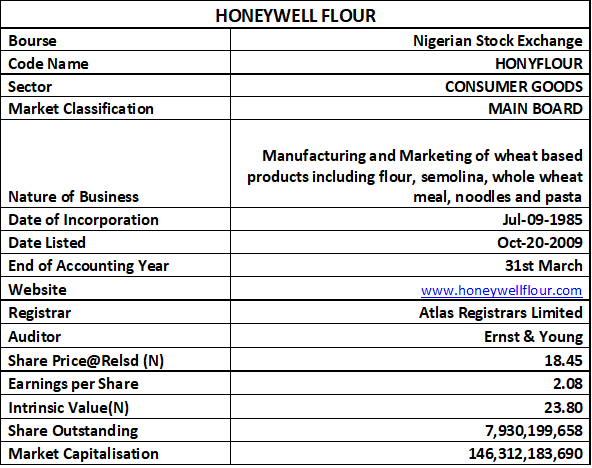
Honeywell Flour Mills Plc recorded a decline in turnover for the 2026 financial year, with revenue decreasing by 3.39% to ₦360.85 billion from ₦373.51 billion in 2025. Cost of sales also declined by 4.94% to ₦324.42 billion, indicating some improvement in cost management. However, operating profit fell by 8.34% to ₦16.58 billion, reflecting pressure on core business operations despite the reduction in production costs. Operating expenses increased significantly by 26.65% to ₦21.35 billion, thereby further constraining operating performance during the period.
Below the operating line, the company recorded notable improvements in some key expense items. Depreciation and amortisation expenses declined by 45.42% to ₦5.16 billion, while finance costs reduced by 28.07% to ₦3.90 billion, suggesting a lighter debt burden and improved asset structure. In addition, net finance income rose strongly by 70.78% to ₦5.32 billion, providing substantial support to earnings. As a result, Profit Before Tax (PBT) increased modestly by 3.29% to ₦21.90 billion despite weaker operating profitability.
Profitability remained resilient with tax expense declining by 18.17% to ₦5.41 billion. Consequently, Profit After Tax (PAT) grew by 13.01% to ₦16.49 billion from ₦14.59 billion in the previous year. Total Comprehensive Income also increased by the same margin to ₦16.49 billion. Overall, the results indicate that while Honeywell Flour Mills faced revenue and operating profit challenges, strong financial income, lower finance costs, and reduced tax charges helped sustain earnings growth and enhance shareholder value during the year under review.
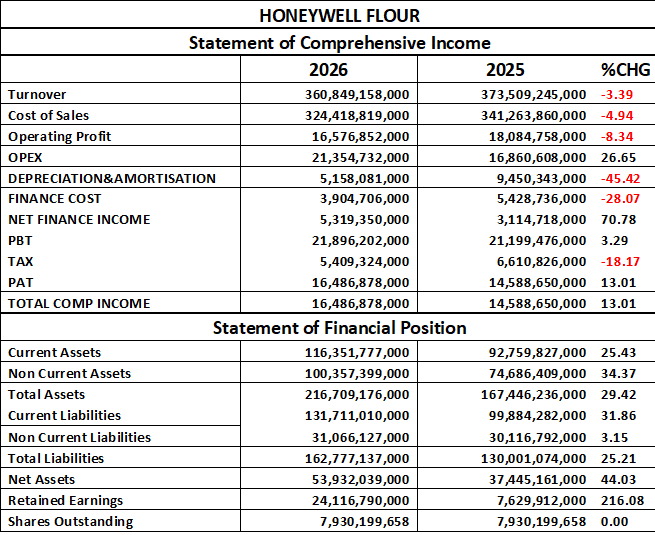
Honeywell Flour Mills Plc recorded significant growth in its asset base during the 2026 financial year. Current assets, for example, increased by 25.43% to ₦116.35 billion from ₦92.76 billion, while non-current assets rose by 34.37% to ₦100.36 billion from ₦74.69 billion. Consequently, total assets expanded by 29.42% to ₦216.71 billion, reflecting substantial investment in both working capital and long-term productive assets. The growth in assets suggests an expansion in the company’s operational capacity and resource base.
On the liabilities side, current liabilities increased by 31.86% to ₦131.71 billion, while non-current liabilities rose marginally by 3.15% to ₦31.07 billion. As a result, total liabilities grew by 25.21% to ₦162.78 billion from ₦130.00 billion in the previous year. Although liabilities increased considerably, the growth rate was lower than that of total assets, indicating that the company’s asset expansion was not solely funded by debt. The relatively moderate increase in non-current liabilities also points to prudent long-term borrowing management.
Shareholders’ funds strengthened considerably during the year, with net assets rising by 44.03% to ₦53.93 billion from ₦37.45 billion. Retained earnings recorded an exceptional increase of 216.08%, growing from ₦7.63 billion to ₦24.12 billion, reflecting strong profit retention and enhanced internal capital generation. Meanwhile, shares outstanding remained unchanged at 7.93 billion units, implying that the increase in net assets was achieved without equity dilution. Overall, the statement of financial position depicts a company with improving financial strength, growing asset capacity, and a significantly enhanced equity position.
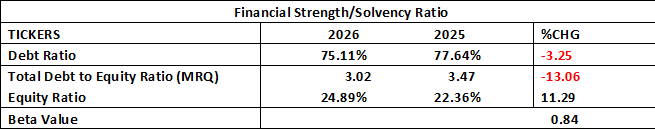
Financial Strength/Solvency Ratio
Honeywell Flour Mills Plc’s solvency position improved in 2026, as reflected by a decline in its Debt Ratio to 75.11% from 77.64% in 2025, representing a 3.25% improvement. Similarly, the Total Debt-to-Equity Ratio decreased from 3.47x to 3.02x, a 13.06% reduction, indicating that the company relied less on debt financing relative to shareholders’ equity. Although leverage remains relatively high, the downward trend suggests strengthening financial stability and a gradual reduction in balance sheet risk.
The Equity Ratio increased to 24.89% from 22.36%, reflecting an 11.29% improvement and indicating that a larger proportion of the company’s assets is now financed by shareholders’ funds. This aligns with the strong growth in net assets and retained earnings observed during the year. Furthermore, the Beta Value of 0.84 suggests that the stock is less volatile than the overall market, making it relatively defensive. Overall, the solvency indicators point to an improving capital structure, stronger equity backing, and a reduced dependence on debt, which enhances the company’s long-term financial resilience.
Profitability Ratios
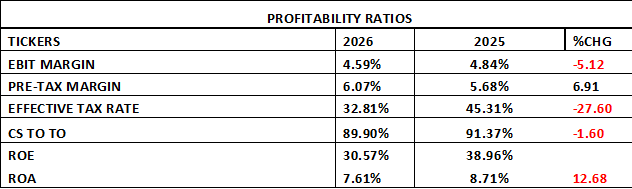
Honeywell Flour Mills Plc’s profitability profile in 2026 presented a mixed performance. The EBIT Margin declined slightly to 4.59% from 4.84% in 2025, reflecting a 5.12% reduction and indicating some pressure on operating efficiency. However, the Pre-Tax Margin improved to 6.07% from 5.68%, representing a 6.91% increase, demonstrating the positive impact of lower finance costs and stronger net finance income on overall earnings. This improvement enabled the company to generate more profit before tax from every naira of revenue despite weaker operating margins.
The company’s tax efficiency improved significantly during the year. The Effective Tax Rate fell sharply to 32.81% from 45.31%, a decline of 27.60%, contributing positively to bottom-line performance. Additionally, the Cost of Sales to Turnover ratio improved from 91.37% to 89.90%, indicating that a lower proportion of revenue was consumed by direct production costs. This suggests improved cost control and better gross profit generation despite the decline in turnover.
Returns to investors and asset utilization, however, weakened compared to the previous year. Return on Equity (ROE) declined to 30.57% from 38.96%, while Return on Assets (ROA) fell to 7.61% from 8.71%, representing a 12.68% decrease. The decline in these ratios reflects the significant expansion in the company’s asset base and shareholders’ funds relative to profit growth. Nevertheless, ROE remains strong above 30%, indicating that Honeywell Flour Mills continues to generate attractive returns for shareholders, while maintaining a reasonable level of efficiency in deploying its assets.
Efficiency Ratios
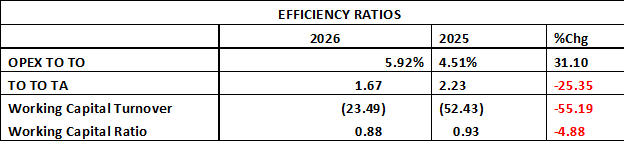
Honeywell Flour Mills Plc’s efficiency indicators reveal a mixed performance in 2026. The Operating Expenses-to-Turnover (OPEX/TO) ratio increased significantly to 5.92% from 4.51%, representing a 31.10% rise. This indicates that a larger portion of revenue was consumed by operating expenses, reflecting reduced cost efficiency and aligning with the notable increase in operating expenses recorded during the year. In addition, the Turnover-to-Total Assets ratio declined to 1.67 times from 2.23 times, a 25.35% reduction, suggesting that the expanded asset base generated relatively less revenue compared to the previous year.
Working capital metrics also point to liquidity and operational efficiency challenges. Although the Working Capital Turnover ratio improved from -52.43 times to -23.49 times, it remained negative, indicating that the company continued to operate with negative working capital, albeit at a less severe level than in 2025. Furthermore, the Working Capital Ratio declined from 0.93x to 0.88x, remaining below the benchmark of 1.0x, which suggests that current liabilities still exceed current assets. Overall, the efficiency ratios indicate that while Honeywell Flour Mills has moderated its working capital pressure, asset utilization and operating cost efficiency weakened during the year, requiring management attention to improve operational productivity and liquidity management.
Investment/Valuation Ratios
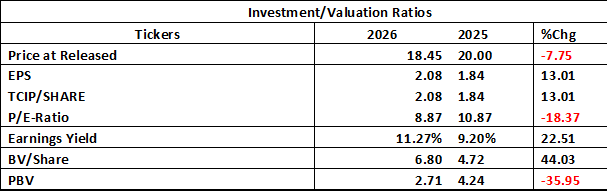
Honeywell Flour Mills Plc’s investment and valuation metrics improved considerably in 2026, despite a decline in its market price. The share price at release fell by 7.75% to ₦18.45 from ₦20.00 in 2025. However, Earnings Per Share (EPS) increased by 13.01% to ₦2.08 from ₦1.84, reflecting the company’s improved profitability during the year. Total Comprehensive Income Per Share also rose by the same margin to ₦2.08, indicating that earnings growth was supported by genuine business performance rather than extraordinary items.
Valuation indicators suggest that the stock became more attractive to investors. The Price-to-Earnings (P/E) ratio declined from 10.87x to 8.87x, representing an 18.37% reduction, while Earnings Yield improved significantly from 9.20% to 11.27%. A lower P/E ratio combined with a higher earnings yield generally indicates that investors are paying less for each naira of earnings, potentially making the stock more attractive from a value-investing perspective. The improvement was largely driven by stronger earnings growth relative to the decline in market price.
The company’s underlying net worth also strengthened substantially. Book Value per Share increased by 44.03% to ₦6.80 from ₦4.72, reflecting the significant growth in shareholders’ funds and retained earnings during the year. Consequently, the Price-to-Book Value (PBV) ratio declined sharply from 4.24x to 2.71x, a reduction of 35.95%, suggesting that the market valuation became more aligned with the company’s intrinsic value. Overall, the investment and valuation ratios indicate a stock with improving earnings power, stronger asset backing, and more attractive valuation multiples, which could appeal to long-term value-oriented investors.
Dividend Information
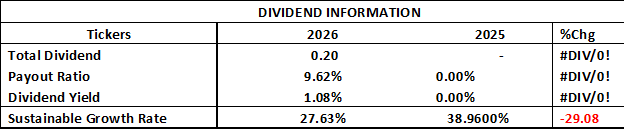
Honeywell Flour Mills Plc resumed dividend payments in 2026, declaring a total dividend of ₦0.20 per share, compared to no dividend payment in 2025. The company maintained a conservative payout ratio of 9.62%, indicating that the majority of earnings were retained to support future growth and strengthen the balance sheet. At the reference share price of ₦18.45, the dividend translates to a modest dividend yield of 1.08%, suggesting that the stock is currently more of a growth and value play than an income investment. Meanwhile, the Sustainable Growth Rate (SGR) stood at 27.63%, although lower than the 38.96% recorded in the previous year, it remains robust and reflects the company’s strong capacity to grow earnings through retained profits. Overall, the dividend profile signals management’s confidence in the company’s recovery while maintaining a prudent balance between rewarding shareholders and reinvesting for future expansion.
Summarily
Honeywell Flour Mills Plc delivered a generally positive financial performance in 2026. While turnover declined by 3.39% and operating profit fell by 8.34%, the company successfully improved its bottom line, with Profit After Tax rising by 13.01%. The balance sheet strengthened considerably, as total assets increased by 29.42%, net assets grew by 44.03%, and retained earnings surged by 216.08%. Solvency indicators also improved, with lower debt ratios and a stronger equity position, demonstrating enhanced financial resilience. However, some concerns remains, regarding operating efficiency, as higher operating expenses and lower asset turnover indicate room for operational improvement.
From an investment perspective, Honeywell Flour Mills appears fundamentally stronger than it was a year ago. Earnings per share increased by 13.01%, Book Value Per Share rose by 44.03%, and valuation metrics became more attractive, with the P/E ratio declining to 8.87x and earnings yield increasing to 11.27%. The significant reduction in the Price-to-Book ratio to 2.71x further suggests that the stock’s market valuation has become more reasonable relative to its underlying net worth. Although revenue growth remains a challenge, the company’s improved profitability, stronger balance sheet, and attractive valuation provide a solid foundation for future value creation.
Final Verdict: Honeywell Flour Mills is a fundamentally improving company with strengthening financial health, solid profitability, and attractive valuation metrics. The major strengths lie in its earnings growth, expanding equity base, reduced leverage, and lower valuation multiples, while the primary weaknesses are declining revenue and weaker operating efficiency. Based on the overall analysis of Financial Strength, Profitability, Efficiency, and Investment/Valuation metrics, the stock earns a BUY rating (7.5/10) for long-term investors. Existing shareholders may continue to accumulate on price weakness, while new investors may consider gradual entry, given the company’s improving fundamentals and reasonable valuation.