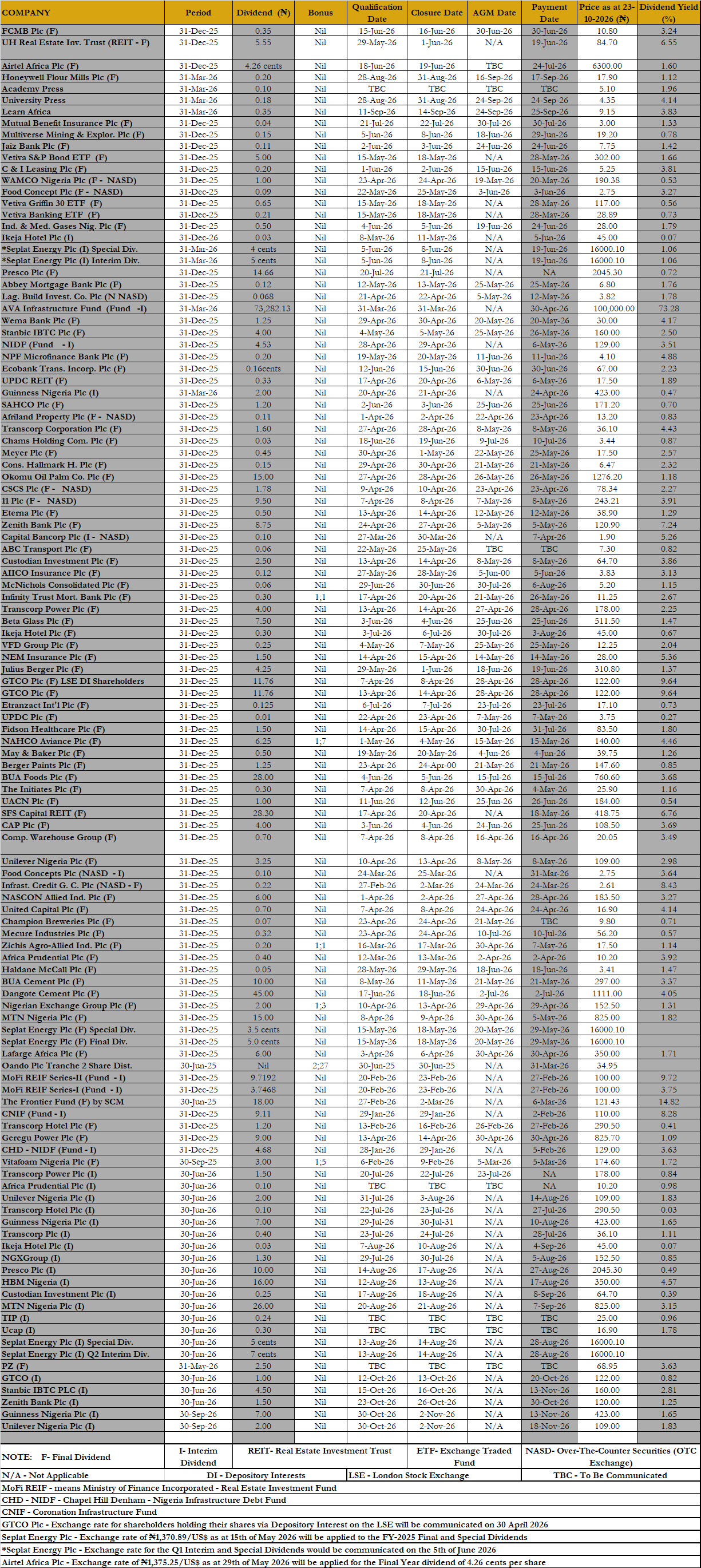

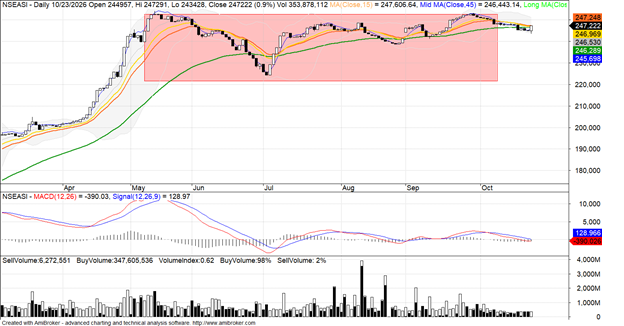
It was a bearish week with two trading sessions of up market and three of down market, as the composite NGX All-Share Index rebounded on Friday due to buying interests on Dangote Cement and seeming reactions to the inflow of impressive Q3 earnings reports to the market ahead of next week’s statutory deadline for quarterly earnings submission. The benchmark NGX All-Share Index declined by 0.13% to close the wee at 247,222.27 basis points, while market capitalisation stood at ₦160.519 trillion. Despite the weekly decline, the market maintained a year-to-date return of 58.87%.
NGXASI Daily Index Action
Trading activity increased during the week, with investors exchanging 2.024 billion shares valued at ₦110.773 billion in 173,113 deals, compared with 1.659 billion shares worth ₦98.088 billion in 184,632 deals in the previous week. This represented increases of approximately 22.0% in volume and 12.9% in value, although the number of deals fell by 6.3%. The Financial Services sector led market activity, recording 1.111 billion shares worth ₦53.908 billion in 81,787 deals. The sector accounted for 54.89% of total equity turnover volume and 48.66% of traded value. Consumer Goods ranked second, with 394.039 million shares valued at ₦9.811 billion in 17,912 deals, while Agriculture placed third with 147.170 million shares worth ₦2.821 billion in 7,462 deals.
The most active traded stocks by volume during the period under review are Multitrex Integrated Foods Plc, Zenith Bank Plc and Livestock Feeds Plc. Altogether they recorded 521.565 million shares valued at ₦19.093 billion in 16,487 deals, representing 25.76% of total turnover volume and 17.24% of traded value.
Market performance remained mixed across the week, as trading opened on a negative note to extend the previous session loss position with the index closing lower by 0.91% at 245,278.34 points, as market capitalisation fell by ₦1.47 trillion to ₦159.26 trillion. Market breadth was negative, with 40 losers against 15 gainers. MULTITREX advanced 10% to lead gainers, while VITAFOAM fell 10%. Trading volume dropped 10.10% to 257.73 million shares worth ₦13.07 billion in 32,032 deals. UBA led volume, while ZENITHBANK recorded the highest transaction value at ₦2.09 billion.
The market recovered on Tuesday, as the ASI gained 0.26% to close at 245,911.13 points, adding 632.79 points. Market capitalisation increased by ₦410.86 billion to ₦159.67 trillion, while the year-to-date return rose to 58.03%. Market breadth improved to 28 gainers against 21 losers. AUSTINLAZ led the advancers, while LIVESTOCK recorded the biggest loss. Trading volume reached 348.75 million shares valued at ₦25.84 billion in 32,639 deals. UBA led volume, while ARADEL topped transaction value at ₦5.11 billion.
Selling pressure returned on Wednesday, October 21, pushing the ASI down 0.32% to 245,116.49 points. Market capitalisation declined by ₦515.95 billion, while the year-to-date return eased to 57.52%. CWG recorded the steepest loss, falling 9.98%, while LIVINGTRUST led gainers. Trading volume rose 1.54% to 354.13 million shares worth ₦23.60 billion across 32,639 deals. ZENITHBANK led trading volume with 48.21 million shares and transaction value at ₦5.90 billion.
The bearish trend continued on Thursday, although losses moderated. The ASI fell 0.07% to 244,956.94 points, reducing market capitalisation by ₦103.60 billion and bringing the year-to-date return to 57.41%. Market breadth remained negative, with 22 decliners against 16 advancers. AVACAP led gainers, while THOMASWY recorded the steepest decline. Trading volume increased 1.87% to 360.75 million shares valued at ₦20.32 billion in 31,401 deals. LIVESTOCK led volume with 40.97 million shares, while ARADEL recorded the highest transaction value at ₦4.34 billion.
The market staged a strong recovery on Friday, as the ASI advanced 0.92% to close at 247,222.27 points. Market capitalisation rose by ₦1.47 trillion, while the year-to-date return improved to 58.87%. DANGCEM and FIRSTHOLDCO gained 10% each, while FIDELITYBK advanced 9.09%. However, market breadth remained negative, with 25 decliners against 23 gainers, as LIVESTOCK recorded the steepest loss. Trading volume surged 69.56% to 611.68 million shares worth ₦23.14 billion across 33,585 deals. LIVESTOCK led volume with 46.84 million shares, while ARADEL topped transaction value at ₦4.20 billion.
Despite Friday’s recovery, market breadth weakened significantly over the week. Only 20 equities appreciated in price, compared with 50 in the previous week, while declining stocks increased to 55 from 30. Meanwhile, 71 equities closed unchanged, up from 66 previously, indicating that selling pressure affected a broader section of the market. Sectoral performance was largely negative, although some indices recorded gains. The NGX Industrial Goods Index advanced 1.95%, the NGX Premium Index rose 0.80%, the NGX Consumer Goods Index gained 0.04%, the NGX Growth Index increased 0.04%, and the NGX Pension Broad Index appreciated 0.03%. The NGX Sovereign Bond Index remained unchanged, while all other indices closed lower.
Overall, the market recorded higher weekly turnover but remained under pressure as declining equities outnumbered gainers. Friday’s rebound helped recover part of the earlier losses, although the negative breadth and weakness across most sectoral indices pointed to cautious investor sentiment.
Week-to-date, the All-Share Index has lost 0.13%, NGX 30 is down by 0.01%, the Banking Index has decreased by 0.67%, the Pension Index decreased by 0.71%, the Insurance Index declined by 2.79%, the Consumer Goods Index decreased by 0.55%. However, the Oil and Gas Index recorded a negative return of 2.55%. Year-to-date, the All-Share Index has gained 58.87%, NGX 30 is up by 60.42%, the Banking Index has increased by 65.94%, the Pension Index increased by 79.88%, the Insurance Index declined by 11.76%, the Consumer Goods Index increase by 0.99%. However, the Oil and Gas Index recorded a positive return of 126.04%.
ABC Transport Plc
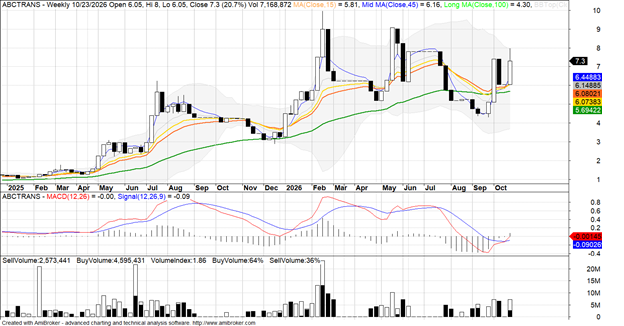
ABC Transport Plc led the gainers, rising by ₦1.25 or 20.66% from an opening price of ₦6.05 to close at ₦7.30. AVA Capital Plc gained ₦1.10 or 17.74%, advancing from ₦6.20 to ₦7.30, while Caverton Offshore Support Group Plc appreciated by ₦0.70 or 17.07%, moving from ₦4.10 to ₦4.80. Fidelity Bank Plc rose by ₦2.95 or 14.01%, from ₦21.05 to ₦24.00, while Multi-Trex Integrated Foods Plc gained ₦0.06 or 10.00%, closing at ₦0.66 from ₦0.60.
UPDCREIT
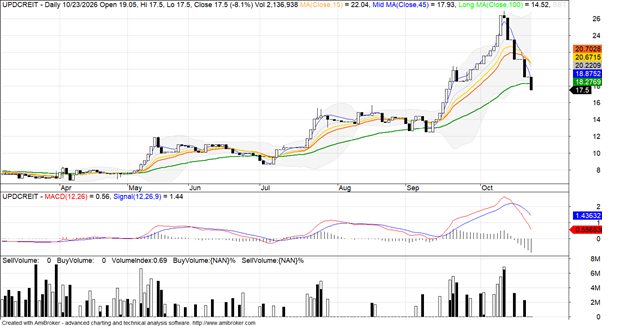
On the losers’ chart, UPDC Real Estate Investment Trust recorded the steepest decline, shedding ₦3.65 or 17.26% to close at ₦17.50 from ₦21.15. Omatek Ventures Plc fell by ₦0.20 or 12.50%, declining from ₦1.60 to ₦1.40, while University Press Plc lost ₦0.60 or 12.12%, closing at ₦4.35 from ₦4.95. Regency Alliance Insurance Plc declined by ₦0.09 or 11.25%, from ₦0.80 to ₦0.71, while Nigerian Exchange Group Plc shed ₦17.50 or 10.29%, falling from ₦170.00 to ₦152.50.
NGX Weekly Comparative Analysis
The Nigerian Exchange recorded a smaller weekly loss of 0.13% in the week ended October 23, 2026, compared with a 0.33% decline in the previous week. The All-Share Index closed at 247,222.27 points, down from 247,539.73 points, while market capitalisation fell from ₦160.725 trillion to ₦160.519 trillion. Year-to-date return also eased from 59.07% to 58.87%, reflecting a slight moderation in the market’s overall performance.
Trading activity improved, with total turnover rising 22% to 2.024 billion shares valued at ₦110.773 billion, compared with 1.659 billion shares worth ₦98.088 billion in the previous week. However, the number of deals declined by 6.3% to 173,113, suggesting that higher trading volume and value were not accompanied by increased transaction frequency.
The Financial Services sector remained the dominant contributor, accounting for 54.89% of total volume and 48.66% of traded value. The Consumer Goods and Agriculture sectors followed in trading activity. Among the sectoral indices, Industrial Goods led with a 1.95% gain, while the Premium and Consumer Goods indices also recorded modest advances. Most other indices closed lower.
Market breadth weakened significantly, with 20 stocks gaining against 55 decliners, compared with 50 gainers and 30 decliners in the previous week. This indicates that selling pressure spread across more stocks despite the improvement in turnover. The market also experienced mixed daily movements, with Friday’s 0.92% rebound helping to limit the weekly decline after losses earlier in the week.
Overall, the market showed improved trading activity and a smaller weekly decline, but weak breadth suggests that investor sentiment remains cautious. Sustained buying interest, stronger market breadth and continued gains in the benchmark index will be important in confirming a more durable recovery in the coming week.
Technical Analysis View
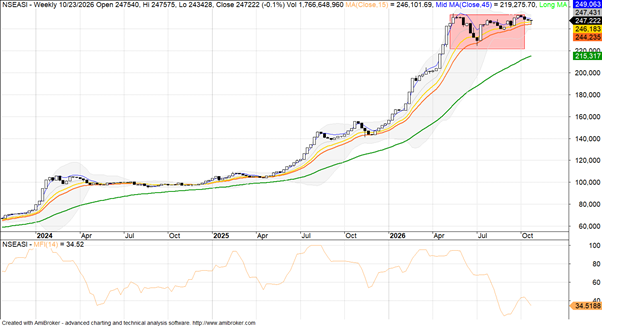
The Nigerian equities market ended the week on a mildly bearish note, with the All-Share Index (ASI) declining 0.13% to 247,222.27 points despite a strong 0.92% rebound on Friday. The late-week recovery suggests renewed demand for selected large-cap stocks, although the index’s inability to sustain an upward trajectory throughout the week indicates that selling pressure remains present.
From a index action perspective, the ASI’s recovery from its midweek weakness points to buying interest around lower trading levels. However, the rebound requires confirmation through follow-through gains and broader market participation before it can be interpreted as the beginning of a sustained bullish reversal. Failure to maintain the recovery could expose the market to renewed selling pressure and a possible retest of recent lows.
Market breadth remains a significant concern. With 55 decliners against 20 advancers for the week, selling pressure was more widespread than buying interest. This negative breadth suggests that Friday’s advance may have been driven largely by selected heavyweight stocks rather than a broad-based improvement in investor sentiment. A sustained bullish trend would require an increase in advancing stocks alongside continued gains in the ASI.
Trading activity provided a mixed signal. Weekly turnover rose to 2.024 billion shares valued at ₦110.773 billion, compared with 1.659 billion shares worth ₦98.088 billion in the preceding week. However, the decline in the number of deals from 184,632 to 173,113 suggests that the increase in volume and value did not translate into wider market participation. Further analysis of price movement alongside turnover will be important in determining whether institutional accumulation or short-term repositioning is driving activity.
Sectoral performance also reflected uneven market sentiment. The Industrial Goods Index gained 1.95%, while the Premium Index advanced 0.80%. Consumer Goods and Growth indices recorded marginal gains of 0.04% each, while several other indices closed lower. This divergence highlights the importance of sector and stock selection as investors position themselves around areas of relative strength.
Market Outlook
The short-term outlook remains cautiously neutral to bullish, supported by Friday’s recovery but constrained by weak market breadth and the ASI’s modest weekly decline. The immediate technical priority is whether the index can sustain its upward movement and build on Friday’s gains. Consecutive positive sessions, accompanied by stronger turnover and an improving advance-decline ratio, would provide more convincing evidence of renewed bullish momentum.
Conversely, a failure to extend the rebound could signal that the latest advance was a temporary recovery within a broader consolidation phase. A renewed decline below recent trading lows would strengthen the bearish case and suggest that sellers retain control of the market. Investors should therefore monitor the index’s reaction around recent support and resistance zones rather than treating a single positive session as confirmation of a trend reversal.
Market breadth, turnover and the performance of large-cap stocks will remain key indicators in the coming week. A rising ASI supported by increasing advancers would strengthen the probability of a sustained recovery, while an index advance accompanied by persistent negative breadth could indicate a narrow rally vulnerable to profit-taking. From an investment standpoint, a selective approach remains appropriate. Investors may prioritise stocks showing relative price strength, improving liquidity and sound earnings fundamentals, while avoiding aggressive positions in shares experiencing sharp short-term rallies without clear fundamental support. Confirmation from price action, trading activity and market breadth will be essential before adopting a more decisively bullish position.
Trending in the Economy: Nigeria’s FAAC allocations increased 4% month-on-month to ₦2.4 trillion in October 2026, driven by a 7% rise in gross statutory revenue to ₦1.7 trillion. The Federal Government received ₦832 billion, states ₦800 billion and local governments ₦561 billion. Allocations to oil-producing states climbed 28% to ₦236 billion on improved oil revenue. Nigeria’s broad money supply rose 5.4% to ₦146.6 trillion in September 2026 from ₦139.09 trillion in August, bringing year-to-date growth to 18.3%. The increase followed the CBN’s reduction of the benchmark interest rate from 26.5% to 23%. Narrow money supply also grew to ₦44.05 trillion from ₦43.11 trillion, reflecting increased liquidity in the financial system.
Global Market and Oil: Global stock markets closed lower on Friday as investors weighed concerns over artificial intelligence investments, rising geopolitical tensions and persistent inflation risks. While technology shares showed mixed performances, escalating hostilities in the Middle East drove oil prices sharply higher, with Brent crude reaching its highest level in nearly six months. Developments across equity, bond and commodity markets reflected growing uncertainty about the global economic outlook.
The Dow Jones Industrial Average fell 652.82 points, or 1.23%, to close at 52,215.16 points. The S&P 500 declined 39.75 points, or 0.52%, to 7,623.68, while the Nasdaq Composite shed 53.52 points, or 0.21%, to 25,955.34. The decline reflected cautious investor positioning as market participants assessed corporate earnings, the sustainability of the rally in technology stocks and the potential economic consequences of higher energy prices.
Despite Friday’s losses, the Dow maintained its positive weekly performance, rising 0.4% for a third consecutive weekly gain. However, the S&P 500 fell 0.5% over the week, while the Nasdaq Composite declined 0.7%, reflecting continued pressure on technology-related investments. Technology stocks recorded mixed performances as investors continued to assess the profitability of artificial intelligence investments. The semiconductor index gained 0.4%, recovering modestly after suffering its largest daily percentage decline since June on Thursday. The S&P 500 technology sector also advanced 0.4%, indicating some resilience despite broader market weakness.
However, sentiment remained fragile following a report from Meta Platforms that reignited concerns about the scale of spending on AI infrastructure and the time required for those investments to generate sufficient returns. Although artificial intelligence has supported substantial gains across technology stocks, investors are becoming more selective as spending commitments increase and expectations for future earnings remain high. Meta shares declined 1% on Friday, while Microsoft advanced 0.7%. Alphabet and Amazon shares also slipped, highlighting the uneven performance of major technology companies.
Attention is now shifting towards the next round of quarterly earnings, with approximately one-third of S&P 500 companies expected to report results in the coming week. Alphabet, Microsoft and Amazon will be among the closely watched companies because of their significant investments in artificial intelligence infrastructure, cloud computing and data centres.
Investors are expected to scrutinise revenue growth, operating margins, cash flow and capital expenditure guidance to determine whether the companies’ AI investments are translating into sustainable financial returns. Any indication that spending is rising faster than revenue could increase pressure on technology valuations, particularly among companies whose share prices already reflect strong growth expectations. The latest developments suggest that investors are no longer assessing AI companies solely on their growth prospects. Instead, greater emphasis is being placed on profitability, investment efficiency and the ability to convert technological advances into measurable earnings.
The US bond market also experienced renewed pressure as Treasury yields rose following Thursday’s sharp decline. The benchmark 10-year Treasury yield increased by 3.7 basis points to 4.99%, remaining just below the psychologically important 5% level. Thursday’s decline in the 10-year yield had been its largest single-day fall in nearly four years, making Friday’s rebound a significant development for investors monitoring interest rate expectations and broader financial conditions.
Persistent inflation concerns remain a key challenge for the bond market. Higher energy prices could increase transportation, production and distribution costs, potentially slowing the decline in inflation and complicating the outlook for monetary policy.
JoAnne Bianco, a partner and senior investment strategist at BondBloxx Investment Management, highlighted the continuing pressure from persistent inflation. Her comments reflected concerns that inflation could remain elevated despite changes in financial market conditions. Rising Treasury yields can also influence equity valuations by increasing the discount rate applied to future corporate earnings. This is particularly relevant for technology and growth companies, whose valuations often depend heavily on expected profits over several years.
Consequently, a sustained increase in government bond yields could create additional headwinds for equities by making fixed-income investments more attractive relative to riskier assets. Higher borrowing costs could also weigh on businesses and consumers, potentially affecting investment decisions, credit demand and economic activity. European stock markets also closed lower as investors assessed political uncertainty, fiscal concerns and developments in global financial markets. The pan-European STOXX 600 index declined 0.31% to 635.77 points, bringing its weekly loss to approximately 1.4%. This marked its steepest weekly decline since early September and reflected growing caution across regional equity markets.
The euro weakened by 0.21% to $1.1191 as concerns over France’s political environment and public finances weighed on sentiment. The country’s fiscal challenges have increased investor scrutiny of government borrowing and the sustainability of public debt.
French authorities announced plans to deploy 70,000 police officers, supported by specialist units, for protests scheduled for Saturday. The planned security deployment highlighted the continued political tensions confronting the country. French government bond yields fell by five basis points to 5.04% on Friday. However, they had risen by nearly 27 basis points during the week, representing the largest weekly increase among major eurozone countries and the sharpest weekly rise since late May.
The sell-off in French government bonds pushed the country’s debt risk premium to its highest level since the 2011 eurozone sovereign debt crisis. This development underscored investor concerns about France’s fiscal outlook and the additional compensation demanded for holding its government debt. The rise in French borrowing costs could further complicate the government’s efforts to manage public finances, particularly if elevated yields persist. Higher debt-servicing expenses could limit fiscal flexibility and increase pressure for spending adjustments or additional revenue measures.
The euro’s weakness also reflected the broader uncertainty surrounding the European economic and political outlook. Continued pressure on government bonds and currency markets could influence investment flows, financial conditions and regional market sentiment.
Global equities finished lower, with MSCI’s gauge of stocks across the world falling 3.96 points, or 0.35%, to 1,118.97 points. Asian markets showed signs of stabilisation following earlier volatility. South Korea’s KOSPI index closed higher after falling as much as 4% during the trading session, suggesting that some investors returned to the market following the initial sell-off. However, the uneven performance across regions indicated that market confidence remained fragile. Investors continued to balance corporate earnings prospects against inflation risks, political uncertainty and concerns about the consequences of rising energy costs.
The prospect of higher oil prices is particularly important for global equities because energy costs affect businesses across multiple sectors. Airlines, transport companies, manufacturers and consumer-facing businesses may experience margin pressure if fuel and operating expenses rise faster than their ability to increase prices.
Conversely, higher crude prices can benefit oil producers and energy companies by supporting revenue and cash flow, although the extent of the gains depends on production costs, output levels and other operational factors. The divergence between energy stocks and other market sectors therefore reflects the differing effects of commodity price movements on corporate profitability.
Oil prices rose sharply on Friday as Houthi attacks in Saudi Arabia heightened concerns about further disruptions to energy supplies from the Middle East. The escalation in regional hostilities increased the geopolitical risk premium in crude markets, pushing Brent crude to its highest level since April 29. Brent crude futures settled at $116.72 per barrel, gaining $3.55, or 3.14%, on the day. US West Texas Intermediate crude rose by $3.80, or 3.8%, to close at $103.27 per barrel.For the week, Brent gained 6%, while WTI advanced 2.3%. The gains reflected growing concerns about the security of energy infrastructure and the possibility that further military escalation could disrupt regional production or export routes.
Earlier in Friday’s session, Brent crude had risen by $1.71, or 1.5%, to $114.99 per barrel by 1300 GMT, after reaching an intraday high of $115.16. At the same time, WTI had gained $1.80, or 1.8%, to $101.27 per barrel. At that point, Brent was on course for a 4.4% weekly increase, its third consecutive weekly gain, while WTI was heading towards a 0.4% weekly decline. These earlier figures reflect prices recorded before the final settlement.
The subsequent increase in prices highlighted the strength of buying interest as concerns over Middle Eastern supply risks intensified. Saudi Arabia remains a major participant in global crude oil markets, making developments affecting its energy infrastructure particularly important to international supply expectations.
Saudi Aramco ordered the evacuation of its headquarters in Dhahran, near the Gulf and Bahrain, on Thursday as fighting intensified between the world’s largest crude exporter and Yemen-based Houthi forces. The development added to concerns about the security of critical energy facilities. Authorities in the United Arab Emirates also reported an oil spill, further increasing uncertainty surrounding regional energy operations. Although the scale of any potential supply disruption remained uncertain, the combination of security threats and infrastructure concerns prompted investors to reassess the risks facing global crude markets.
The rally also lifted energy stocks. The S&P 500 energy sector gained 2.5%, reaching a record high as investors responded to stronger crude prices and the prospect of improved earnings for oil producers. However, sustained increases in oil prices could have wider economic implications. Higher crude prices tend to raise fuel, transportation and production costs, potentially placing upward pressure on inflation. If elevated energy prices persist, central banks could face greater difficulty in easing monetary policy, particularly in economies where inflation remains above target.
For oil-importing countries, the increase could also widen import bills, place pressure on foreign exchange demand and complicate efforts to maintain price stability. Oil-exporting economies may benefit from stronger export earnings, although the overall impact depends on production volumes, fiscal requirements and domestic economic conditions. The immediate outlook for crude prices will depend heavily on developments in the Middle East, the security of energy infrastructure and any evidence of actual disruptions to production or shipments. Further escalation could sustain the geopolitical risk premium, while signs of de-escalation or uninterrupted supplies could ease some of the upward pressure.
Overall, Friday’s trading highlighted the growing influence of geopolitical risks on global financial markets. While concerns over AI spending weighed on parts of the technology sector and persistent inflation supported higher Treasury yields, rising crude prices strengthened energy stocks and increased uncertainty over the global inflation outlook.