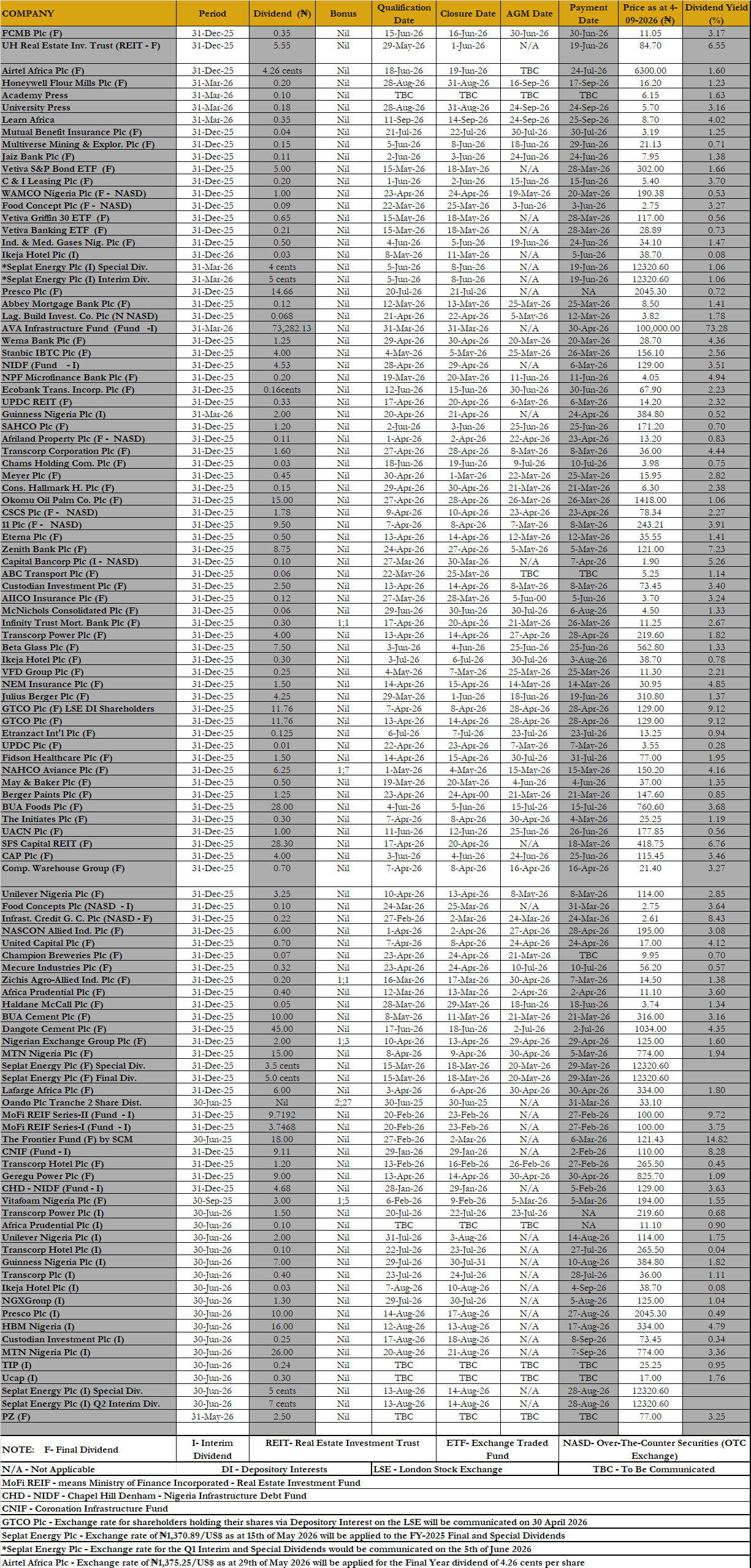

Trading on the Nigerian Exchange had mixed trend with the market resisting further decline and consolidating in the week under review on a low traded volume ahead of the earnings reporting session that kicked off with Transcorp Power and Africa Prudential Plc presenting their half-year score-cards. Despite, the mix performance of these companies, their directors declared interim dividend of N1.50 and 10 Kobo per share respectively.
The market was up for two trading sessions and closed negative in three, following which the composite index closed marginally in the red. The corporate earnings of listed companies are expected to determine the next major move or direction of the NGX.
For the week, investors traded a total of 2.819 billion shares valued at ₦182.499 billion in 226,729 deals, compared to 3.648 billion units worth ₦220.568 billion exchanged in 251,861 deals in the previous week. The Financial Services sector dominated activity with 2.006 billion shares worth ₦99.697 billion traded in 96,171 deals, accounting for 71.17% of total volume and 54.63% of total market value. The Consumer Goods sector followed with 178.863 million shares valued at ₦7.872 billion in 26,637 deals, while the Oil and Gas sector recorded 151.237 million shares worth ₦38.309 billion in 16,879 deals.
Trading was driven mainly by First HoldCo Plc, FCMB Group Plc and Access Holdings Plc, which jointly accounted for 939.402 million shares valued at ₦57.673 billion in 19,051 deals, representing 33.33% of the total trading volume and 31.60% of the total market value for the week. At the close of the week, the NGX All-Share Index declined by 0.14% to 243,462.13 points, while market capitalisation advanced by 0.39% to ₦157.057 trillion.
Most sectoral indices finished higher, except for the NGX Main Board Index which fell 1.54%, the NGX Consumer Goods Index (-0.15%), the NGX Oil & Gas Index (-0.11%), the NGX Lotus II Index (-0.40%), the NGX Industrial Goods Index (-6.26%), the NGX Growth Index (-0.09%), and the NGX Sovereign Bond Index, which also closed lower.
Week-to-date, NGX 30 is up by 0.34%, the Banking Index has increased by 9.30%, the Pension Index increased by 3.55%, the Insurance Index inclined by 0.25%, the Consumer Goods Index decreased by 0.15%. However, the Oil and Gas Index recorded a negative return of 0.11%. Year-to-date, the All-Share Index has gained 56.45%, NGX 30 is up by 56.87%, the Banking Index has increased by 54.96%, the Pension Index increased by 71.65%, the Insurance Index declined by 4.50%, the Consumer Goods Index increase by 17.84%. However, the Oil and Gas Index recorded a positive return of 96.59%.
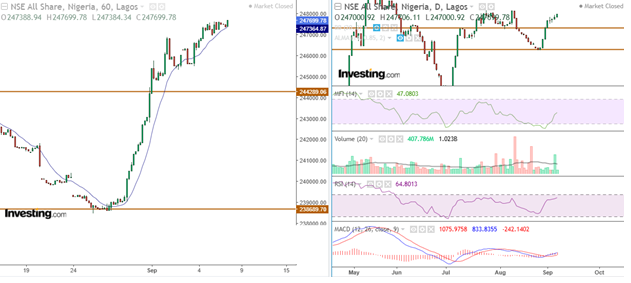
Below is the daily index’s action of the NGX
NGXASI Daily Index Actions
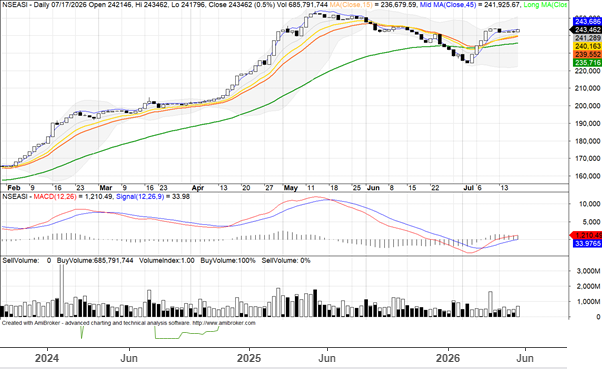
Monday trading opened on a negative note, thereby extending the previous session red position, as sustained profit-taking in banking, industrial and other blue-chip stocks dragged the benchmark index lower. The NGX All-Share Index (ASI) declined by 0.84% to 241,749.11 points, erasing ₦1.32 trillion from investors’ wealth and reducing the year-to-date return to 55.35%. Major laggards included PZ, BUACEMENT, CADBURY, NASCON, FIRSTHOLDCO, ZENITHBANK and GTCO. Market breadth remained weak at 19 gainers against 47 losers, while NIDF and FTGINSURE closed above their 52-week highs. Trading activity strengthened by 18.66% to 523.54 million shares worth ₦22.28 billion in 59,945 deals, with FCMB leading volume and SEPLAT recording the highest traded value.
The market rebounded on Tuesday, snapping a two-day losing streak as buying interest in banking, insurance and other blue-chip stocks lifted sentiment. The ASI gained 0.46% to close at 242,870.44 points, while the year-to-date return improved to 56.07%. Investors gained ₦719.56 billion in market value. FIRSTHOLDCO, TRANSCOHOT and STANBIC topped the gainers’ chart, while market breadth turned positive at 27 gainers against 22 losers. Trading volume rose 21.25% to 634.78 million shares valued at ₦53.34 billion in 42,494 deals, with FIRSTHOLDCO accounting for the largest share of market activity.
At midweek, profit booking returned, reversing part of the previous day’s gains. The NGX All-Share Index declined 0.21% to 242,366.75 points, while the year-to-date return eased to 55.75%. Despite the decline, market capitalisation increased by about ₦390.32 billion. Market breadth stayed positive at 34 gainers against 18 losers, led by FIRSTHOLDCO on the gainers’ list, while TRANSEXPR recorded the biggest loss. Trading slowed to 476.34 million shares worth ₦29.63 billion in 40,992 deals, with FIRSTHOLDCO leading trading volume.
The market extended its decline on Thursday, July 16, 2026, as continued profit-taking pushed the benchmark index lower. The ASI slipped 0.09% to 242,145.61 points, reducing the year-to-date return to 55.61%. Investors lost about ₦32.16 billion, although the listing of 13.81 billion new SterlingNG shares moderated the impact. Market breadth remained positive at 27 gainers to 23 losers, with FIRSTHOLDCO emerging as the top gainer and EUNISELL leading the losers. Trading improved to 498.45 million shares valued at ₦34.87 billion in 39,484 deals, with JAPAULGOLD leading volume and SEPLAT posting the highest traded value.
On the last trading session of the week, NGX rebounded, as renewed buying interest in banking stocks lifted the benchmark index. The NGX All-Share Index advanced 0.54% to 243,462.13 points, while the year-to-date return improved to 56.45%. Investors gained about ₦849.28 billion in market value. Market breadth closed positive at 34 gainers against 23 losers, with FIRSTHOLDCO leading the gainers and REDSTAREX topping the losers’ chart. Trading activity increased to 685.87 million shares worth ₦42.68 billion in 44,134 deals, as FIRSTHOLDCO remained the most actively traded stock.
First Holdco Plc
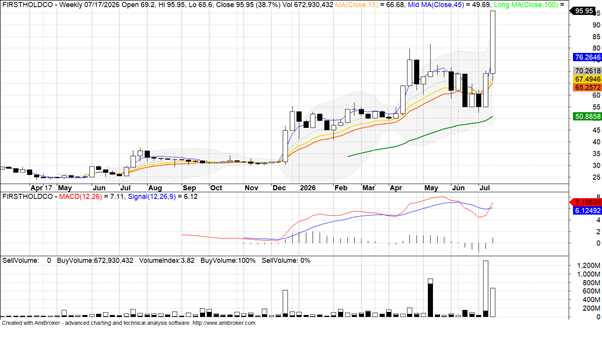
Among the gainers, First HoldCo Plc surged by ₦26.75 or 38.66% to close at ₦95.95 from ₦69.20. Thomas Wyatt Nigeria Plc gained ₦0.66 or 27.16% to ₦3.09 from ₦2.43, while Fidelity Bank Plc advanced by ₦2.85 or 15.00% to ₦21.85 from ₦19.00. Learn Africa Plc appreciated by ₦1.30 or 14.44% to ₦10.30 from ₦9.00, and United Bank for Africa Plc added ₦4.50 or 10.98% to close at ₦45.50 from ₦41.00.
BUA Cement Plc
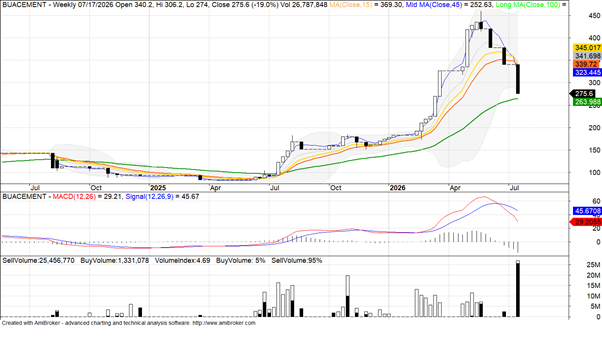
On the losers’ chart, BUA Cement Plc recorded the biggest decline, shedding ₦64.60 or 18.99% to close at ₦275.60 from ₦340.20. Red Star Express Plc lost ₦4.55 or 18.53% to ₦20.00 from ₦24.55, while International Energy Insurance Plc fell by ₦0.84 or 15.27% to ₦4.66 from ₦5.50. C & I Leasing Plc dropped ₦0.85 or 13.28% to ₦5.55 from ₦6.40, and PZ Cussons Nigeria Plc declined by ₦9.05 or 10.06% to close at ₦80.95 from ₦90.00.
Comparative Analysis: Week Ended July 10 vs. Week Ended July 17, 2026
The Nigerian stock market slowed in the week ended July 17, 2026, after the strong rally recorded a week earlier. The NGX All-Share Index (ASI) declined 0.14% to 243,462.13 points, compared with a 6.35% gain to 243,798.76 points in the previous week, while the year-to-date return eased slightly to 56.45% from 56.67%. Despite the decline in the benchmark index, market capitalisation increased 0.39% to ₦157.057 trillion from ₦156.445 trillion, supported by the listing of 13.81 billion additional SterlingNG shares.
Market activity also moderated, with investors trading 2.819 billion shares worth ₦182.499 billion in 226,729 deals, down from 3.648 billion shares valued at ₦220.568 billion in 251,861 deals recorded the previous week. The Financial Services sector remained the most active, accounting for 2.006 billion shares worth ₦99.697 billion or 71.17% of total volume and 54.63% of market value, compared with 2.899 billion shares valued at ₦147.360 billion, representing 79.48% of traded volume and 66.81% of transaction value a week earlier.
Trading concentration also eased, as First HoldCo, FCMB Group and Access Holdings accounted for 939.402 million shares worth ₦57.673 billion (33.33% of volume and 31.60% of value), compared with First HoldCo, Zenith Bank and Fidelity Bank, which traded 1.745 billion shares valued at ₦121.828 billion, representing 47.85% of total volume and 55.23% of total value in the previous week.
Overall, the market shifted from strong buying momentum to profit-taking and consolidation, with investors becoming more selective after the previous week’s impressive rally. Forty-four (44) equities appreciated in price during the week, lower than sixty (60) equities in the previous week. Thirty-five (35) equities depreciated in price, higher than twenty-eight (28) equities in the previous week, while sixty-seven (67) equities remained unchanged, higher than fifty-eight (58) recorded in the previous week.
Technical Analysis View
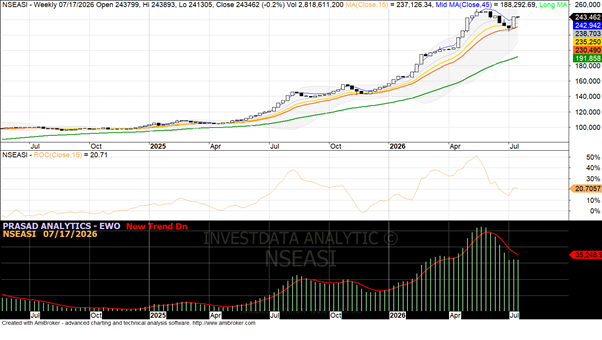
The Nigerian Exchange closed the week on a mixed note as the benchmark NGX All-Share Index (ASI) slipped 0.14% week-on-week to 243,462.13 points, despite a strong rebound on Friday. The market spent most of the week under pressure from profit-taking in banking, industrial and consumer goods stocks before bargain hunters returned to large-cap banking names in the final session.
Although the weekly decline was marginal, the index remained comfortably above the 243,000-point support zone, indicating that the broader uptrend is still intact. The positive market breadth recorded in most trading sessions and the sustained interest in banking stocks suggest that buying momentum has not completely faded.
The week’s pullback also appears to be a healthy correction rather than a trend reversal, as investors rotated funds into fundamentally strong stocks while locking in profits on recent gainers. With the market maintaining a 56.45% year-to-date return and market capitalisation rising to ₦157.057 trillion, sentiment remains broadly positive despite intermittent volatility.
Market Outlook
The market is expected to trade with a mixed but positive bias in the coming week as investors continue to balance profit-taking with bargain hunting. Attention is likely to remain on banking, insurance and other fundamentally strong stocks, especially those with attractive earnings prospects and dividend potential.
Investor sentiment will also be influenced by second-quarter earnings expectations, corporate actions and macroeconomic developments. Sustained buying above the 243,000-point level could strengthen momentum and pave the way for another attempt at new record highs. However, intermittent profit-taking is expected after the market’s strong year-to-date performance.
Overall, the medium-term outlook remains bullish, supported by strong liquidity, improving corporate fundamentals and continued institutional demand, although short-term price swings are likely as investors reposition ahead of the earnings season.
Trending in the Economy: Nigeria’s external reserves rose by $1.9 billion to $51.5 billion in June 2026, driven by stronger foreign inflows, higher oil export earnings, improved crude production and a more stable foreign exchange market, according to CBN data. The increase has strengthened support for the naira, with further gains expected if oil earnings remain firm and foreign investor inflows continue.
Meanwhile, headline inflation eased marginally to 15.91% in June from 15.93% in May, while food inflation settled at 17.52%. The figures reinforce expectations that the CBN will likely leave interest rates unchanged at next week’s MPC meeting. Inflation is expected to slow further in the second half of the year, though seasonal supply challenges could keep food prices under pressure.
Global Market and Oil: Global financial markets ended Friday on a weak note as investors continued to pull back from technology and artificial intelligence (AI)-related stocks, while escalating geopolitical tensions in the Middle East pushed crude oil prices to their highest level in more than a month and increased demand for safe-haven assets. The latest wave of selling was driven by renewed concerns over the sustainability of AI spending and intensifying competition after Chinese AI startup Moonshot unveiled Kimi K3, which it described as the world’s largest open-weight AI model, with performance approaching Anthropic’s frontier AI system. The announcement added to existing worries that lofty valuations in the AI sector may be difficult to justify, prompting another round of profit-taking across global technology stocks.
The Philadelphia Semiconductor Index (SOX) fell 1.6% on Friday, marking its third consecutive daily decline. The index now stands 20% below its record closing high reached on June 22, after falling as much as 23.5% below that peak during the session, highlighting the sharp correction in chipmakers that have led the AI rally over the past year.
Despite recovering from intraday lows as some investors covered short positions, Wall Street closed firmly in negative territory. The Dow Jones Industrial Average dropped 406.55 points, or 0.77%, to 52,146.42. The S&P 500 shed 76.08 points, or 1.01%, to 7,457.69, while the technology-heavy Nasdaq Composite lost 361.70 points, or 1.40%, to close at 25,520.24. The losses also dragged major U.S. indexes lower for the week. The S&P 500 declined 1.55%, the Nasdaq Composite fell 2.9%, reflecting the sharp sell-off in technology shares, while the Dow Jones slipped 0.93%.
Global equities followed the same downward trend. MSCI’s All-Country World Index dropped 13.17 points, or 1.17%, to 1,108.52, reflecting broad-based weakness across developed and emerging markets. European stocks also ended lower, with the STOXX Europe 600 Index slipping 0.34%. The downturn was more pronounced in Asia, where MSCI’s Asia-Pacific Index excluding Japan fell 2.7%, while Japan’s Nikkei 225 plunged 4%, leaving it 12% below its recent peak as investors reduced exposure to technology and export-oriented stocks.
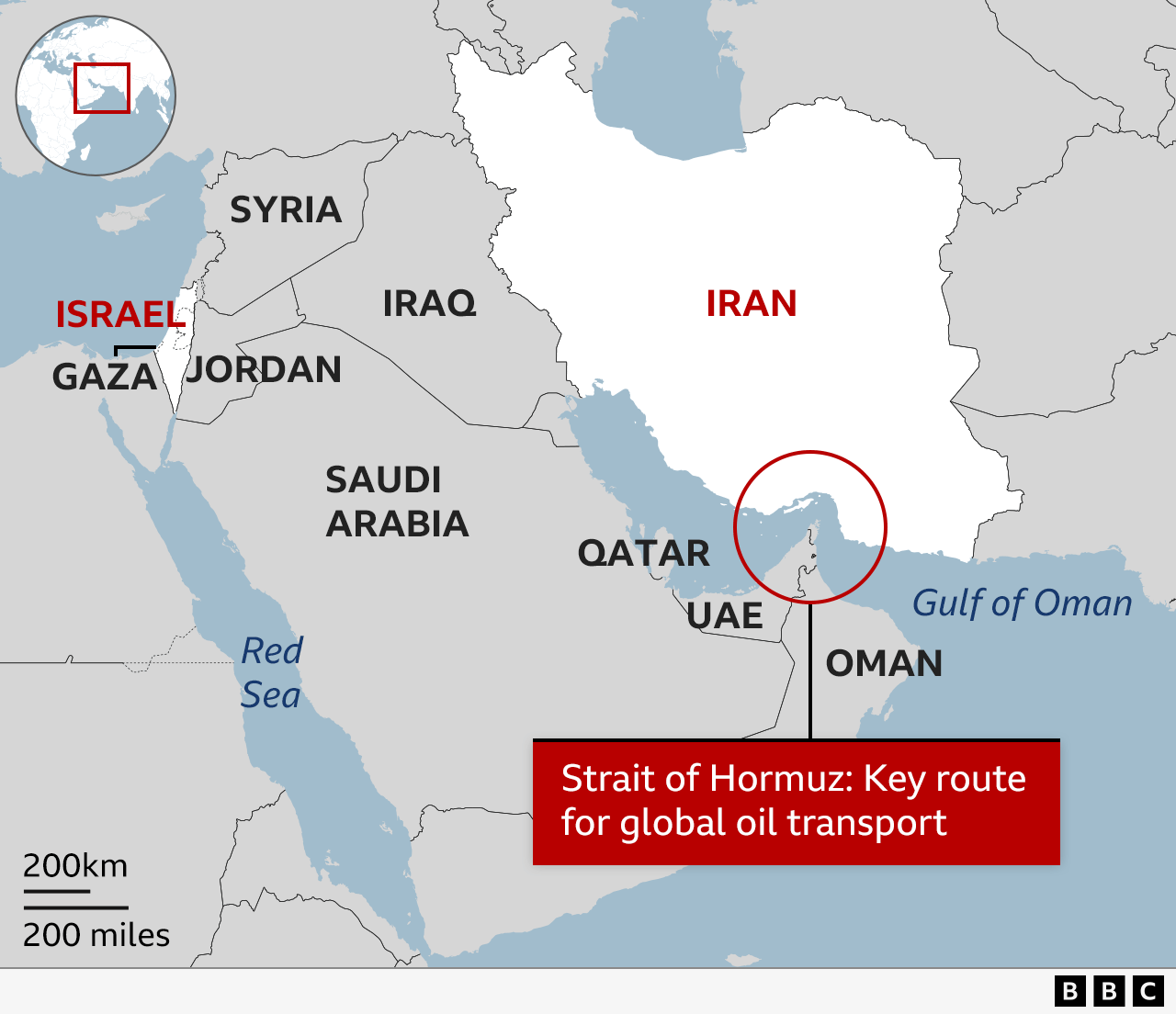
Investor sentiment was further shaken by the worsening conflict in the Middle East. Oil prices surged after the United States and Iran expanded military attacks to include critical infrastructure. Reports indicated that U.S. forces struck bridges in Iran, while Tehran responded by targeting a power generation and desalination facility in Kuwait. Fresh disruptions were also reported around the Strait of Hormuz, a key global oil transit route, where U.S. Marines boarded a tanker and another vessel was reportedly struck by a projectile, raising concerns over potential supply disruptions.
The geopolitical escalation lifted crude prices sharply. U.S. West Texas Intermediate (WTI) crude gained $3.54, or 4.48%, to settle at $82.49 per barrel, while Brent crude rose $3.87, or 4.59%, to close at $88.10 per barrel, both reaching their highest levels in over one month. The rally in crude oil made energy stocks the only U.S. sector to finish higher on Friday, while investors rotated into more defensive assets amid heightened uncertainty. Market participants also increased allocations to government bonds and lower-risk equity sectors, including utilities, which outperformed high-growth industries during the session.
In the bond market, U.S. Treasury yields edged lower as investors assessed fresh economic data and largely ruled out the possibility of another Federal Reserve rate hike at its policy meeting later this month. The yield on the benchmark 10-year U.S. Treasury declined 1.55 basis points to 4.554%, down from 4.569% on Thursday, while the 30-year Treasury yield fell 2.39 basis points to 5.0731%.
The foreign exchange market remained relatively stable. The U.S. Dollar Index, which tracks the greenback against a basket of major currencies, rose 0.05% to 100.76, although it still ended the week lower after softer U.S. inflation data prompted traders to reduce expectations for further Federal Reserve tightening. The euro eased 0.03% to $1.1437, while the U.S. dollar strengthened 0.03% against the Japanese yen to 162.43.
Gold prices also moved higher as investors sought safe-haven assets amid rising geopolitical risks. Spot gold climbed 0.99% to $4,009.19 per ounce, while U.S. gold futures advanced 0.79% to $4,017.20 per ounce. However, despite Friday’s rebound, the precious metal still recorded its largest weekly decline in six weeks, as higher energy prices fueled inflation concerns and reinforced expectations that U.S. interest rates could remain elevated for longer.
Overall, markets ended the week under pressure as investors weighed growing geopolitical uncertainty against a reassessment of AI-driven valuations. With technology stocks undergoing a significant correction, oil prices climbing on supply concerns, and investors shifting toward defensive assets, market volatility is expected to remain elevated in the coming sessions.