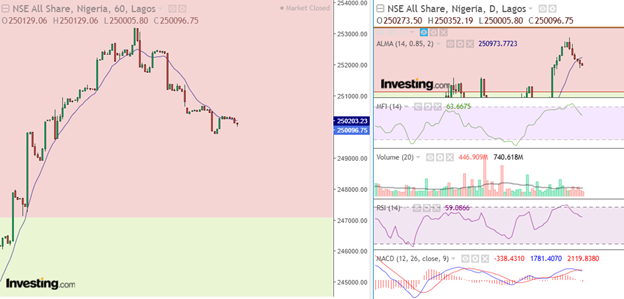

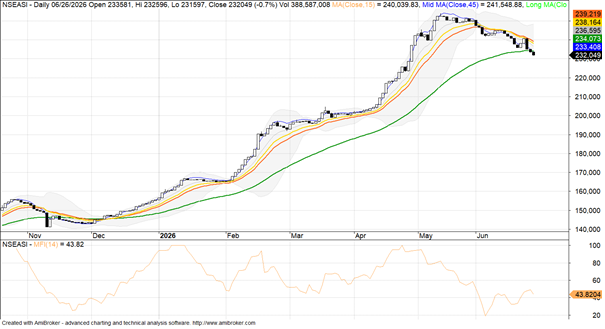
The last full trading week of June witnessed a mixed trend of two sessions of up market and three trading days of negative outing which extended two weeks of back-to-back bear run on profit booking, sector rotation and portfolio repositioning. The development is coming amid fears of sell-offs by market participants to buy into the Dangote Petroleum Refinery private placement that closed in the week under review. The ensuing market correction created new entering opportunities for discerning investors and smart traders.
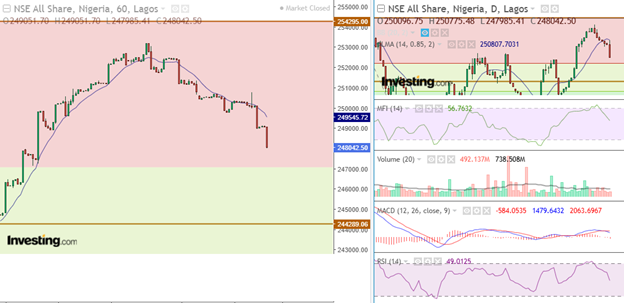
The chart below reveals the daily index action.
NGXASI Daily Action
Overall, trading activity slowed for the week, with investors exchanging 2.324 billion shares worth ₦134.49 billion in 249,328 deals, compared with 3.075 billion shares valued at ₦254.61 billion in 287,157 deals in the previous week.
The Financial Services sector remained the market’s busiest, accounting for 1.523 billion shares worth ₦47.54 billion, followed by the ICT sector with 198.821 million shares valued at ₦32.62 billion and the Consumer Goods sector with 151.635 million shares worth ₦10.93 billion. Access Holdings, Fidelity Bank and Chams Holding accounted for 485.749 million shares valued at ₦7.66 billion, representing 20.90% of total volume and 5.69% of total value traded.
The composite index NGX All-Share declined 1.65% to close at 232,049.02 points, while market capitalisation fell 1.60% to ₦148.91 trillion. Most sector indices ended in the red with the exception of NGX Consumer Goods (+2.40%), NGX Banking (+3.51%), NGX AFR Bank Value (+3.28%), NGX AFR Dividend Yield (+9.93%) and NGX MERI Value (+0.56%) indices posted gains.
Week-to-date, NGX 30 is down by 1.67%, the Banking Index has increased by 3.51%, the Pension Index decreased by 0.52%, the Insurance Index declined by 4.39%, the Consumer Goods Index decreased by 1.53%. However, the Oil and Gas Index recorded a negative return of 9.86%. Year-to-date, the All-Share Index has gained 49.12%, NGX 30 is up by 48.29%, the Banking Index has increased by 40.53%, the Pension Index increased by 58.74%, the Insurance Index declined by 6.07%, the Consumer Goods Index increase by 16.33%. However, the Oil and Gas Index recorded a positive return of 90.31%.
Trading for the week opened on a strong note, snapping a six-day losing streak as renewed demand for banking and other blue-chip stocks lifted sentiments.
On Monday, the NGX All-Share Index advanced by 0.97% to 238,219.19 points, just as ₦1.52 trillion added to market value, raising year-to-date return to 53.08%. Investors traded 489.05 million shares worth ₦36.71 billion in 63,747 deals, with FIDELITYBK leading volume and MTNN recording the highest value.
The rally continued on Tuesday as sustained buying pushed the NGX All-Share Index up by 1.06% to 240,743.19 points. Investors gained another ₦1.64 trillion, lifting the year-to-date return to 54.71%. Trading closed with 564.91 million shares valued at ₦39.35 billion exchanged in 49,230 deals, while FIDELITYBK remained the volume leader and MTNN topped value traded.
At midweek, the positive recovery trend reversed sharply on profit-taking that wiped out the previous gains, with the benchmark index declining 2.35% to 235,074.54 points, while in the process chopping ₦3.64 trillion from market capitalization. This reduced year-to-date return to 51.06%, while a total of 488.08 million shares worth ₦20.93 billion changed hands in 46,239 deals. FIRSTHOLDCO led trading volume, while GEREGU recorded the highest traded value.
The selling pressure persisted on Thursday, with the NGX All-Share Index falling 0.64% to 233,580.83 points. Market value dropped by ₦958.50 billion, while the year-to-date return eased to 50.10%. Investors traded 393.65 million shares valued at ₦19.21 billion in 45,813 deals. ACCESSCORP led volume and WAPCO dominated value traded.
The market closed the week on a weaker note on Friday when the benchmark index shed another 0.66% to 232,049.02 points. Investors lost ₦982.96 billion, bringing the year-to-date return down to 49.12%. Trading activity stood at 388.69 million shares worth ₦18.43 billion in 44,631 deals, with ACCESSCORP leading volume and ARADEL posting the highest traded value.
McNichols Plc
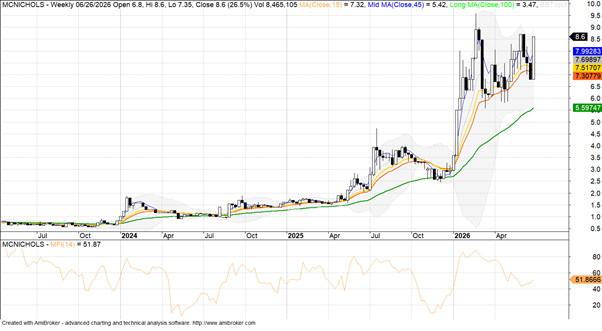
Top Gainers: The price of McNichols Plc advanced from ₦6.80 to ₦8.60, representing a ₦1.80 or 26.47% rise. International Energy Insurance Plc followed, rising from ₦5.06 to ₦5.79, up ₦0.73 or 14.43%. Guaranty Trust Holding Company Plc appreciated from ₦115.55 to ₦127.90, adding ₦12.35 or 10.69%. First HoldCo Plc climbed from ₦55.00 to ₦60.50, gaining ₦5.50 or 10.00%, while Airtel Africa Plc increased from ₦3,962.60 to ₦4,358.80, up ₦396.20 or 10.00%.
Trans-Nationwide Express Plc
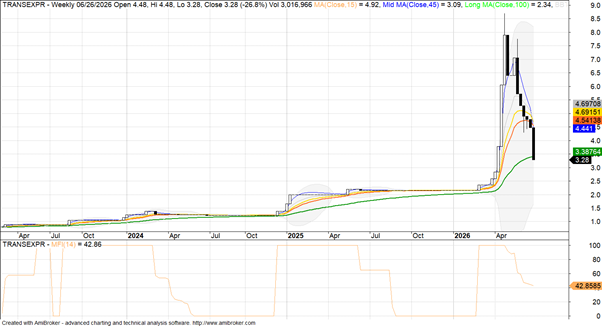
Top Losers: Trans-Nationwide Express Plc’s share price fell from ₦4.48 to ₦3.28, shedding ₦1.20 or 26.79%. Deap Capital Management & Trust Plc declined from ₦4.89 to ₦3.75 per share, losing ₦1.14 or 23.31%. Abbey Mortgage Bank Plc crashed from ₦10.10 to ₦8.05, down ₦2.05 or 20.30%. Aradel Holdings Plc slipped from ₦1,750.00 to ₦1,417.50, losing ₦332.50 or 19.00%, while Regency Assurance Plc eased from ₦0.97 to ₦0.79, down ₦0.18 or 18.56%.
Comparative Analysis: Last Week vs This Week
The Nigerian equities market remained under pressure for a second consecutive week, although the pace of decline slowed. The NGX All-Share Index (ASI) fell 1.65% to 232,049.02 points last week, compared with a steeper 3.59% decline to 235,941.27 points in the previous week. Similarly, market capitalisation declined by 1.60% to ₦148.91 trillion, down from ₦151.33 trillion.
Trading activity weakened significantly. Total volume traded fell to 2.324 billion shares from 3.075 billion shares, while transaction value dropped to ₦134.49 billion from ₦254.61 billion. The number of deals also declined to 249,328 from 287,157, indicating reduced market participation.
The Financial Services sector remained the most active, accounting for 1.523 billion shares worth ₦47.54 billion this week, compared with 2.074 billion shares valued at ₦64.49 billion last week.
The week’s most active stocks were Access Holdings, Fidelity Bank and Chams Holding, which traded 485.749 million shares worth ₦7.66 billion, representing 20.90% of total volume and 5.69% of total value, compared with Access Holdings, Sterling Financial Holdings and Jaiz Bank, which traded 819.234 million shares worth ₦12.247 billion, accounting for 26.64% of volume and 4.81% of value last week.
Sector performance improved despite the market decline. Unlike last week, when all sector indices closed lower except the NGX Sovereign Bond Index, this week the NGX Consumer Goods Index (+2.40%), NGX Banking Index (+3.51%), NGX AFR Bank Value Index (+3.28%), NGX AFR Dividend Yield Index (+9.93%), and NGX MERI Value Index (+0.56%) ended higher.
Overall, while the market remained bearish, the slower decline in the benchmark index, improved sector performance, and reduced selling pressure suggest investors are becoming more selective, with renewed interest in fundamentally strong and dividend-paying stocks.
Twenty-two (22) equities appreciated in price during the week higher than eleven (11) equities in the previous week. Fifty-seven (57) equities depreciated in price, lower than seventy-eight (78) equities in the previous week, while sixty-seven (67) equities remained unchanged, higher than fifty-seven (57) recorded in the previous week.
Technical Analysis View
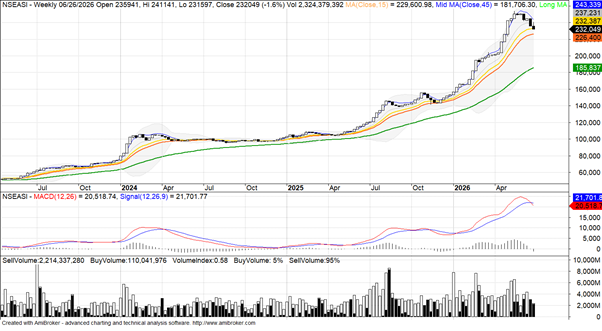
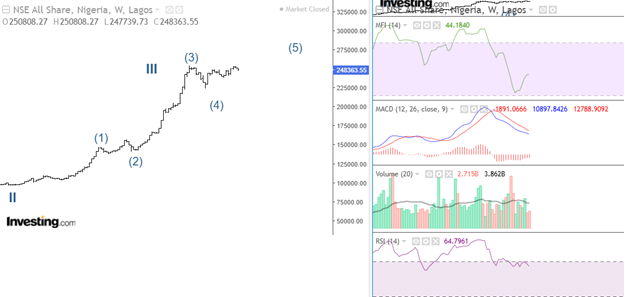
The Nigerian market closed the week on a bearish note after three consecutive sessions of profit-taking erased the gains recorded at the start of the week. Despite the decline, the benchmark index continues to trade above key medium- and long-term support levels, indicating that the broader uptrend remains intact.
Market breadth and declining trading volume reflect cautious investor sentiment, while the banking sector continued to attract buying interest, helping limit the overall downside. The pullback appears to be a healthy correction following the market’s recent rally, as investors rebalance portfolios and lock in profits.
Market Outlook
Looking ahead, analysts see corporate earnings expectations driving market direction in weeks ahead, in addition to dividend positioning, and institutional demand. Bargain hunting is likely to emerge in fundamentally strong stocks if prices remain attractive, although intermittent profit-taking could keep the market volatile in the near term.
Trending in the Economy: Nigeria’s manufacturing sector recorded a sharp decline in Company Income Tax (CIT) payments, which fell 68.3% year-on-year to N74.48 billion in Q1 2026, according to the National Bureau of Statistics (NBS). The drop reflects mounting pressure from rising production costs, weak consumer demand, and persistent foreign exchange challenges, pointing to softer profitability in the sector despite ongoing tax reform efforts.
Nigeria’s trade with other African countries climbed 21% to $9.02 billion in 2025, up from $7.47 billion in 2024. The growth was driven by expanding opportunities under the African Continental Free Trade Area (AfCFTA), with crude oil remaining the country’s leading export alongside increased shipments of manufactured goods and agricultural products.
Global Market and Oil: Global equity markets ended lower on Friday as investors continued to lock in profits from high-flying technology and semiconductor stocks after months of strong gains. The cautious mood was reinforced by a sharp decline in crude oil prices as supply concerns eased, with more oil tankers resuming transit through the Strait of Hormuz.
On Wall Street, trading remained volatile throughout the session, with losses in technology, industrial and energy stocks outweighing gains in healthcare and real estate. The Dow Jones Industrial Average slipped 0.09%, the S&P 500 eased 0.05%, while the Nasdaq Composite fell 0.24%.
The week’s performance reflected the shift in investor sentiment. Both the S&P 500 and Nasdaq Composite posted weekly losses, while the Dow Jones remained on course for a modest weekly gain, highlighting a rotation away from growth and technology stocks into more defensive sectors. Semiconductor stocks were among the worst performers during the week. The Philadelphia Semiconductor Index (SOX) dropped 5.3% on Friday alone, extending its weekly decline to 7.7%, marking its biggest weekly loss since March 2025. The selloff followed months of exceptional gains driven by optimism surrounding artificial intelligence, prompting investors to take profits amid concerns over stretched valuations.
Market analysts described the weakness as a healthy correction rather than the start of a prolonged downturn. According to strategists, the recent rally since March had left technology stocks vulnerable to profit-taking, while investors continued to rotate into sectors offering more attractive valuations. Despite the pullback, confidence remains supported by resilient corporate earnings and expectations that investors will continue buying market dips.
Concerns over inflation also resurfaced after Apple announced price increases on some of its products, raising fears that the enormous spending on artificial intelligence infrastructure and the limited supply of critical technology components could keep price pressures elevated for longer.
The weakness extended beyond the United States. European shares came under pressure, with the STOXX Europe 600 Index declining nearly 0.7%, while the region’s technology sector dropped 1.17%.
Asian markets experienced even steeper losses. MSCI’s Asia-Pacific Index excluding Japan fell nearly 3%, reflecting widespread risk aversion across the region. South Korea’s KOSPI suffered one of the sharpest declines, falling as much as 5.8% during trading as technology stocks led the selloff.
Globally, the MSCI World Index slipped 0.53% on Friday and finished the week down approximately 2%, reflecting broad-based weakness across developed and emerging markets.
Oil Prices Tumble
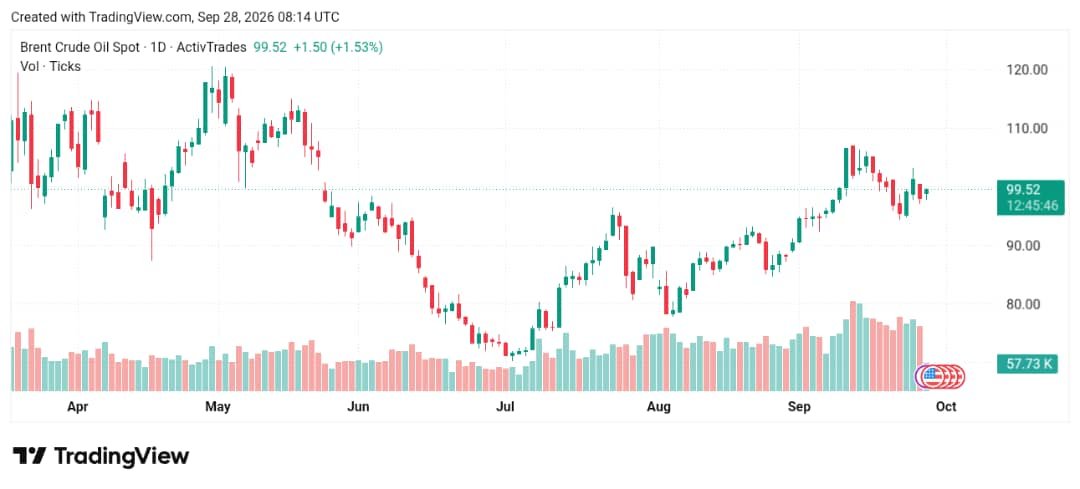
Crude oil prices recorded one of their biggest daily declines in weeks as concerns over supply disruptions eased. The market reacted positively to the increasing number of oil tankers successfully passing through the Strait of Hormuz, reducing fears of significant supply shortages despite ongoing geopolitical tensions in the Middle East.
Shipping data also showed that Saudi Aramco resumed crude loading operations at its Ras Tanura export terminal after a suspension that lasted nearly four months, further easing supply concerns. As a result, Brent crude futures fell 4.34% to settle at $72 per barrel, reversing part of the sharp gains recorded earlier in the month.
Currency Market
In the foreign exchange market, the Japanese yen remained under intense pressure, hovering at 161.76 per U.S. dollar, close to its weakest level in 40 years. The currency remained well above the psychologically important 160 mark, increasing speculation that Japanese authorities could intervene to support the yen. The euro gained 0.14% against the dollar to trade at $1.1385, although it still recorded its second consecutive weekly loss against the greenback.
Meanwhile, the U.S. Dollar Index, which measures the dollar against a basket of major currencies, slipped 0.16% to 101.35 on Friday but still posted its second straight weekly gain, supported by expectations that U.S. interest rates could remain elevated for longer.
Bond Market
Demand for government bonds increased modestly, pushing Treasury yields lower. The benchmark U.S. 10-year Treasury yield declined 1.16 basis points to 4.38%, while the 2-year Treasury yield, which is more sensitive to expectations for Federal Reserve policy, fell 2.48 basis points to 4.096%. The decline in yields reflected investors’ preference for safer assets amid weakness in global equity markets and ongoing uncertainty over the interest rate outlook.
Gold Advances
Gold prices benefited from the cautious market mood, attracting fresh safe-haven demand. Spot gold climbed 1.06% to $4,068.72 per ounce, supported by falling Treasury yields and a slightly weaker U.S. dollar.
Overall, global financial markets ended the week on a cautious note as investors reduced exposure to technology stocks after their strong rally. While analysts continue to view the recent decline as a period of consolidation rather than a major trend reversal, market participants remain focused on inflation risks, interest rate expectations, corporate earnings and geopolitical developments, all of which are expected to shape investor sentiment in the coming weeks.