
The U.S Federal Reserve is going to keep interest rates unchanged today—and in doing so, will confirm how little control it currently has over the forces shaping the global economy, affirms Nigel Green, CEO of deVere Group, one of the world’s largest independent financial advisory organisations.
The analysis from Green comes ahead of the central bank’s latest policy decision, with markets assigning a probability above 90% to a hold, even as inflation remains above target and external pressures intensify.
He expects that: “The Federal Reserve is expected to hold, but the reason matters. This isn’t a confident pause, it’s a constrained one.
“Oil above $110, geopolitical risk building, and inflation still running hot mean policymakers don’t have the freedom markets would like to believe.”
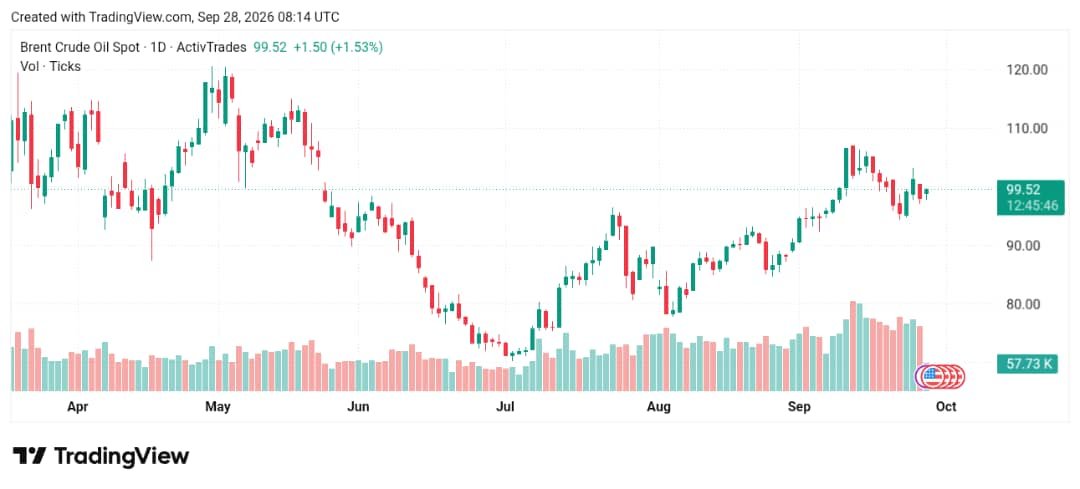
Brent crude is trading around $111 a barrel, after briefly pushing toward $120. Energy prices at these levels are feeding directly into inflation expectations, complicating any path toward rate cuts.
At the same time, global oil demand remains near record levels at more than 102 million barrels per day. Supply risks tied to tensions involving Iran and potential disruption through the Strait of Hormuz, which handles roughly 20% of global oil flows, are keeping markets tightly balanced.
Nigel Green continues: “Energy is driving the inflation story again. Central banks can’t drill for oil and they can’t reopen shipping lanes. As such, one of the biggest inputs into inflation is outside their control, and that’s a serious problem.”
The Federal Reserve’s benchmark rate, currently in the 3.50%–3.75% range, remains firmly restrictive. Borrowing costs across the economy are still elevated, with US 30-year mortgage rates near 6.5% and corporate financing conditions significantly tighter than in the pre-tightening cycle.
“Keeping rates at these levels continues to squeeze growth,” notes the deVere CEO.
“Businesses are delaying investment, consumers are feeling the pressure, and credit conditions remain tight. Holding doesn’t ease that, it prolongs it.”
Markets are expected to take the decision in stride, with the focus shifting rapidly to forward guidance. Current pricing still suggests the possibility of cuts later in 2026, but that outlook is increasingly sensitive to inflation dynamics, particularly energy.
Nigel Green adds: “If oil stays above $100, the timeline for rate cuts stretches. If it moves back toward $120, the conversation changes completely.
“Markets are still pricing in easing, but that assumption is becoming harder to justify.”
Currency markets reflect this tension. The US dollar remains supported by yield differentials and relative economic resilience, while equity markets face a more uneven outlook as higher input costs and sustained borrowing pressures weigh on earnings expectations.
“Investors looking for a clear signal are unlikely to get one.
“The Fed is in a holding pattern, but the risks around it are still moving and, in some cases, accelerating.”
The deVere chief executive concludes: “Of course, the US central bank remains important, but it’s no longer in full control of the narrative.
“Oil, geopolitics, and supply constraints are driving inflation from the outside.
“This means more volatility, more uncertainty, and a more complicated path for markets in the months ahead.”