
It was a mixed trading week on the Nigerian Exchange, as profit-taking and market correction dominated activities, creating buying opportunities for discerning market players that took advantage of the pullbacks to position in value stocks. This led to Friday’s rebound, while at the same time signaling recovery ahead of the half-year earnings reporting season. These bargain hunting need to be confirmed in the new week with improved trading volume and strong market internals. The NGX recorded three trading sessions of down market and two days of positive outing as revealed by the index action below.
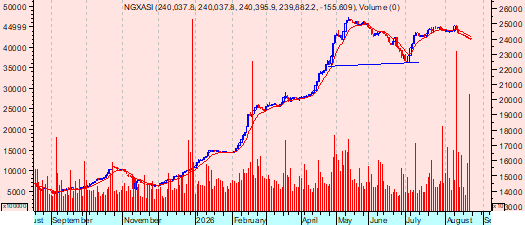
Despite Friday’s impressive rebound and stronger market turnover, the NGX All-Share Index closed the week 1.21% lower at 229,240.34 points, heading to breakout the T line after it had acted as a resistance since June 2, 2026 to reveal the weak market and downtrend while market capitalisation settled at ₦147.103 trillion. Most sectoral indices finished the week in negative territory, with only the NGX Main Board Index posting a gain of 2.27%.
Week-to-date, the All-Share Index has lost 1.21%%, NGX 30 is down by 1.09%, the Banking Index has increased by 3.72%, the Pension Index decreased by 2.10, the Insurance Index declined by 2.52%, the Consumer Goods Index decreased by 1.60%. However, the Oil and Gas Index recorded a negative return of 4.34%. Year-to-date, the All-Share Index has gained 47.31%, NGX 30 is up by 46.67%, the Banking Index has increased by 35.31%, the Pension Index increased by 55.41%, the Insurance Index declined by 8.43%, the Consumer Goods Index increase by 14.47%. However, the Oil and Gas Index recorded a positive return of 82.04%.
During the week, investors exchanged a total of 3.821 billion shares valued at ₦154.393 billion in 258,567 deals, compared with 2.324 billion shares worth ₦134.486 billion traded in 249,328 deals in the previous week. The Financial Services sector maintained its dominance with 2.330 billion shares valued at ₦54.606 billion traded in 108,978 deals, representing 60.99% of total market volume and 35.37% of total value. The Services sector followed with 509.473 million shares worth ₦16.353 billion in 16,527 deals, while the Consumer Goods sector recorded 216.344 million shares valued at ₦8.057 billion across 25,963 deals.
Top volume traded stocks were Sterling Financial Holdings Plc, Access Holdings Plc and Ikeja Hotel Plc. These three accounted for 1.405 billion shares worth ₦28.370 billion in 12,898 deals. The trio contributed 36.78% of total traded volume and 18.37% of the total market value.
NGXASI Daily Action
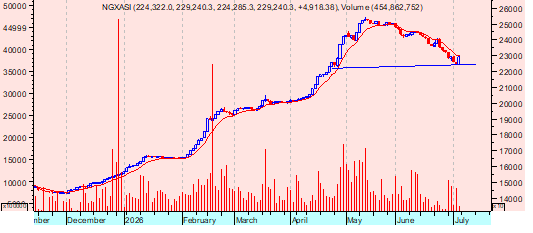
On Monday, trading opened for the week in the red as sustained profit-taking dragged the NGX All-Share Index (ASI) down by 1.57% to 228,401.92 points, just as market capitalisation declined by ₦2.34 trillion, while the year-to-date return moderated to 46.78%. Market breadth was negative at 47 losers against 13 gainers as MTNN, UNILEVER, CADBURY and WEMABANK led the losers’ chart. Trading activity remained robust with 1.06 billion shares valued at ₦44.57 billion exchanged in 62,482 deals, led by Ikeja Hotel in both volume and value traded.
Buying interest returned on Tuesday, lifting the benchmark index by 0.45% to 229,419.18 points. The recovery added ₦652.77 billion to investors’ wealth and pushed the year-to-date return to 47.43%. Despite the gain, market breadth remained weak with 33 losers against 19 gainers. A total of 966.62 million shares worth ₦39.95 billion changed hands in the session, with LINKASSURE recording the highest traded volume, while ARADEL emerged as the most traded stock by value.
At the midweek’s session, the market reversed lower, as fresh profit-taking pulled the NGX All-Share Index down by 1.63% to 225,690.07 points. Investors lost ₦2.39 trillion in market value, while the year-to-date return eased to 45.03%. Market breadth remained negative with 33 losers against 19 gainers. Trading volume stood at 488.07 million shares worth ₦13.93 billion, with STERLINGNG leading the volume chart and ZENITHBANK recording the highest value traded.
The bearish trend persisted on Thursday, when the benchmark index shed another 0.61% to close at 224,321.97 points. Investors’ wealth declined by ₦877.91 billion, while the year-to-date return weakened further to 44.15%. Market breadth closed at 36 losers against 12 gainers, led by declines in FCMB, FIRSTHOLDCO, OANDO, ZENITHBANK and WAPCO. Trading activity improved as 855.32 million shares worth ₦28.37 billion were traded, with STERLINGNG leading volume while ARADEL topped the value chart.
The market rebounded strongly on Friday, as renewed buying across banking, telecommunications, oil and gas and other blue-chip stocks lifted the NGX All-Share Index by 2.19% to 229,240.19 points. The rally added ₦3.16 trillion to investors’ wealth and raised the year-to-date return to 47.31%. Market sentiment improved significantly, with 39 gainers against 15 losers. Investors traded 454.86 million shares valued at ₦27.57 billion, while ZENITHBANK emerged as the most active stock in both volume and value traded.
Airtel Africa Plc
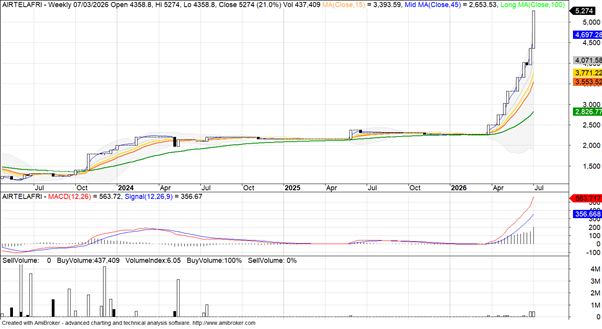
The above price action led the weekly gainers chart with 21.00%, rising from ₦4,358.80 to ₦5,274.00. Regency Assurance Plc appreciated by 20.25% from ₦0.79 to ₦0.95, while UPDC Plc climbed 12.31% to ₦3.65. DAAR Communications Plc advanced 7.84% to ₦1.65, and SUNU Assurances Nigeria Plc added 7.50% to close at ₦3.87.
IEI Plc
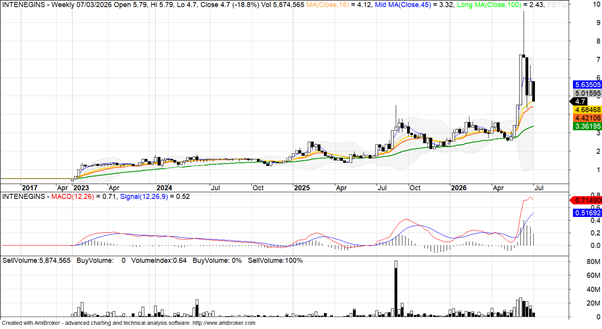
On the losers’ chart, International Energy Insurance Plc led the decliners, shedding 18.83% from ₦5.79 to ₦4.70. McNichols Plc dropped 18.60% to ₦7.00, University Press Plc fell 17.54% to ₦4.70, RT Briscoe Plc lost 13.98% to close at ₦10.15, while UPDC Real Estate Investment Trust declined 13.00% to ₦8.70per share.
Comparative Analysis: Last Week vs This Week
The Nigerian equities’ market remained under selling pressure for the third consecutive week, although the decline slowed on the back of strong bargain hunting on Friday, helping to reduce the level of losses.
The NGX All-Share Index (ASI) fell 1.21% this week to close at 229,240.34 points, compared with a steeper 1.65% decline last week when the index settled at 232,049.02 points. Similarly, market capitalisation declined to ₦147.103 trillion this week from ₦148.91 trillion last week.
Trading activities improved significantly this week as investors traded 3.821 billion shares worth ₦154.393 billion in 258,567 deals, compared with 2.324 billion shares valued at ₦134.486 billion in 249,328 deals last week. This represents an increase of 64.41% in volume, 14.80% in value and 3.70% in the number of deals, indicating stronger investor participation despite the market’s decline.
The Financial Services sector remained the most active, accounting for 2.330 billion shares worth ₦54.606 billion in 108,978 deals, representing 60.99% of total volume and 35.37% of gross value traded. Last week, the sector traded 1.523 billion shares valued at ₦47.54 billion. The Services sector ranked second this week with 509.473 million shares worth ₦16.353 billion, replacing the ICT sector, which held the second position last week with 198.821 million shares valued at ₦32.62 billion.
The most traded stocks also changed. This week, Sterling Financial Holdings Plc, Access Holdings Plc and Ikeja Hotel Plc accounted for 1.405 billion shares worth ₦28.370 billion, representing 36.78% of total market volume and 18.37% of total value traded. Last week, Access Holdings Plc, Fidelity Bank Plc and Chams Holding Plc traded a combined 485.749 million shares valued at ₦7.66 billion, contributing 20.90% of total volume and 5.69% of total value.
Overall, although the market closed lower for the third straight week, the sharp increase in trading volume and Friday’s broad-based recovery suggest that investors are gradually returning to fundamentally sound stocks as prices become more attractive.
Technical Analysis View
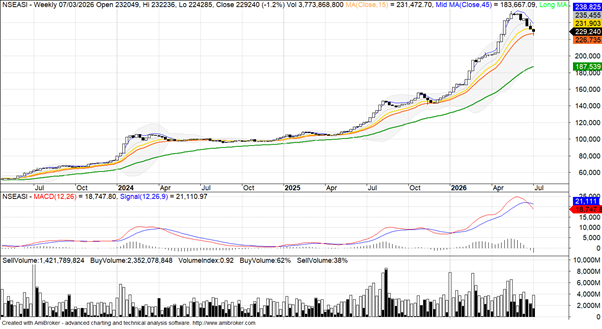
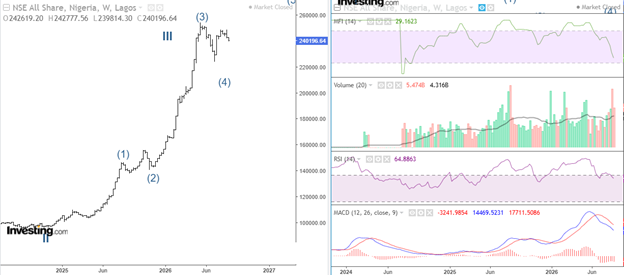
The NGX All-Share Index closed the week 1.21% lower at 229,240.34 points, forming a hummer candlestick pattern that signal reversal from a downtrend as bargain hunters gradually return to fundamentally sound counters following the recent pullbacks. Market sentiment improved sharply on Friday as breadth turned positive at 39 gainers against 15 losers, indicating a broader participation in the recovery. Trading activities also remained healthy throughout the week, with 3.821 billion shares valued at ₦154.393 billion exchanged, reflecting sustained investor interest despite heightened volatility.
Technically, the index remains above its key medium- and long-term moving averages, preserving the primary uptrend despite the recent correction. However, momentum indicators suggest the market is still searching for direction after easing from overbought levels.
The ability of the benchmark index to reclaim the 229,000-point mark is encouraging, but sustained buying will be required to break above the immediate resistance around 230,000–232,000 points. A successful breakout could pave the way for another test of the recent highs, while failure to sustain momentum may trigger another round of profit-taking toward the 225,000-point support zone.
Market Outlook
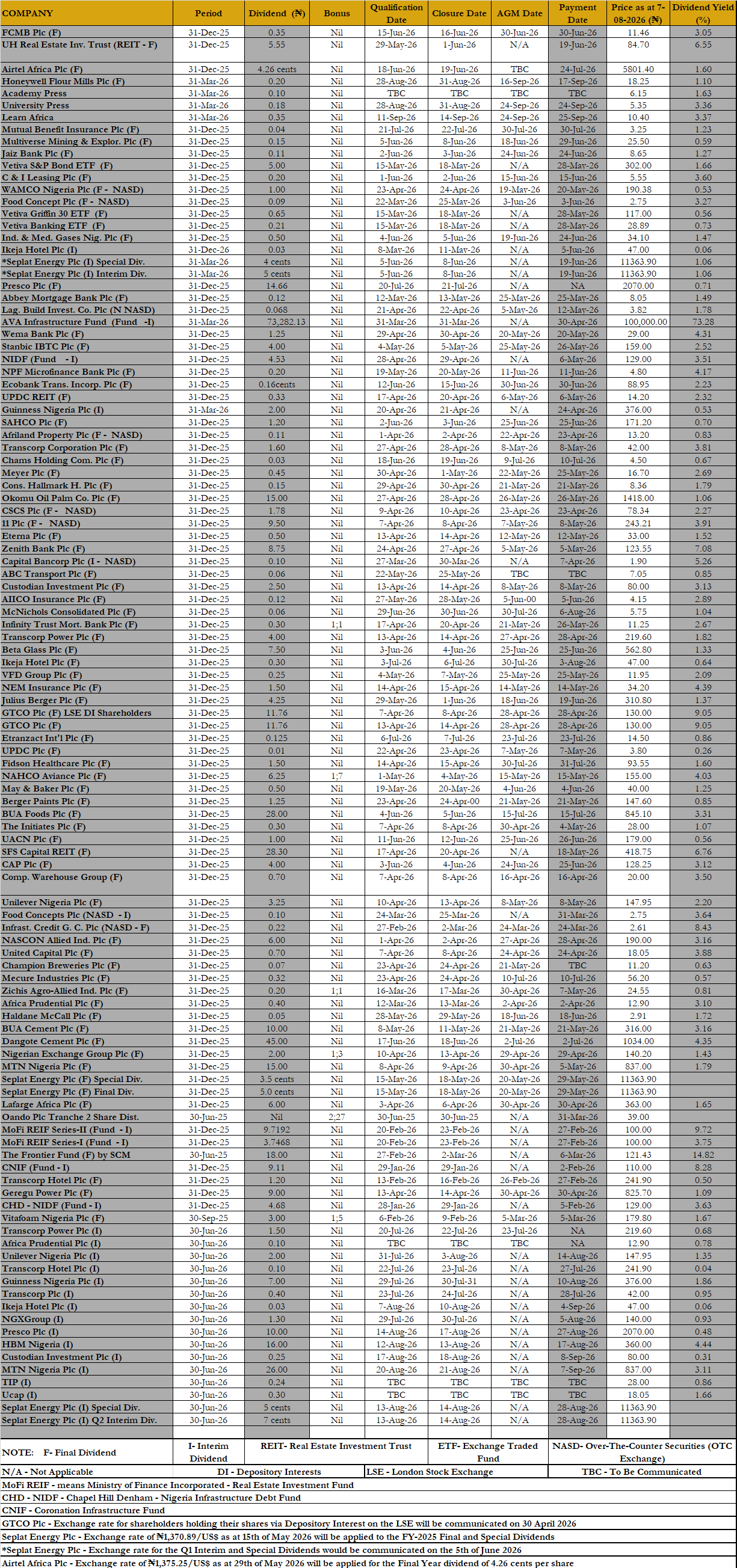
Looking ahead, investors are expected to continue positioning in fundamentally strong companies as the half-year earnings season approaches. Corporate earnings expectations, interim dividend prospects, movements in fixed-income yields, inflation data and developments in the domestic macroeconomic environment will remain key drivers of market direction. While intermittent profit-taking cannot be ruled out after Friday’s strong rally, the broader market outlook remains constructive, with bargain hunting likely to persist in quality stocks across the banking, industrial, consumer goods and energy sectors.
Trending in the Economy: The Federal Government has urged petroleum marketers to cut petrol prices following the decline in global crude oil prices. Petroleum Minister Heineken Lokpobiri said Nigerians should benefit from the lower costs, while the FCCPC warned that marketers who ignore the directive risk regulatory sanctions. The IMF has revealed that Nigeria excluded public spending worth about 2% of its GDP from recent budgets, leading to an understatement of the country’s fiscal deficit. IMF Resident Representative Christian Ebeke said the government is updating its budget framework to include the omitted spending and improve fiscal accountability. Even as the purchasing managers index for the month June slowdown to 53.7points from 54.1 in May.
Global Market and Oil: Global equity markets closed the week on a strong footing, posting their best weekly performance in two months after weaker-than-expected U.S. employment data strengthened expectations that the Federal Reserve may delay further interest rate hikes. The softer labour market report reduced pressure on policymakers to tighten monetary policy, weakening the U.S. dollar, lifting gold prices and encouraging renewed buying across global equities.
In Europe, investor sentiment remained upbeat as the STOXX 600 advanced 0.6% to a fresh record high. The regional benchmark was on course for a 2.6% weekly gain, marking its strongest performance since mid-May. The rally reflected growing investor preference for European equities, which continue to trade at lower price-to-earnings valuations than their U.S. counterparts and have relatively less exposure to the highly valued artificial intelligence sector.
The positive mood was equally evident in the broader global market. MSCI’s All-Country World Index rose 0.4% on Friday, extending its weekly gain to 2%, its best weekly performance in two months. Market participants continued to diversify away from expensive U.S. technology stocks into sectors and regions offering more attractive valuations.
The rotation out of AI-related companies followed recent weakness in semiconductor stocks on Wall Street, where investors shifted funds into financial and healthcare stocks. However, chipmakers staged a rebound in Asia, helping regional markets recover.
South Korea’s KOSPI surged by around 6%, driven largely by gains in semiconductor stocks, while Japan’s Nikkei 225 climbed 1.5%. The recovery was supported by stronger-than-expected business activity data across the region.
Purchasing Managers’ Index (PMI) figures showed that Japan’s services sector returned to expansion in June after stagnating in the previous month. China’s services sector also continued to expand, although at a slightly slower pace than before. More importantly, overseas demand for Chinese services rose at its fastest pace in 20 months, suggesting external demand remains resilient despite ongoing global economic uncertainties.
The latest economic data reinforced expectations that Asia’s major economies maintained positive growth momentum throughout the second quarter of the year.
The biggest driver of global market sentiment, however, came from the United States. Official data released on Thursday showed that June job growth slowed sharply, while payroll figures for the previous two months were revised downward, indicating that the U.S. labour market is gradually losing momentum after a prolonged period of strength. The weaker employment report significantly reduced expectations of another immediate interest rate increase by the Federal Reserve. According to the CME FedWatch Tool, the probability that the U.S. central bank will keep interest rates unchanged at its September 15-16 policy meeting increased to 46.8%, compared with 35.8% just one day earlier. Investors are now increasingly pricing in the possibility that any further policy tightening may be delayed until October.
The shift in interest rate expectations weighed on the U.S. dollar after it had climbed to its highest level in more than a year against a basket of major currencies earlier in the week.
In the foreign exchange market, the euro strengthened 0.1% to $1.144, while the British pound traded largely unchanged at $1.335. Against the Japanese currency, the dollar remained around ¥161, close to the 40-year low recorded by the yen earlier in the week. Investors continued to monitor developments in Japan amid speculation that authorities in Tokyo could intervene to support the currency if depreciation persists. The softer dollar also boosted precious metals. Gold rose 1% to trade above $4,160 per ounce, putting the safe-haven asset on course for a 1.8% weekly gain—its first weekly advance since the end of May—as lower interest rate expectations improved the appeal of non-yielding assets.
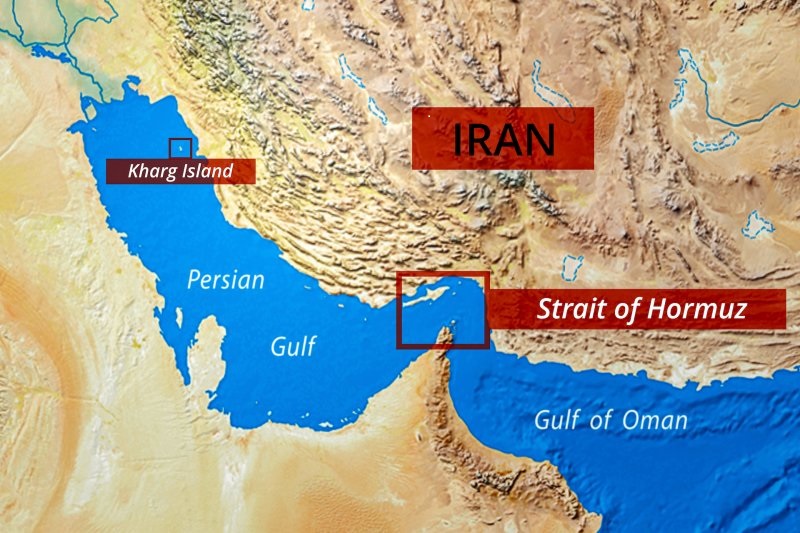
Despite the improved market sentiment, inflation concerns have not completely faded. Analysts warned that disruptions to global shipping routes remain a significant upside risk to consumer prices. The continued closure of the Strait of Hormuz has forced shipping companies to reroute vessels over longer distances, reducing global shipping capacity and increasing transportation costs. Economists believe these higher logistics costs could eventually feed into global inflation if disruptions persist.
U.S. equity futures also reflected the improved risk appetite despite Wall Street being closed for the Independence Day holiday. S&P 500 futures advanced 0.3%, while Nasdaq futures gained 1.2%, suggesting investors remain optimistic about the outlook for risk assets following the latest economic data.
In the commodities market, Brent crude oil futures rose 0.45% to $71.12 per barrel, supported by improving global risk sentiment and expectations that stable monetary policy could help sustain economic activity and energy demand. Overall, global financial markets ended the week with renewed optimism as cooling U.S. employment conditions strengthened expectations for a pause in Federal Reserve tightening. Stronger economic activity across Asia, record highs in European equities and improving investor appetite for undervalued markets combined to deliver the strongest weekly performance for global stocks in two months, although inflation risks linked to global shipping disruptions remain an important factor for investors to monitor.