
Market Update For July 29, 2026
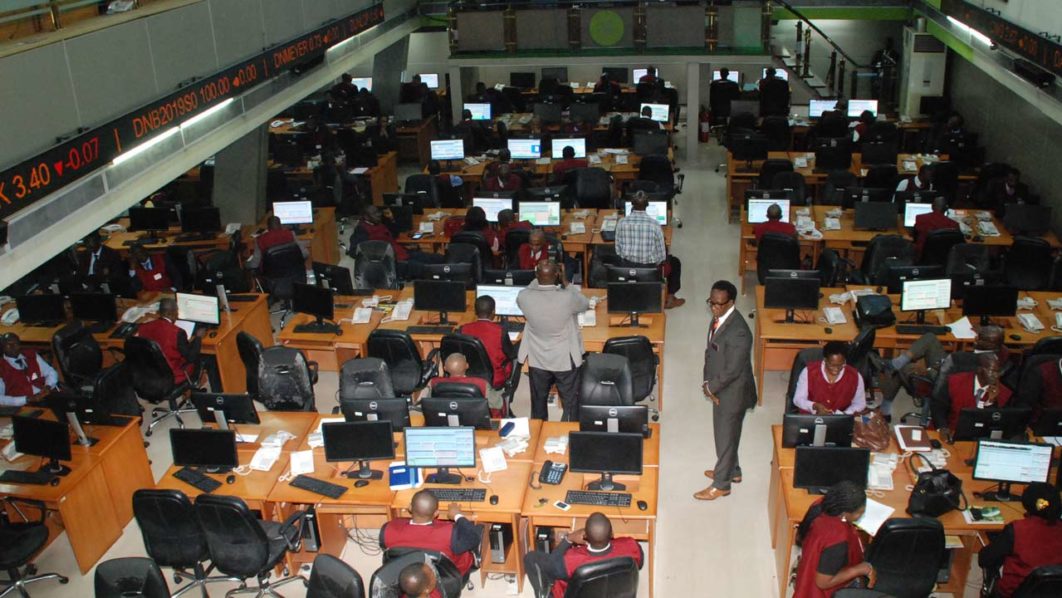
The Nigerian Exchange (NGX) returned to negative territory on Wednesday after renewed selling pressure across major stocks reversed the gains recorded in previous sessions. The market came under broad-based pressure as investors appeared to take profits following the strong rally in Nigerian equities, with losses spread across banking, industrial, consumer and other key segments.
The session was marked by a clear dominance of sellers, with 45 decliners compared with 23 gainers. The weak breadth showed that the decline was not driven by a handful of stocks alone, but reflected a wider deterioration in sentiment across the market. Several bellwether counters also recorded losses, adding to the pressure on the benchmark index.
The selloff was particularly pronounced in some of the market’s active stocks. TIP declined 9.91%, while NREIT fell 8.85% to a fresh 52-week low of N103.00. DANGSUGAR dropped 4.54%, HBMNG lost 3.80% and OANDO declined 2.44%.
The banking sector, which remains one of the most influential segments of the NGX, also struggled during the session. WEMABANK fell 2.21%, GTCO declined 1.91%, FIRSTHOLDCO lost 1.65%, while ZENITHBANK and UBA dropped 1.58% and 1.17%, respectively. FIDELITYBK also declined 0.92%.
The weakness was not restricted to financial stocks. NB fell 0.78%, while NAHCO declined 0.24%, further reflecting the broad nature of the selloff. TRIPPLEG also came under pressure, falling from N3.36 to N3.20 and hitting a fresh 52-week low.
The emergence of fresh 52-week lows amid the broader market decline suggests that some investors are becoming increasingly cautious about individual stocks, even as the overall NGX remains significantly higher on a year-to-date basis.
Wednesday’s decline appears to have been driven largely by profit-taking. The NGX has recorded substantial gains in recent months, leaving investors with an opportunity to lock in profits, particularly in stocks that have delivered strong returns.
The market’s performance also highlights the difference between the index-level trend and the performance of individual stocks. Although the broader market continues to post a strong year-to-date return, several counters are experiencing significant selling pressure.
This divergence is important for investors because a strong index does not necessarily mean that all stocks are performing equally. The emergence of new 52-week lows indicates that portfolio performance is becoming increasingly dependent on stock selection rather than broad market exposure.
Despite the bearish performance, activity across the market improved during the session. Total volume traded increased by 12.11% to 758.87 million shares, indicating that investors remained active despite the decline in prices.
The market recorded N33.79bn in value turnover across 55,251 deals. The combination of higher volume and a lower index suggests that the session was characterised by active repositioning, with selling pressure outweighing demand.
FCMB emerged as the most traded stock by volume, recording 92.44 million shares, equivalent to 12.18% of total market volume. FIRSTHOLDCO dominated value turnover with N8.77bn worth of transactions, representing 25.94% of the total value traded.
FIRSTHOLDCO and ACCESSCORP also accounted for 9.37% and 5.70% of total market volume, respectively. ZENITHBANK and HBMNG were also among the leading contributors to value turnover.
The concentration of trading activity in major financial stocks is significant because the banking sector has a substantial influence on the NGX. Continued weakness in heavyweight banks could place additional pressure on the index, while renewed demand for these counters could help support a market recovery.
The market breadth of 45 decliners against 23 gainers was one of the clearest indicators of the day’s negative sentiment. The ratio showed that selling pressure was widespread, with nearly twice as many stocks declining as advancing.
Negative breadth becomes particularly important when it occurs alongside higher volume. It suggests that the market decline was supported by meaningful participation rather than being the result of thin trading in a few stocks.
For the bullish trend to regain strength, market breadth would need to improve, with more stocks participating in any recovery. A rebound led only by a few heavyweight counters may not be sufficient to signal a broad return of positive sentiment.
Investors will therefore be watching the number of gainers and decliners closely in subsequent sessions, alongside volume and the performance of major market movers.
Technical Analysis
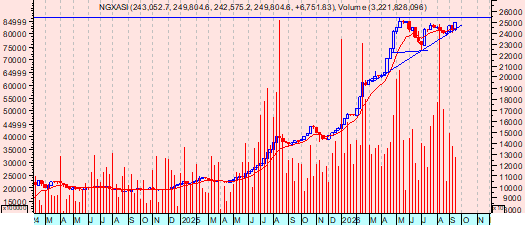
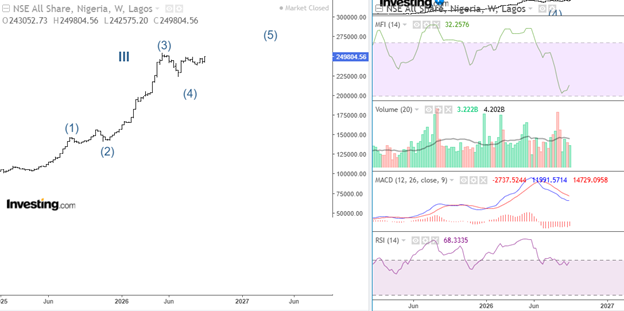
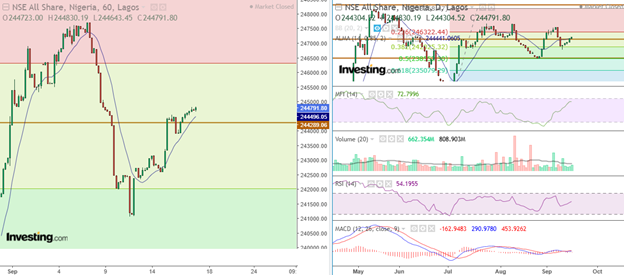
From a technical perspective, the NGX All-Share Index lost 0.41%, moving from 247,984.55 points to 246,980.17 points. The decline indicates that the index struggled to maintain its recent upward momentum and came under renewed selling pressure.
The technical picture is further weakened by the combination of declining prices, rising volume and negative breadth. When volume expands during a market decline, it can indicate stronger distribution as investors use the available liquidity to reduce positions.
However, the latest decline alone is not sufficient to confirm a reversal of the broader bullish trend. The index remains well above its earlier levels and continues to record a strong year-to-date return.
The next few sessions will therefore be important in determining whether Wednesday’s decline represents a temporary correction or the beginning of a deeper consolidation phase. A recovery accompanied by stronger breadth and increased demand for large-cap stocks would improve the technical outlook.
On the other hand, continued declines accompanied by elevated volume could reinforce the bearish signal and expose the index to further downside. Investors should therefore monitor the index’s ability to hold key support areas and watch for changes in momentum.
The performance of the banking sector will remain central to the NGX’s direction in the near term. GTCO, FIRSTHOLDCO, ZENITHBANK, UBA, FIDELITYBK and WEMABANK all closed lower on Wednesday, adding pressure to the broader market.
Given the significant weighting and liquidity of major banking stocks, sustained weakness in the sector could have a disproportionate impact on the All-Share Index. Conversely, renewed buying interest in these counters could quickly improve the overall market tone.
Investors will also be watching corporate earnings and other company-specific developments for direction. Strong financial results could provide a catalyst for renewed buying, while weaker-than-expected earnings or cautious corporate outlooks could reinforce the ongoing profit-taking.
Oil prices jumped nearly 7% on Wednesday as renewed airstrikes in the Middle East reduced hopes of an immediate end to the U.S.-Israeli war with Iran. Brent crude futures gained $5.70, or 6.8%, to $89.79 per barrel, while U.S. West Texas Intermediate (WTI) rose $4.94, or 6.2%, to $84.20 per barrel.
The renewed military activity increased concerns about potential disruptions to crude supplies and shipping through the Strait of Hormuz. Iranian officials reiterated their position on controlling shipping activity through the strategic waterway, while lower oil flows through the region added to supply concerns.
The United States and Saudi Arabia also launched strikes against Iran-backed groups in Iraq after drone attacks on Saudi oil facilities, further increasing geopolitical tensions.
For Nigeria, the rise in oil prices could be positive if sustained. Higher crude prices can improve foreign exchange inflows, strengthen government revenues and provide additional support for the country’s external position.
However, the impact on the NGX may not be entirely positive. While higher oil prices support Nigeria’s macroeconomic fundamentals, increased geopolitical tensions can also trigger a global risk-off environment. Investors may become more cautious towards emerging and frontier markets if the conflict escalates.
The net effect on Nigerian equities will therefore depend on the duration of the oil price increase and the extent to which geopolitical tensions affect global investor sentiment.
Outlook
The NGX enters the next trading session with a cautious short-term outlook following Wednesday’s broad-based selloff. Profit-taking could remain a major feature of the market as investors lock in gains from the strong rally recorded so far this year.
At the same time, the correction could create opportunities for investors looking to accumulate fundamentally strong stocks at more attractive prices. Companies with resilient earnings, strong balance sheets, sustainable dividends and favourable growth prospects may continue to attract interest even when the broader market is under pressure.
The performance of heavyweight banking stocks will remain particularly important. A stabilisation in GTCO, FIRSTHOLDCO, ZENITHBANK, UBA and other major financial stocks could help the index regain momentum. Continued weakness in these names, however, could extend the market’s consolidation.
Market breadth will also be a key indicator. A narrowing gap between gainers and decliners would suggest that selling pressure is easing, while another session of significantly more losers than gainers would reinforce the current cautious outlook.
Trading volume should also be closely monitored. A decline in volume alongside market stabilisation could indicate that selling pressure is fading. Conversely, rising volume during another decline would suggest that distribution remains active.
Overall, the current weakness appears more consistent with profit-taking and short-term consolidation than a confirmed reversal of the broader market trend. Nevertheless, investors should remain selective and avoid chasing stocks that have already recorded significant gains.
The external environment will also remain important. Sustained high oil prices could support Nigeria’s macroeconomic position, but a worsening Middle East conflict could increase global volatility and put pressure on risk assets.
For the NGX, the immediate focus will be on whether buyers return at lower price levels, whether market breadth improves and whether heavyweight stocks regain momentum. A combination of stronger breadth, improving volume dynamics and a recovery in large-cap stocks would provide a more constructive signal for the next leg of the market.
Market Summary
The NGX All-Share Index (ASI) declined by 0.41% to close at 246,980.17 points, compared with 247,984.55 points in the previous session. The decline resulted in an estimated N648bn loss in market capitalisation, while the market’s year-to-date return moderated to 58.71%. Total volume traded rose 12.11% to 758.87 million shares, while market value stood at N33.79bn across 55,251 deals. FCMB led traded volume with 92.44 million shares, representing 12.18% of total volume, while FIRSTHOLDCO recorded the highest value turnover at N8.77bn, accounting for 25.94% of total value traded. FIRSTHOLDCO and ACCESSCORP contributed 9.37% and 5.70% of total volume, respectively, while ZENITHBANK and HBMNG were also among the leading stocks by value. Market breadth closed negative at 45 decliners against 23 gainers. LASACO emerged as the session’s top gainer, although its percentage gain and closing price were not included in the available data. On the losers’ chart, LEGENDINT led with a closing price of N4.04, while TIP declined 9.91%, NREIT fell 8.85% to N103.00, DANGSUGAR dropped 4.54%, HBMNG lost 3.80%, OANDO declined 2.44%, WEMABANK fell 2.21%, GTCO dropped 1.91%, FIRSTHOLDCO declined 1.65%, ZENITHBANK lost 1.58%, UBA fell 1.17%, FIDELITYBK declined 0.92%, NB dropped 0.78%, and NAHCO shed 0.24%. TRIPPLEG also declined from N3.36 to N3.20, recording a fresh 52-week low, while NREIT equally touched a new 52-week low at N103.00.