

Market Update For July 27, 2026
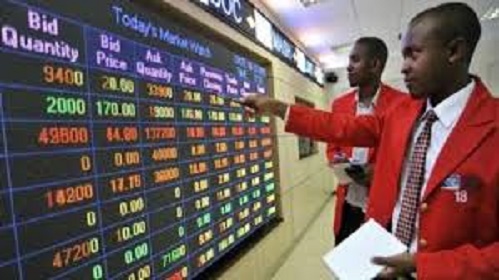
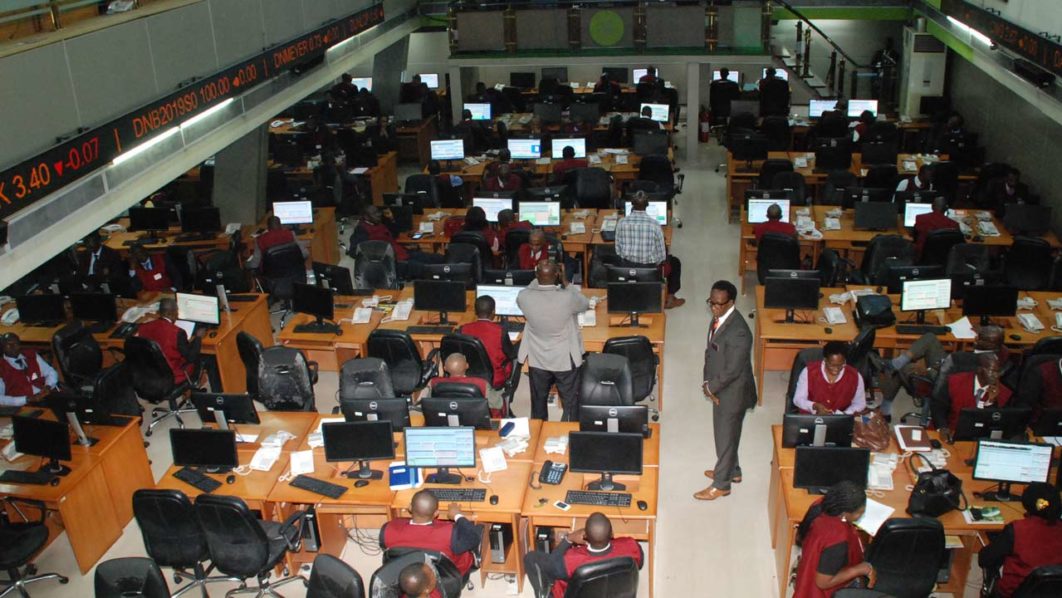
The Nigerian equities market opened the new trading week on a mildly bearish note on Monday, July 27, 2026, extending the previous session’s losses as investors continued to lock in profits following the market’s impressive rally in recent weeks. The cautious mood was driven largely by valuation concerns, portfolio rebalancing and a series of recommendation downgrades by capital market operators, prompting investors to reduce exposure to several stocks that had delivered significant capital gains.
Although buying interest remained visible in selected counters, it was insufficient to offset the widespread selling pressure across major sectors of the market. Banking, insurance, consumer goods, industrial goods and selected oil and gas stocks all witnessed varying degrees of profit-taking as investors sought to preserve gains accumulated during the recent bullish run.
The session reflected a market transitioning from aggressive accumulation to selective positioning, with institutional and retail investors becoming more valuation-conscious after weeks of sustained price appreciation. The modest decline also suggests that market participants are becoming increasingly disciplined, preferring to rebalance portfolios rather than chase stocks trading at elevated valuations.
The renewed profit-taking follows one of the strongest rallies witnessed on the Nigerian Exchange this year, during which several blue-chip and mid-cap stocks recorded double-digit gains on the back of improved corporate earnings, attractive dividend expectations, strong liquidity and sustained domestic institutional participation. Consequently, many investors considered the current levels an opportunity to realise profits while awaiting fresh catalysts that could support another leg of the market’s upward movement.
Despite the negative close, market activity remained resilient, indicating that investor confidence has not weakened significantly. Instead, trading patterns suggest that funds are gradually rotating into fundamentally attractive and relatively undervalued stocks rather than exiting the market completely. This rotational strategy has continued to define trading behaviour over recent weeks, with investors selectively increasing exposure to counters that still offer attractive risk-adjusted returns.
Trading activity strengthened considerably during the session, reflecting sustained investor participation. Total volume traded advanced by 3.81% to 637.96 million shares, while the value of transactions stood at ₦57.20 billion across 71,240 deals. The improvement in both volume and turnover indicates that liquidity remains healthy despite the market’s cautious performance.
ACCESSCORP emerged as the most actively traded stock by volume, accounting for 47.57 million shares or 7.46% of the day’s total transactions. FCMB followed with 6.32% of total volume, while FIRSTHOLDCO contributed 5.36%, underscoring continued investor interest in the banking sector despite the profit-taking witnessed in several financial stocks.
On the value chart, ARADEL dominated market turnover with transactions worth ₦27.57 billion, representing an impressive 48.20% of the day’s total traded value. FIRSTHOLDCO and ZENITHBANK also ranked among the highest contributors by value, highlighting sustained institutional participation in large-cap counters.
The dominance of ARADEL in value terms demonstrates that sizeable institutional transactions continue to flow into selected stocks despite the broader market weakness. This suggests that long-term investors remain active, particularly in fundamentally sound companies with strong earnings prospects and attractive valuations.
Investor sentiment was also shaped by developments in the global commodities market. International oil prices declined sharply on Monday after geopolitical tensions between the United States and Iran showed signs of easing. Reports that both countries paused military strikes over the weekend renewed hopes for a diplomatic resolution and the possible restoration of crude shipments through the Strait of Hormuz.
Brent crude futures fell by around 6% to approximately $90.93 per barrel after earlier dropping as much as 9.5%, while U.S. West Texas Intermediate crude declined by about 5.6% to around $84.33 per barrel. Both benchmarks traded at their lowest levels in about one week, reversing part of the sharp gains recorded during the height of the conflict.
For the Nigerian market, movements in crude oil prices remain an important driver of investor sentiment. While lower oil prices may reduce expectations for earnings growth among upstream energy companies, easing geopolitical tensions could improve global risk appetite, moderate inflation expectations and reduce uncertainty across financial markets. Investors will therefore continue to monitor developments in the Middle East for their potential impact on both global energy markets and domestic equities.
Technical Analysis and Outlook
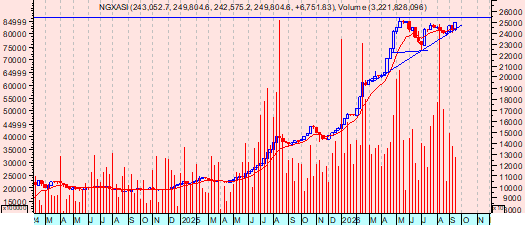
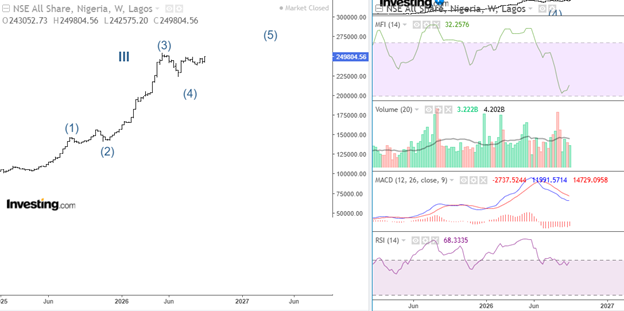
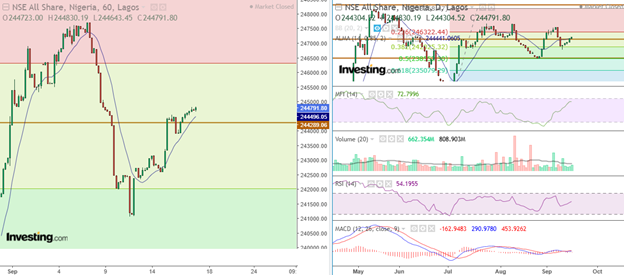
Technically, Monday’s trading session reflects a continuation of the consolidation phase that began in the previous session. The marginal decline in the benchmark index indicates that sellers currently hold a slight advantage, although the market has not experienced the kind of aggressive distribution that would suggest a reversal of the broader uptrend.
The NGX All-Share Index remains comfortably above key medium-term support levels, preserving the bullish market structure established over the past several months. However, the increase in the number of declining stocks relative to gainers suggests that market breadth is beginning to weaken, a development that should be monitored closely over the coming sessions.
Momentum indicators are likely to moderate after the market’s extended rally, creating room for further short-term consolidation. Nevertheless, as long as institutional liquidity remains robust and macroeconomic conditions continue to improve, any pullback is expected to present fresh buying opportunities rather than signal the beginning of a prolonged bearish trend.
Investors are expected to remain selective in the days ahead, focusing on companies with strong earnings momentum, attractive dividend yields, resilient balance sheets and reasonable valuations. Portfolio rotation into fundamentally sound stocks is also expected to intensify as investors position ahead of upcoming corporate disclosures and macroeconomic releases.
The banking sector is likely to remain in focus given its strong contribution to market liquidity and turnover, while industrial, consumer goods and energy stocks could continue to witness mixed sentiment depending on valuation levels and sector-specific developments.
Overall, the market is expected to trade within a consolidation range in the near term, with intermittent bouts of profit-taking likely to be matched by bargain hunting in quality stocks. The underlying market tone remains constructive, supported by improving corporate fundamentals, sustained domestic institutional participation and expectations of continued economic recovery. Investors should therefore monitor market breadth, trading volume and institutional flows for clearer signals on the next directional move.
The NGX All-Share Index (ASI) declined by 0.05% to close at 247,238.74 points from 247,357.40 points in the previous session, while market capitalisation shed approximately ₦76.56 billion, moderating the market’s year-to-date return to 58.88%. Market breadth weakened as 32 stocks declined against 28 gainers, reflecting broad-based profit-taking across key sectors. Among the major market movers, TRANSPOWER lost 10.00%, FIDSON fell 9.00%, NEM declined 8.52%, ACCESSCORP shed 7.53%, OANDO dropped 4.25%, BUACEMENT fell 2.47%, NAHCO declined 2.12%, CWG lost 1.68%, CADBURY eased 1.11%, while NIGERIAN BREWERIES slipped 0.90%. On the positive side, CNIF led the gainers’ chart. SUNUASSUR and TRANSPOWER featured among the weakest performers, with both stocks trading below their respective 52-week lows of ₦3.24 and ₦219.60, reinforcing the cautious sentiment that characterised the session.