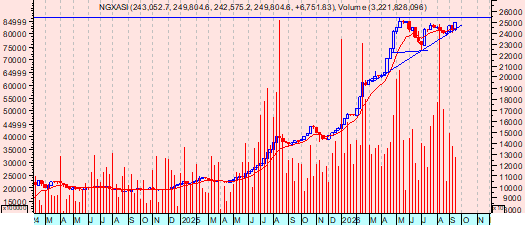

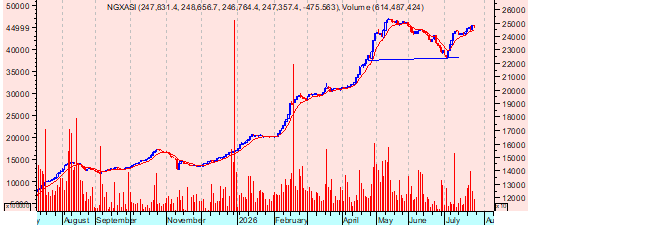
It was a positive week on the Nigerian Exchange, with three sessions of up market and two red days as a volley of corporate scorecards hit the bourse. The numbers seem to be mixed as some companies beat market expectation while others came in mixed, even as some companies also posted disappointing results. In all these, the market expectedly reacted positively to some of the earnings reports especially companies that announced interim dividend payouts. The index’s action below reveal market sentiments on daily chart.
NGXASI Daily Index Action
Weekly trading activities strengthened significantly, with 4.433bn shares worth ₦306.143bn exchanged in 255,589 deals, up from 2.819bn shares valued at ₦182.499bn in 226,729 deals the previous week. The Financial Services sector remained dominant, accounting for 3.422bn shares worth ₦207.206bn across 117,545 deals, representing 77.18% of total volume and 67.68% of turnover value. Consumer Goods followed with 201.978m shares valued at ₦17.171bn, while ICT recorded 169.481m shares worth ₦21.194bn.
Transactions in the shares of FIRSTHOLDCO, ACCESSCORP and GTCO were the most traded equities, combining for 2.151bn shares worth ₦170.793bn in 44,768 deals. Together, they accounted for 48.51% of total equity volume and 55.79% of turnover value. Overall, market sentiment remained bullish, although declines in the Consumer Goods, NGX Lotus II, NGX Growth, NGX Sovereign Bond and NGX Commodity indices reflected pockets of profit-taking across the market.
Week-to-date, the All-Share Index gained 1.60%, NGX 30 is up by 1.66%, the Banking Index has increased by 8.35%, the Pension Index increased by 3.21%, the Insurance Index inclined by 3.86%, the Consumer Goods Index decreased by 3.76%. However, the Oil and Gas Index recorded a positive return of 0.11%. Year-to-date, the All-Share Index has gained 58.96%, NGX 30 is up by 59.47%, the Banking Index has increased by 67.90%, the Pension Index increased by 77.16%, the Insurance Index declined by 0.80%, the Consumer Goods Index increase by 13.41%. However, the Oil and Gas Index recorded a positive return of 96.80%.
Trading for the week began on a strong note, extending the previous session’s gain, as the benchmark All-Share index gained 1.12% to a close at 246,183.96 basis points, while market capitalisation increased by ₦1.76trn and YTD return rose to 58.20%. NEM and CUSTODIAN topped the gainers at 10.00% each, followed by BUACEMENT (+9.98%), FIRSTHOLDCO (+9.95%), NGXGROUP (+6.63%) and UBA (+6.37%). Trading volume rose 24.17% to 851.63m shares worth ₦49.59bn in 56,873 deals, with FIRSTHOLDCO accounting for 203.94m shares valued at ₦21.52bn.
On Tuesday, the market extended its rally as the ASI gained 0.19% to 246,659.56 points, lifting YTD return to 58.51% and investors’ wealth by ₦306.81bn. IKEJAHOTEL (+9.53%), TIP (+9.52%), NGXGROUP (+7.15%), CUSTODIAN (+3.36%), BUACEMENT (+2.28%) and ACCESSCORP (+1.96%) led the gains. Volume rose 9.49% to 932.45m shares worth ₦49.28bn, while ACCESSCORP led activity with 336.62m shares valued at ₦8.65bn.
Profit-taking emerged at midweek, pushing the ASI down 0.50% to 245,418.37 points and reducing investors’ wealth by ₦800.70bn. YTD return slipped to 57.71%. BUAFOODS and NESTLE fell 10.00% each, while MECURE (-9.94%) and UACN (-7.75%) also declined. Trading activity surged, with 1.25bn shares worth ₦118.18bn exchanged 47,458 deals. FIRSTHOLDCO dominated turnover with 736.04m shares valued at ₦80.81bn.
The market rebounded on Thursday, with the ASI advancing 0.98% to 247,831.40 points. Investors’ wealth rose by ₦1.58trn, while YTD return climbed to 59.26%. GUINNESS (+10.00%), ACCESSCORP (+9.98%), FIRSTHOLDCO (+9.91%), CADBURY (+7.66%), UNILEVER (+7.64%) and ZENITHBANK (+4.42%) led the gains. However, volume fell 37.54% to 782.35m shares worth ₦56.30bn in 46,273 deals, with FIRSTHOLDCO again leading activity at 106.40m shares valued at ₦12.49bn.
Profit-taking returned on Friday as the ASI declined 0.19% to 247,357.40 points, trimming investors’ wealth by ₦305.82bn and easing YTD return to 58.96%. PRESCO (-10.00%), FIDELITYBK (-4.55%), UBA (-4.37%) and CWG (-4.15%) led the losses, while CNIF topped the gainers and closed at ₦127.60, above its 52-week high. Trading volume dropped 21.45% to 614.55m shares worth ₦32.95bn in 55,282 deals. ACCESSCORP led volume with 128.01m shares, while ARADEL recorded the highest traded value at ₦6.62bn.
UPDCREIT
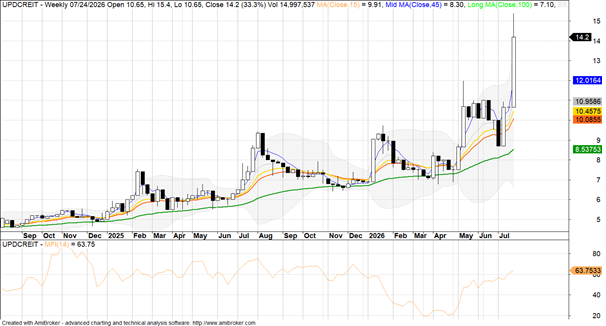
UPDC Real Estate Investment Trust emerged as the week’s best-performing stock, rising from an opening price of ₦10.65 to ₦14.20, representing a gain of ₦3.55 or 33.33%. First Holdco Plc followed, advancing from ₦95.95 to ₦120.50, a gain of ₦24.55 or 25.59%. Unilever Nigeria Plc climbed from ₦124.00 to ₦147.95, gaining ₦23.95 or 19.31%. Cadbury Nigeria Plc also recorded strong buying interest, rising from ₦57.00 to ₦67.50, representing a gain of ₦10.50 or 18.42%. AXA Mansard Insurance Plc completed the top five gainers, appreciating from ₦11.20 to ₦13.20, up ₦2.00 or 17.86%.
MECURE INDUSTRIES Plc
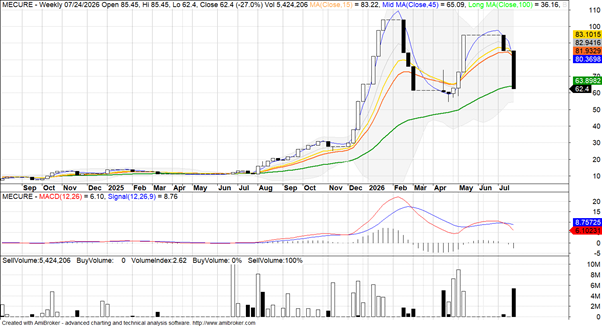
Mecure Industries Plc recorded the biggest price decline during the week, falling from ₦85.45 to ₦62.40. The stock lost ₦23.05, representing a 26.97% decline. Royal Exchange Plc declined from ₦1.48 to ₦1.29, shedding ₦0.19 or 12.84%. Tripple Gee and Company Plc dropped from ₦3.89 to ₦3.41, representing a loss of ₦0.48 or 12.34%. Sunu Assurances Nigeria Plc fell from ₦4.00 to ₦3.60, losing ₦0.40 or 10.00%. BUA Foods Plc also declined by 10.00%, dropping from ₦939.00 to ₦845.10, a loss of ₦93.90.
NGX Weekly Comparative Analysis
The Nigerian equities market recorded a stronger performance this week than the previous week, with the NGX All-Share Index (ASI) gaining 1.60% to close at 247,357.40 points, compared with a 0.14% decline to 243,462.13 points last week. Market capitalisation also rose by 1.61% to ₦159.588 trillion, up from ₦157.057 trillion, while the year-to-date (YTD) return improved to 58.96% from 56.45%.
Market activity strengthened considerably as investors traded 4.433 billion shares worth ₦306.143 billion in 255,589 deals, compared with 2.819 billion shares valued at ₦182.499 billion in 226,729 deals in the previous week. This represents increases of 57.26% in volume, 67.75% in value, and 12.73% in deals.
The Financial Services sector remained the dominant driver of activity, accounting for 3.422 billion shares worth ₦207.206 billion in 117,545 deals, representing 77.18% of total volume and 67.68% of total turnover, compared with 2.006 billion shares valued at ₦99.697 billion in 96,171 deals, which accounted for 71.17% of volume and 54.63% of value last week.
Trading concentration also increased, with FIRSTHOLDCO, ACCESSCORP and GTCO accounting for 2.151 billion shares worth ₦170.793 billion in 44,768 deals, representing 48.51% of total volume and 55.79% of total value. This compares with FIRSTHOLDCO, FCMB and ACCESSCORP, which traded 939.402 million shares worth ₦57.673 billion in 19,051 deals, accounting for 33.33% of volume and 31.60% of value in the previous week. Fifty-seven (57) equities appreciated in price during the week, higher than forty-four (44) equities in the previous week. Thirty-eight (38) equities depreciated in price, higher than thirty-five (35) equities in the previous week, while fifty-one (51) equities remained unchanged, lower than sixty-seven (67) recorded in the previous week.
Technical Analysis View
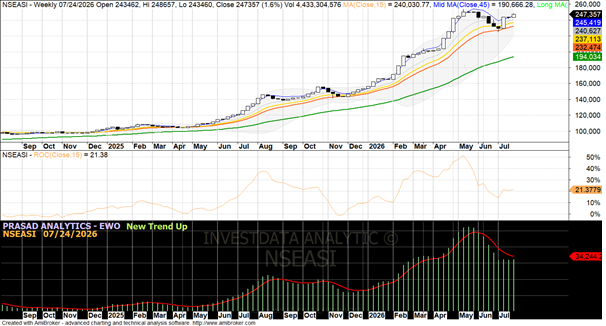
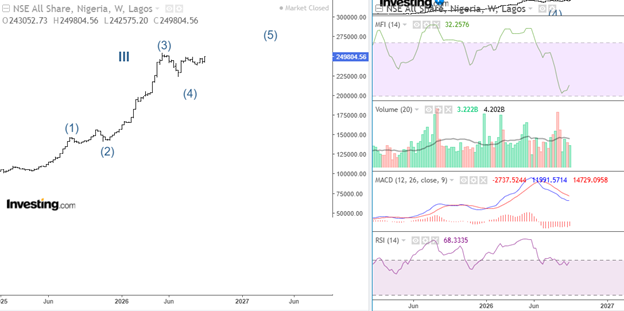
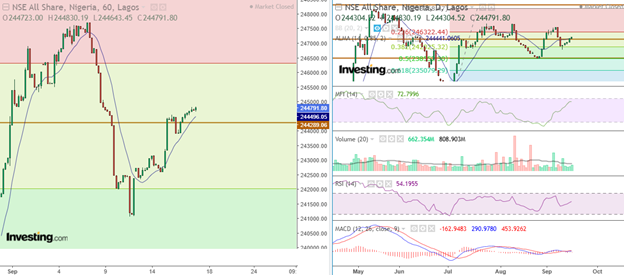
The NGX All-Share Index maintained a strong bullish bias during the week, advancing 1.60% to 247,357.40 points and reaching a fresh high of 247,831.40 points before profit-taking trimmed gains on Friday. The index remains above key short-term support levels, indicating that buyers still have control. However, the late-week decline, coupled with heavy selling in some banking and large-cap stocks, suggests rising profit-taking pressure at elevated levels. Trading activity also strengthened significantly, pointing to increased investor participation and liquidity.
Market Outlook
The market outlook remains cautiously bullish, supported by strong year-to-date gains, sustained demand for large-cap stocks and improved trading turnover. However, the sharp gains recorded in recent sessions could trigger further profit-taking and short-term volatility. Investors should watch the 247,800–248,000 area as the immediate resistance zone, while 245,000 points could provide near-term support. A decisive break above the resistance zone may open the way for further gains, while a sustained move below support could signal a deeper correction. Overall, sentiment remains positive, but investors are likely to favour fundamentally strong stocks and adopt a more selective approach as the market trades near record levels.
Trending in the Economy: The Central Bank of Nigeria maintained its benchmark interest rate at 26.50% for the second consecutive meeting, as policymakers remain cautious over inflation and geopolitical risks linked to renewed Middle East tensions. Despite inflation easing to 15.91% in June, Governor Olayemi Cardoso said a tight policy stance was still appropriate. Analysts expect liquidity to remain tight and fixed-income yields attractive, with possible rate cuts from September if inflation continues to moderate. Nigeria’s petrol imports surged 207% to 543 million litres in June 2026, up from 177 million litres in May, according to the NMDPRA. Daily supply increased to 50.6 million litres, while consumption rose to 47.4 million litres. Domestic refineries provided 64% of total receipts, with imports supplying the remainder.
Crude deliveries to local refineries climbed 10% to 632,000 barrels per day, while average refinery capacity utilisation stood at 101.36%.
Global Market and Oil: Global financial markets ended the week on a mixed note, with U.S. and European equities recovering from recent losses as oil prices pulled back. However, elevated government bond yields and renewed concerns over inflation continued to weigh on investor sentiment, as markets increasingly anticipated the possibility of higher interest rates from major central banks.
The inflation outlook was further complicated by the decision of U.S. President Donald Trump’s administration to impose higher tariffs on goods from 60 trading partners. Investors remain concerned that the tariffs could increase the cost of imported goods, potentially adding to inflationary pressures and limiting the ability of central banks to ease monetary policy.
On Wall Street, trading was mixed. The Dow Jones Industrial Average gained 0.46%, while the S&P 500 ended little changed. The Nasdaq Composite, which has been particularly sensitive to movements in interest rates and bond yields, declined 0.64%. Technology stocks remained under pressure as investors continued to question whether the huge sums being committed to artificial intelligence infrastructure and development would generate sufficient returns.
Intel was among the major decliners, with its shares falling about 8% despite the chipmaker reporting strong results. The sell-off reflected broader concerns about valuations across the technology sector and the growing uncertainty surrounding multi-billion-dollar investments in artificial intelligence. Investors are increasingly demanding clearer evidence that the enormous spending on AI will translate into sustainable earnings and cash flows.
European equities, however, posted a stronger performance. The pan-European STOXX 600 index rose 0.8%, recovering from a decline of more than 1% in the previous session. The index also recorded gains for a second consecutive week, supported by improving economic data and renewed buying interest across several sectors. The pullback in oil prices provided some relief to global markets. Brent crude settled at $96.78 per barrel, declining by $3.91 or 3.88%. The decline came after Brent had closed above the $100-per-barrel level in the previous session for the first time since May. Lower oil prices helped ease some immediate concerns about inflation, given the important role energy costs play in consumer prices and business expenses.
Nevertheless, geopolitical risks remained a major threat to the global energy outlook. Attacks by Iran-aligned Houthi forces on Saudi tankers in the Red Sea raised concerns that disruptions could spread across another critical route for global oil supplies. This comes alongside heightened tensions around the Strait of Hormuz, through which a significant share of the world’s oil supplies passes, with Iran reportedly moving towards a near-closure of the strategic waterway.
The escalating tensions have increased uncertainty over the direction of oil prices. U.S. President Donald Trump threatened “major military punishment” against Iran and its Houthi allies, while the U.S. military carried out attacks for a 13th consecutive night. Any further escalation in the Middle East could disrupt energy supplies, push crude prices higher and reignite inflation concerns globally.
Bond Yields Remain Elevated
The bond market remained a major focus for investors as government yields stayed close to multi-year highs. U.S. Treasury yields eased slightly on Friday as oil prices fell, but investors remained cautious ahead of the Federal Reserve’s policy meeting next week.
The benchmark 10-year U.S. Treasury yield slipped to 4.679%, easing from an 18-month high. However, the longer-dated 30-year Treasury yield remained elevated at 5.163%, close to its 19-year peak of 5.201% and levels last seen around 2007. The elevated yields reflect growing expectations that central banks may need to maintain restrictive monetary policies for longer or even raise interest rates further if inflation remains persistent. Higher bond yields also increase borrowing costs across the economy and can place pressure on equity valuations, particularly growth and technology stocks whose future earnings are discounted at higher rates.
Market pricing has shifted significantly in recent days. Investors now see roughly a one-in-three chance of the Federal Reserve raising interest rates as early as next week, a major change from just one week earlier. A rate increase in September is also more than fully priced into markets, highlighting the extent to which expectations have changed.
Analysts have pointed to uncertainty surrounding both the Federal Reserve’s policy rate and the size of its balance sheet as potential sources of pressure for the U.S. Treasury market in the coming months. While the base-case expectation remains for the Fed to leave rates unchanged, investors are increasingly questioning whether policymakers will take sufficiently strong action to ensure inflation returns sustainably to target.
ECB Holds Rates as September Hike Bets Rise
In Europe, the European Central Bank left interest rates unchanged on Thursday, but markets continued to price in a significant probability of another rate increase in September. Current market pricing puts the likelihood of a September hike at about 70%. The shift in expectations comes as policymakers remain focused on inflation risks while monitoring economic activity across the euro zone. Higher energy prices, trade tariffs and geopolitical tensions could complicate the inflation outlook and make monetary policy decisions more difficult.
However, economic data released on Friday offered some encouragement. Business surveys showed that Germany’s private sector returned to growth in July, marking its first expansion in four months. At the same time, the contraction in France’s private sector eased during the month, suggesting that economic conditions may be stabilising in parts of the euro zone. The improving data could provide some support for European equities, although the prospect of higher interest rates remains a potential headwind for businesses and consumers.
Dollar Strengthens as Yen Nears Four-Decade Low
Currency markets were relatively calm, with most major currencies trading broadly steady against the U.S. dollar. Despite the mixed performance in equities, the dollar index was on track for its strongest weekly advance in approximately one month. The Japanese yen remained particularly weak, trading around 163.84 per dollar and close to a 40-year low. The sharp depreciation of the yen has increased concerns among Japanese policymakers, while also attracting warnings from U.S. Treasury officials over excessive volatility in foreign exchange markets. Japan’s finance minister also raised concerns about the currency’s movements, underscoring growing pressure on authorities to respond if the yen’s weakness becomes disorderly. A weaker yen increases the cost of imports for Japan and can contribute to higher domestic inflation, adding another challenge for policymakers.
Global Market Outlook
The global markets remains highly dependent on the direction of inflation, interest rates, energy prices and geopolitical developments. The decline in Brent crude to $96.78 per barrel offered some temporary relief to investors, but the risk of further supply disruptions in the Middle East remains significant. At the same time, elevated U.S. Treasury yields, with the 10-year yield at 4.679% and the 30-year yield at 5.163%, continue to signal that investors are demanding higher returns to compensate for inflation and interest-rate risks. The 30-year yield’s proximity to its 5.201% peak further highlights the pressure facing global fixed-income markets. Equity investors are also navigating growing uncertainty around technology valuations and the enormous capital being deployed into artificial intelligence. Intel’s 8% decline despite strong results illustrates the increasingly demanding environment for technology companies, while the Nasdaq’s 0.64% decline reflects the sensitivity of growth stocks to higher borrowing costs and rising bond yields.
Overall, markets are likely to remain volatile in the near term. Investors will closely monitor the Federal Reserve’s upcoming policy decision, the European Central Bank’s outlook for September, movements in oil prices and developments in the Middle East. Any further rise in energy prices could intensify inflation concerns and strengthen expectations for additional rate hikes, while a sustained decline in oil prices could provide some relief to both bond and equity markets.
For now, the combination of elevated bond yields, renewed tariff-related inflation risks, geopolitical tensions and uncertainty over central bank policy is keeping investors cautious. While the STOXX 600’s 0.8% gain and the Dow’s 0.46% advance point to pockets of resilience, the 0.64% decline in the Nasdaq and continued pressure on long-term Treasury bonds highlight the fragile nature of the current market environment.