
Market Update For July 30, 2026
The Nigerian equities market extended its bearish run on Thursday, July 30, 2026, as renewed profit-taking and broad-based selloffs across major stocks outweighed pockets of buying interest. The decline marked another weak session for the domestic bourse, with investors appearing increasingly cautious after the strong rally recorded in the first seven months of the year.
The session reflected a shift in short-term sentiment, particularly as selling pressure spread across several heavyweight stocks. Banking, consumer and industrial counters were among the major areas affected, with declines in large-cap names exerting additional pressure on the broader market.
The weakness also came despite a sharp increase in trading activity. The significant rise in volume and value traded suggests that the session was characterised by active repositioning rather than a lack of market participation. With the index falling as turnover increased, the activity points more towards distribution and profit-taking as investors reduced positions in selected stocks.
FIRSTHOLDCO was at the centre of the day’s trading activity, accounting for the overwhelming majority of turnover. The stock recorded 1.57bn shares traded, while its transaction value reached ₦196.20bn. Its contribution represented 74.77% of the total market volume and 85.00% of total value traded.
The dominance of FIRSTHOLDCO was particularly significant because the stock itself closed lower. Heavy activity accompanied by a price decline can indicate substantial selling interest, especially when the broader market is also declining. Investors will therefore be watching the stock closely in subsequent sessions to determine whether the elevated turnover represents temporary profit-taking or a more sustained distribution phase.
Other actively traded counters included ACCESSCORP and STERLINGNG, which contributed 1.78% and 1.71%, respectively, to total market volume. ARADEL and ZENITHBANK also ranked among the leading stocks by value traded, further highlighting the concentration of investor attention around major and liquid names.
Broad-Based Selling Signals Caution
The breadth of the decline provided another indication of the market’s weak underlying sentiment. Rather than being driven by one or two heavyweight stocks alone, the selloff extended across a wide range of counters.
Major banking names recorded losses, including WEMABANK, FIRSTHOLDCO, ZENITHBANK, ACCESSCORP and UBA. The weakness in financial stocks is particularly relevant because of the sector’s substantial contribution to the overall NGX and its influence on investor sentiment.
Consumer-facing stocks also faced pressure, with NASCON, CADBURY, PZ, NB and DANGSUGAR all recording declines. Industrial and other large-cap counters were similarly affected, with NGXGROUP and HBMNG among the notable losers.
The broad-based nature of the decline indicates that investors were not simply rotating from one sector into another. Instead, the session showed evidence of a more cautious approach, with investors reducing exposure across several segments of the market.
The appearance of fresh 52-week lows added to the negative tone. TRIPPLEG fell from ₦3.20 to ₦2.85, while HMCALL declined from ₦3.02 to ₦2.85. Both stocks closed at fresh 52-week lows, highlighting the extent of weakness in some counters.
Fresh lows are important from a technical standpoint because they can reinforce negative investor sentiment and trigger additional selling where stop-loss levels are breached. However, they can also attract bargain hunters if investors believe the affected stocks have fallen below their fundamental value.
Profit-Taking Remains a Key Driver
The latest decline comes against the backdrop of a strong year-to-date performance in the Nigerian equities market. With the market still delivering a substantial return in 2026, investors who entered positions earlier in the rally have significant gains to protect.
As a result, profit-taking is likely to remain a key feature of trading activity in the near term. Investors may continue to lock in gains in stocks that have appreciated substantially, particularly where recent earnings, valuations or dividend expectations no longer justify further aggressive buying.
The increased turnover observed during Thursday’s session reinforces this possibility. Rising activity during a declining market is often associated with distribution, particularly when major stocks are responsible for a large proportion of the trading value.
However, the current weakness does not necessarily indicate the beginning of a prolonged bear market. The market remains strongly positive on a year-to-date basis, and any stabilisation in heavyweight stocks could quickly improve sentiment.
Technical Analysis and Outlook
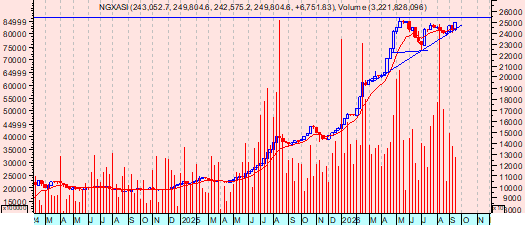
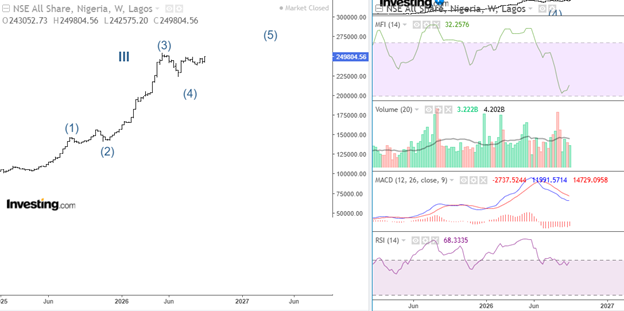
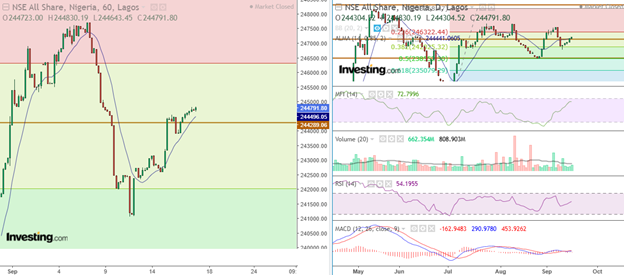
From a technical perspective, the NGX has entered a short-term corrective phase, with the latest decline reinforcing the negative momentum seen in the previous session.
The immediate technical focus is the 245,000-point area, which now represents an important support level. The ability of the ASI to hold above this region could determine whether the current decline remains a normal correction within the broader uptrend or develops into a deeper pullback.
A sustained move below 245,000 points could expose the market to further selling pressure as short-term traders respond to the breakdown. Such a move would likely increase caution among investors and could encourage additional profit-taking across recently outperforming stocks.
On the upside, the 247,000–248,000-point region remains an important resistance band. A recovery above this area, particularly if accompanied by improved market breadth and stronger buying volume, would provide an early signal that the correction may be losing momentum.
For the bulls to regain control, the market would need to see a combination of stronger demand in large-cap stocks, improved breadth and a reduction in the number of stocks making fresh lows.
In the short term, therefore, the outlook remains cautious to bearish. Investors may favour fundamentally strong companies with sustainable earnings, attractive dividend prospects and reasonable valuations while waiting for clearer signs of market stabilisation.
Oil Prices Decline as Hormuz Risk Remains
Developments in the international oil market also remained relevant to the Nigerian investment environment on Thursday.
Crude prices declined as investors weighed diplomatic discussions between Oman and Iran over the Strait of Hormuz against renewed military exchanges between Washington and Tehran. Brent futures fell $1.42, or 1.56%, to $89.32 per barrel at 1324 GMT, after touching an intraday high of $93.31.
U.S. West Texas Intermediate crude futures also declined by $1.14, or 1.35%, to $83.32 per barrel after reaching a high of $85.94.
The talks between Oman and Iran are being closely watched because the Strait of Hormuz remains one of the world’s most important energy corridors. Any progress towards ensuring safe passage could reduce fears of supply disruptions and ease some of the geopolitical premium currently embedded in oil prices.
However, the market remains vulnerable to further shocks. Renewed military activity between the United States and Iran continues to raise concerns about potential disruption to regional energy infrastructure.
The reported attack that caused a fire involving two gas vessels at Egypt’s Mediterranean port of Damietta also reinforced concerns over the vulnerability of energy assets in the region. The incident was confirmed by the Egyptian government as an attack rather than an accident.
For Nigeria, crude oil remains a critical external factor. Oil prices influence foreign exchange liquidity, government revenues, external reserves and broader investor confidence. A prolonged period of elevated crude prices could provide support for Nigeria’s external position, while a sharp decline in prices could create renewed macroeconomic pressures.
What Investors Should Watch
Going into the next trading sessions, investors will likely monitor whether the selling pressure spreads further across large-cap stocks or begins to moderate.
The performance of the banking sector will remain particularly important because of its weight within the market and its role in overall investor sentiment. A stabilisation in banking stocks could help the index recover, while continued losses in the sector would likely keep the ASI under pressure.
Trading volume will also provide an important signal. If the market continues to decline on elevated turnover, it could suggest that distribution is becoming more entrenched. Conversely, if turnover declines while prices stabilise, it could indicate that selling pressure is losing momentum.
Market breadth will be another key indicator. The current 44-to-17 decliner-to-gainer ratio reflects significant weakness. A gradual improvement in breadth would provide evidence of renewed participation by buyers, while another session of heavily negative breadth could reinforce the bearish near-term outlook.
The market will also need to reclaim the resistance area around 247,000–248,000 points before a stronger recovery can be confirmed. Until then, the prevailing strategy is likely to remain selective, with investors focusing on individual stock fundamentals rather than chasing broad market momentum.
Despite Thursday’s decline, the NGX remains significantly higher on a year-to-date basis. This leaves room for further profit-taking without necessarily changing the longer-term positive trend. However, the depth and duration of the current correction will depend on whether investors return to the market at key support levels.
The NGX All-Share Index (ASI) declined 0.66% to 245,362.26 points, from 246,980.17 points, while market capitalisation fell by approximately ₦1.01trn. The market’s YTD return moderated to 57.67%. Total volume traded surged 177.01% to 2.10bn shares, valued at ₦230.83bn across 48,231 deals. FIRSTHOLDCO dominated the session with 1.57bn shares worth ₦196.20bn, accounting for 74.77% of total volume and 85.00% of total value traded. ACCESSCORP and STERLINGNG contributed 1.78% and 1.71% of total volume, while ARADEL and ZENITHBANK followed FIRSTHOLDCO in value turnover. Market breadth remained negative, with 44 decliners against 17 gainers. Major market movers included NGXGROUP (-5.79%), WEMABANK (-5.65%), HBMNG (-4.00%), FIRSTHOLDCO (-3.96%), ZENITHBANK (-3.60%), NASCON (-3.50%), ACCESSCORP (-3.33%), CADBURY (-2.62%), PZ (-2.30%), NB (-2.22%), UACN (-1.70%), ETERNA (-1.64%), DANGSUGAR (-1.63%) and UBA (-1.29%). LEGENDINT emerged as the session’s top gainer, while TRIPPLEG led the losers’ chart, declining from ₦3.20 to ₦2.85. HMCALL also fell from ₦3.02 to ₦2.85, with both counters closing at fresh 52-week lows.