
Market Update For July 31, 2026
The Nigerian equities market closed the final trading session of July 2026 on a negative note, extending the cautious mood that dominated the last few trading days of the month as sustained profit-taking in highly capitalised stocks continued to outweigh bargain hunting across key sectors. The bearish close reflected investors’ decision to lock in gains after an impressive rally that has delivered one of the strongest year-to-date performances among frontier markets, even as the broader market fundamentals remain supportive.
Although buying interest persisted in selected banking, insurance and energy counters, it was insufficient to offset widespread selling pressure in several bellwether stocks. The session therefore ended with a marginal decline in the benchmark index, reinforcing the current consolidation phase as investors reassess portfolio positions ahead of the new month and react to the ongoing flood of half-year corporate earnings.
Trading sentiment remained mixed throughout the session, with institutional investors continuing to rebalance portfolios after months of sustained market appreciation. Retail investors also appeared cautious, preferring to take profits in stocks that have recorded substantial gains this year while gradually accumulating fundamentally strong companies with attractive dividend prospects and resilient earnings outlooks. This rotation between sectors continues to define market activity and explains why gains in several counters failed to reverse the broader market weakness.
The decline was largely driven by profit-taking in some of the market’s biggest names. Stocks such as CAP, VITAFOAM, TIP, NAHCO, OANDO, UBA, NB, STANBIC, MTNN, NASCON, CADBURY, WEMABANK and FIDELITYBK all came under selling pressure as investors booked profits following their strong price appreciation in recent months. The selloffs in these heavyweight stocks dragged the benchmark index lower despite renewed demand in selected insurance, industrial and energy counters.
Nevertheless, the session also highlighted the resilience of investor appetite for quality stocks. Several equities posted strong gains as bargain hunters took advantage of recent price weakness to accumulate fundamentally sound companies. Insurance stocks remained among the best-performing counters, while buying interest was also evident in selected industrial and oil & gas stocks. FIRSTHOLDCO maintained its impressive momentum by recording another fresh 52-week high, reinforcing confidence in the banking sector amid improving earnings expectations and stronger balance sheets.
Market activity slowed considerably compared with previous sessions, reflecting reduced participation as investors adopted a wait-and-see approach. Trading volume and value both moderated, suggesting that many market participants preferred to await additional corporate earnings releases before taking fresh positions. Despite the softer turnover, institutional investors remained active in large-cap stocks, particularly within the energy sector where SEPLAT continued to dominate value traded.
The gradual decline in trading activity also reflects the changing market dynamics after months of sustained bullish momentum. Rather than broad-based buying, investors are becoming increasingly selective, concentrating their attention on companies with strong earnings visibility, healthy cash flows, consistent dividend history and attractive valuations. This selective accumulation is expected to become more pronounced as additional audited and half-year financial statements are released in the coming weeks.
Macroeconomic fundamentals continue to provide support for the Nigerian market despite the recent correction. Inflation has continued to moderate, foreign exchange conditions have shown greater stability, external reserves remain relatively healthy and government reforms aimed at improving fiscal sustainability are gradually strengthening investor confidence. These developments, combined with expectations of stronger corporate earnings, continue to support the medium-term investment case for Nigerian equities.
The banking sector is expected to remain a major driver of market performance as investors position for stronger earnings growth, higher interest income and improved capital positions. Consumer goods companies are also attracting attention as easing inflation gradually improves household purchasing power, while the energy sector continues to benefit from stronger international crude oil prices and sustained reforms within Nigeria’s oil industry.
Beyond the domestic market, investors are also monitoring developments in the global economy. Expectations regarding interest rate decisions by major central banks, geopolitical tensions in the Middle East, global inflation trends and movements in commodity prices continue to shape investment flows into emerging and frontier markets. These external factors could influence foreign portfolio participation on the Nigerian Exchange over the coming weeks.
Crude oil prices strengthened further on Friday and remained on course to record one of their strongest monthly performances this year. Brent crude traded above $90 per barrel, while West Texas Intermediate (WTI) climbed above $85 per barrel following reports of disruptions to tanker movements through the Strait of Hormuz. Concerns over shipping flows and geopolitical tensions prompted traders to reassess global supply risks, supporting oil prices throughout the session. For Nigeria, sustained higher crude prices remain positive for foreign exchange earnings, government revenue and fiscal stability, factors that could indirectly support investor sentiment on the domestic bourse.
The stronger oil market also enhances the earnings outlook for listed energy companies, particularly upstream producers that benefit directly from higher crude prices. Should oil prices remain elevated, investors may continue rotating into energy stocks, especially companies with robust production volumes and healthy balance sheets.
Technical Analysis and Outlook
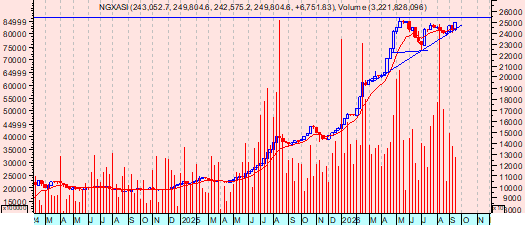
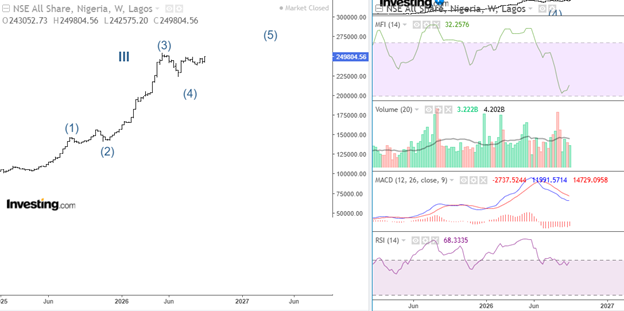
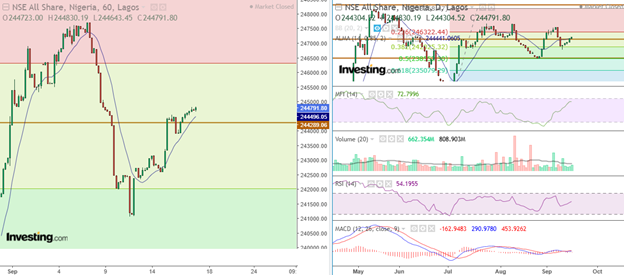
From a technical standpoint, the Nigerian Exchange remains in a medium-term uptrend despite the recent pullback. The ongoing decline appears to be a healthy correction following months of uninterrupted gains rather than the beginning of a sustained bearish reversal. The benchmark index continues to trade above key medium-term support levels, suggesting that the broader bullish structure remains intact.
The 245,000-point region has now emerged as a critical support level. A successful defence of this zone could encourage renewed bargain hunting, particularly by institutional investors seeking attractive entry points ahead of stronger earnings releases. Such a rebound could propel the market back toward the 247,000 and 250,000-point resistance levels.
However, failure to sustain this support could trigger additional profit-taking in the short term, especially in stocks that have significantly outperformed the market this year. Even so, the strength of corporate earnings, attractive dividend expectations and improving macroeconomic indicators should limit the downside and encourage fresh accumulation whenever valuations become compelling.
Momentum indicators have weakened slightly, reflecting reduced buying pressure and increased caution among investors. Market liquidity, however, remains healthy, and institutional participation continues to support selected sectors. Investors are therefore advised to focus on fundamentally strong companies with consistent earnings growth, resilient cash flows and sustainable dividend policies while avoiding speculative trades driven solely by short-term price movements.
Looking ahead, the market is expected to remain earnings-driven, with investors closely analysing half-year financial results for signals on corporate profitability and dividend prospects. Stocks posting stronger-than-expected earnings could attract renewed institutional inflows, while companies delivering weak numbers may continue to face selling pressure. Overall, the medium- to long-term outlook for Nigerian equities remains constructive despite the current consolidation phase.
The NGX All-Share Index (ASI) declined by 78.58 points, or 0.03%, to close at 245,283.68 points from 245,362.26 points, while market capitalisation slipped by ₦13.24 billion to ₦158.33 trillion. The market still delivered an impressive year-to-date return of 57.62%, reflecting the strength of the rally recorded since the beginning of the year. Market breadth finished slightly negative with 36 gainers, 37 losers and 73 unchanged stocks, indicating mixed sentiment across sectors. Trading activity weakened as investors exchanged 692.89 million shares worth ₦44.84 billion in 55,357 deals. AVACAP emerged as the volume leader with 91.12 million shares, while SEPLAT topped the value chart with transactions worth ₦16.26 billion. On the gainers’ table, CONHALLPLC, ETERNA and REGALINS appreciated by 10.00% each, while FTGINSURE led the losers with a 10.00% decline. Other notable laggards included CAP (-9.97%), VITAFOAM (-7.70%), TIP (-6.67%), NAHCO (-6.63%), OANDO (-4.56%), UBA (-2.94%), NB (-2.67%), STANBIC (-2.42%) and MTNN (-2.35%). FIRSTHOLDCO also extended its strong run, hitting a fresh 52-week high of ₦129.55 from ₦127.00, underscoring sustained investor confidence in the stock despite the market’s cautious close.