
Nigerian Stock Market Note For Month Ended July 31, 20
Akintunde Oyedokun
The Nigerian equities market sustained its bullish momentum, posting another month of impressive gains in July 2026, despite increased profit-taking witnessed in the closing sessions.
The NGX All-Share Index (ASI) advanced from 225,690.07 basis points at the beginning of the month to 245,283.68bps when trading closed on July 31, representing a cumulative 8.68% gain. Market capitalisation settled at ₦158.326 trillion, while the year-to-date return stood at 57.62%.
Trading throughout the month reflected the strong institutional demand particularly for banking stocks, alongside renewed interests in selected insurance, consumer goods and industrial counters.
Although profit-taking emerged after the market tested the 248,000-point level, the broader market remained firmly in positive territory.
Market Performance
The NGX delivered another impressive monthly performance with the strongest advance coming during the second week, while the final week reflected healthy profit-taking after the sustained rally.
Banking stocks remained the major drivers of market performance, supported by strong investor confidence and improved liquidity. Insurance stocks also attracted significant interest, while activity in consumer goods and industrial counters remained selective.
Top Gainers
FTGINSURE emerged as the best-performing stock in July with a remarkable 136.36% appreciation. FIRSTHOLDCO followed closely with a gain of 126.49%, while THOMASWY advanced 59.27%. UPDCREIT appreciated 52.20%, CNIF gained 33.02%, ABBEYBDS rose 32.63%, and ENAMELWA increased 31.17%.
Top Losers
MECURE led the decliners after shedding 40.78% during the month. INTENEGINS lost 28.32%, CAP declined 26.76%, ABCTRANS fell 26.28%, HMCALL dropped 25.77%, VFDGROUP lost 24.88%, while TIP declined 22.89%.
Week One: Investors Open July with Profit-Taking
The market began July on a cautious note as investors booked profits across major sectors. The ASI declined 1.63% on July 1 to 225,690.07 points, erasing ₦2.39 trillion from investors’ wealth. The selling pressure continued on July 2, with the benchmark shedding another 0.61% to 224,321.97 points, reducing market value by ₦877.91 billion.
Buying interest returned on July 3, lifting the ASI by 2.19% to 229,240.19 points as investors gained ₦3.16 trillion. The rebound helped moderate the week’s losses, although the market still ended the week 1.21% lower at 229,240.34 points, with market capitalisation closing at ₦147.103 trillion.
Weekly turnover improved to 3.821 billion shares valued at ₦154.393 billion in 258,567 deals, compared with 2.324 billion shares worth ₦134.486 billion in 249,328 deals recorded in the previous week.
Financial Services remained the most active sector with 2.330 billion shares worth ₦54.606 billion, accounting for 60.99% of traded volume, while Services and Consumer Goods followed with 509.473 million shares and 216.344 million shares, respectively.
Week Two: Banking Rally Sparks Strongest Weekly Advance
The second week witnessed the strongest rally of the month as aggressive buying in banking and blue-chip stocks pushed the ASI 6.35% higher to 243,798.76 points. Market capitalisation climbed to ₦156.445 trillion, while the YTD return strengthened to 56.67%.
The market gained 2.15% on July 6, 1.24% on July 7, 2.27% on July 8, and 0.62% on July 9, before recording a marginal 0.07% decline on July 10 as investors took profits.
The week’s trading volume stood at 3.648 billion shares worth ₦220.568 billion in 251,861 deals.
Financial Services dominated market activity with 2.899 billion shares valued at ₦147.360 billion, representing 79.48% of volume and 66.81% of value. First HoldCo, Zenith Bank and Fidelity Bank jointly accounted for 1.745 billion shares worth ₦121.828 billion, highlighting sustained investor interest in the banking sector.
Week Three: Market Consolidates
Following the previous week’s sharp rally, the market entered a consolidation phase. The ASI declined 0.14% on a weekly basis to 243,462.13 points, although market capitalisation edged 0.39% higher to ₦157.057 trillion.
The benchmark lost 0.84% on July 13, recovered 0.46% on July 14, slipped 0.21% on July 15, eased 0.09% on July 16, and rebounded 0.54% on July 17.
Investors traded 2.819 billion shares worth ₦182.499 billion in 226,729 deals during the week.
Financial Services again dominated activity with 2.006 billion shares valued at ₦99.697 billion, while Consumer Goods and Oil & Gas followed with 178.863 million shares and 151.237 million shares, respectively.
Week Four: Bulls Push ASI Above 247,000 Points
Renewed buying momentum returned in the fourth week as investors positioned ahead of earnings expectations. The ASI appreciated 1.60% to 247,357.40 points, while market capitalisation rose to ₦159.588 trillion.
The market advanced 1.12% on July 20 and 0.19% on July 21 before profit-taking triggered a 0.50% decline on July 22. Strong buying resumed on July 23, when the ASI gained 0.98% to reach the month’s highest level of 247,831.40 points before easing 0.19% on July 24.
Weekly turnover rose to 4.433 billion shares worth ₦306.143 billion in 255,589 deals.
Financial Services accounted for 3.422 billion shares valued at ₦207.206 billion, representing 77.18% of total volume, while Consumer Goods and ICT recorded 201.978 million shares and 169.481 million shares, respectively.
Week Five: Profit-Taking Slows Market Momentum
The final week was dominated by profit-taking after the market approached the 248,000-point resistance level.
The ASI dipped 0.05% on July 27, recovered 0.30% on July 28, declined 0.41% on July 29, dropped 0.66% on July 30, and closed the month with a marginal 0.03% loss at 245,283.68 points on July 31.
Despite the weaker finish, trading activity reached its highest level of the month as investors exchanged 5.119 billion shares valued at ₦404.762 billion in 285,223 deals.
Financial Services remained the dominant sector with 3.918 billion shares worth ₦271.428 billion, accounting for 76.55% of total traded volume.
Macroeconomic Environment
Nigeria’s external reserves rose by $1.9 billion to $51.5 billion in June 2026, providing additional support for the country’s external position and foreign exchange stability.
Headline inflation eased marginally to 15.91% in June from 15.93% in May, while food inflation remained elevated at 17.52%. The marginal decline in headline inflation offered some support to investor sentiment, although persistent food-price pressures remained a concern.
The Central Bank of Nigeria retained its benchmark interest rate at 26.50% for the second consecutive meeting, keeping monetary conditions tight as authorities continued to monitor inflation and broader economic risks.
Technical Analysis
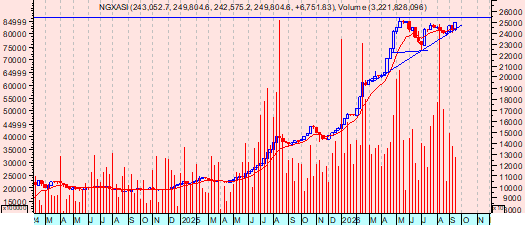
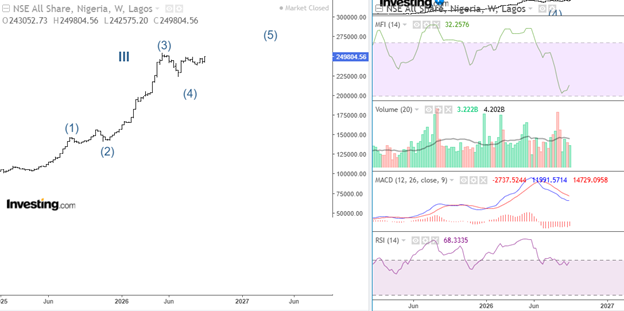
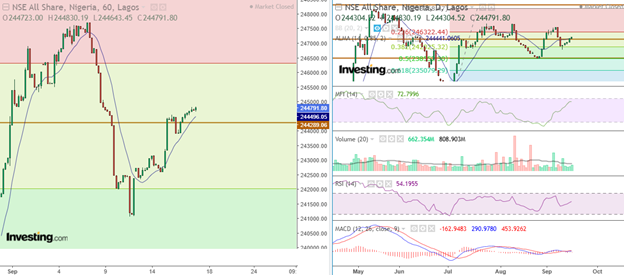
Technically, the NGX maintained its medium-term bullish structure throughout July despite the late-month correction. The index successfully advanced from 225,690.07 points to an intra-month high of 247,831.40 points, confirming sustained buying momentum.
The 242,000–243,000-point zone now serves as the immediate support area, while 248,000 points remains the major resistance level. Momentum indicators suggest that the broader trend remains positive, although the increase in profit-taking during the final trading sessions points to weakening short-term momentum.
The significant rise in trading volume towards month-end also indicates active portfolio rebalancing, suggesting that institutional investors remain engaged despite intermittent market weakness.
Outlook
The outlook for August remains constructive but cautious. Strong corporate earnings expectations, sustained interest in fundamentally sound banking stocks and improving macroeconomic conditions are expected to provide support for the market.
However, after delivering an 8.68% monthly return and 57.62% year-to-date gain, intermittent profit-taking is likely to persist. The ability of the ASI to hold above the 242,000-point support level will be critical. A sustained breakout above 248,000 points could trigger another wave of buying, while a break below support may result in a deeper market correction before the broader uptrend resumes.
Global Market and Oil: Global financial markets ended July 2026 on a broadly positive note, although trading remained volatile as investors weighed strong corporate earnings, artificial intelligence optimism, interest-rate expectations and rising geopolitical tensions.
U.S. equities remained among the strongest performers. The S&P 500 gained 0.7% on July 31 to close at 7,489.72 points, while the Dow Jones Industrial Average rose 0.5% to 52,485.03 points. The Nasdaq Composite advanced 1.0% to 25,373.85 points. For the week, the Nasdaq gained 1.6%, while the S&P 500 and Dow increased 1.0% each.
Strong earnings from major technology companies supported sentiment, with continued investment in artificial intelligence remaining a key driver of market optimism. However, concerns over elevated valuations and the sustainability of heavy AI spending triggered periodic profit-taking.
European Markets
European equities also recorded solid gains during July. The FTSE 100 and Germany’s DAX remained supported by improved corporate earnings expectations and resilient investor sentiment.
The FTSE 100 reached a record level during the month, reflecting strength in large-cap stocks and energy-related companies. However, rising crude oil prices toward the end of July increased concerns about renewed inflationary pressure and the potential impact on monetary policy.
Asian Markets
Asian markets delivered mixed performances as investors responded to developments in global technology stocks, trade, currencies and regional economic conditions.
Japan’s Nikkei remained one of the strongest major Asian benchmarks, while China’s Shanghai Composite and Hong Kong’s Hang Seng faced greater challenges. Semiconductor and technology stocks experienced significant swings as investors reassessed valuations and the outlook for global chip demand.
The divergence across Asian markets highlighted differences in economic growth, monetary policy and exposure to global technology and commodity trends.
Emerging Markets
Emerging-market equities remained sensitive to movements in the U.S. dollar, interest rates, commodity prices and geopolitical developments.
Higher crude oil prices supported oil-producing economies but created pressure for major energy importers. Investors also remained cautious about currencies and inflation, particularly in economies with high external financing needs.
Oil Market
Crude oil was one of the biggest stories of July. Prices surged as geopolitical tensions raised concerns about global supply disruptions and the security of major shipping routes.
Brent crude ended July at $90.12 per barrel, representing a 24% monthly increase, while West Texas Intermediate settled at $84.67 per barrel, gaining approximately 21% during the month.
The rally was driven mainly by geopolitical concerns, particularly risks surrounding crude shipments through the Strait of Hormuz and other strategic routes. Falling U.S. crude inventories also provided additional support.
The increase in oil prices became an important concern for global investors because higher energy costs could push inflation higher and make it more difficult for central banks to reduce interest rates.
Energy Stocks
The oil rally provided strong support for energy companies. Oil producers, refiners and other energy-related stocks benefited from expectations of stronger revenues and cash flows.
However, the impact of higher crude prices was less positive for the broader economy. Sustained increases in energy costs could raise transportation and production expenses, squeeze corporate margins and reduce household purchasing power.
Key Market Drivers
Corporate earnings: Strong quarterly results, particularly from major technology companies, supported global equity markets and reinforced confidence in corporate profitability.
Artificial intelligence: AI remained a major investment theme. Demand for semiconductors, cloud computing and data-centre infrastructure continued to support technology stocks, although high valuations increased the risk of sharp corrections.
Geopolitical tensions: Rising tensions in the Middle East increased uncertainty across financial markets and pushed oil prices sharply higher.
Interest rates: Investors continued to monitor inflation and central-bank policy. Higher oil prices created fresh concerns that energy-driven inflation could delay monetary easing.
Technical Analysis
Global equities retained a medium-term bullish structure during July despite periods of profit-taking and volatility. The S&P 500 and Nasdaq remained close to record levels, supported by strong technology and AI-related momentum.
The S&P 500’s move around the 7,500-point psychological level is important. A sustained break above this level could reinforce the bullish trend, while weakness below the 7,400 region could encourage a deeper correction.
Oil’s technical structure also turned strongly bullish. Brent’s move toward $90 per barrel represents a major psychological level. Sustained trading above this zone could expose prices to the $95-$100 region, while easing geopolitical tensions could trigger a pullback toward the low-$80s.
Outlook
The outlook for August remains cautiously bullish but highly volatile.
Equity markets could extend their gains if corporate earnings remain strong, AI investment continues to expand and geopolitical tensions ease. However, elevated valuations, rising oil prices and inflation risks could limit further gains.
The relationship between oil prices and interest rates will remain particularly important. If Brent stays above $90 for an extended period, higher energy costs could push inflation expectations higher and reduce expectations for aggressive monetary easing.
For crude oil, geopolitical developments remain the biggest price catalyst. Continued disruptions to global supply routes could push Brent toward $100, while an improvement in geopolitical conditions could cause prices to retreat sharply.
Conclusion
July 2026 was a positive but volatile month for global financial markets. U.S. and European equities maintained their upward momentum, while Asian markets delivered mixed performances. Strong corporate earnings and continued AI investment supported equities, but geopolitical tensions and the sharp rise in crude oil prices introduced fresh inflationary risks.
The S&P 500 closed July at 7,489.72 points, the Dow at 52,485.03 points and the Nasdaq at 25,373.85 points. Meanwhile, Brent crude ended the month at $90.12 per barrel, while WTI settled at $84.67.
Overall, global markets enter August with a positive underlying trend but face increasing risks from oil prices, inflation, interest rates, geopolitical tensions and stretched technology valuations.