
Market Update For October 9, 2026
The Nigerian equities market returned to positive territory on Friday, October 9, 2026, as selective bargain hunting in large-cap stocks helped the benchmark index recover modestly after seven consecutive sessions of losses. However, persistent selling pressure across several listed equities kept overall market sentiment cautious, suggesting that investors remain focused on protecting gains accumulated over the course of the year.
The session’s performance reflected a market caught between bargain-hunting opportunities and continued profit-taking. While renewed demand for selected stocks supported the benchmark index, the number of declining equities indicated that the recovery was not broad-based. Investors appeared to be taking advantage of lower prices in selected counters while reducing exposure to stocks facing sustained selling pressure.
The gains recorded in CAP, OANDO, MTNN, UNILEVER, UPDC and other advancing stocks provided support for the market, helping to offset losses in several other equities. However, the persistence of negative market breadth suggests that confidence has yet to improve sufficiently to support a sustained recovery across the broader market.
The latest rebound also comes against the backdrop of a market that has delivered substantial returns since the beginning of the year. With the year-to-date performance remaining strong despite the recent correction, investors are increasingly balancing the opportunity to accumulate fundamentally sound stocks at more attractive prices against the need to lock in profits and manage portfolio risk.
The modest improvement in the All-Share Index suggests that buying interest has returned to selected equities following the recent market downturn. However, the limited size of the advance indicates that investors remain cautious about committing fresh capital aggressively.
Large-cap stocks continue to play an important role in determining the direction of the Nigerian equities market because of their influence on the benchmark index and overall market capitalisation. Gains in selected stocks can therefore support the index even when selling pressure persists across a significant portion of the market.
This pattern was evident during Friday’s session, as advances in CAP, OANDO, MTNN and UNILEVER helped lift the market despite the larger number of declining stocks. The performance highlights the importance of examining market breadth alongside the benchmark index when assessing the underlying strength of a trading session.
A positive close does not necessarily indicate that the broader market has regained its upward momentum. Rather, the combination of a modest index gain and negative market breadth suggests that the recovery was concentrated in selected counters, with investors remaining selective in their allocation decisions.
For the market to establish a stronger recovery, buying interest would need to extend beyond a handful of influential stocks. Improved participation across banking, consumer goods, industrial goods, telecommunications and other sectors would provide a more convincing indication that investor confidence is returning.
Despite the market’s return to positive territory, profit-taking remained a dominant feature of trading. The 34 declining stocks against 25 advancing equities indicated that selling pressure continued to affect several listed companies.
The trend reflects the cautious approach investors have adopted following the substantial appreciation recorded by Nigerian equities over the past several months. As share prices rise, some investors typically seek to realise gains, particularly when concerns emerge about valuations, earnings expectations or the sustainability of the market’s rally.
This behaviour can produce periods of consolidation in which the benchmark index fluctuates within a relatively narrow range while individual stocks experience significant price movements. Stocks with strong fundamentals, improving earnings prospects and attractive dividend yields may continue to attract buying interest, while counters perceived to have limited near-term upside may remain vulnerable to profit-taking.
The current market environment therefore requires investors to distinguish between temporary price weakness and a deterioration in the underlying investment case of individual companies. A decline in share price does not automatically make a stock attractive, just as a rising price does not necessarily indicate that it remains undervalued.
Investors are likely to pay closer attention to corporate earnings, dividend expectations, balance-sheet strength and sector-specific developments when making allocation decisions. This approach could favour companies with sustainable earnings growth and the capacity to withstand changing economic conditions.
Trading activity declined during the session, reflecting a more restrained approach by market participants. The reduction in traded volume suggests that investors were less aggressive in executing transactions, even as selected stocks recorded notable price gains.
Zenith Bank remained the most prominent stock by trading volume and value, highlighting its importance in the market’s daily activity. The bank accounted for a substantial proportion of total traded value, while GTCO and Access Holdings also featured prominently in volume transactions.
The concentration of trading activity in major banking stocks underscores the continued importance of the financial services sector to market liquidity. Banking equities often attract significant investor attention because of their trading depth, dividend prospects, earnings visibility and sensitivity to monetary policy developments.
However, the decline in overall market activity suggests that the modest rebound was not accompanied by a decisive increase in trading participation. A sustained recovery would be more convincing if supported by rising volumes, improving market breadth and stronger demand across several sectors.
Lower trading activity during a positive session may indicate that investors are still waiting for clearer signals before increasing their exposure. It may also reflect a temporary balance between buyers seeking opportunities at lower prices and sellers looking to exit positions after the recent market weakness.
The direction of trading activity in subsequent sessions will therefore be important in determining whether Friday’s rebound represents the beginning of a recovery or merely a temporary interruption in the market’s downward movement.
Livestock attracted attention after its share price advanced to a new 52-week high of ₦13.15, reflecting strong buying interest during the session. The stock’s performance stood out against the broader market’s cautious tone and demonstrated that investors continued to identify opportunities in selected counters.
A move above a 52-week high can indicate positive price momentum, particularly when accompanied by strong trading activity. However, investors should also assess the sustainability of the movement by examining the company’s earnings performance, valuation, liquidity and broader business outlook.
The performance of individual stocks during periods of market weakness can differ significantly from that of the benchmark index. While some companies experience continued selling pressure, others may benefit from company-specific developments, improving investor expectations or renewed interest from traders seeking momentum opportunities.
Livestock’s advance therefore highlights the importance of combining broader market analysis with stock-specific research. Investors seeking opportunities in the current environment should consider whether recent price movements are supported by underlying business performance rather than relying solely on short-term market momentum.
Oil Market
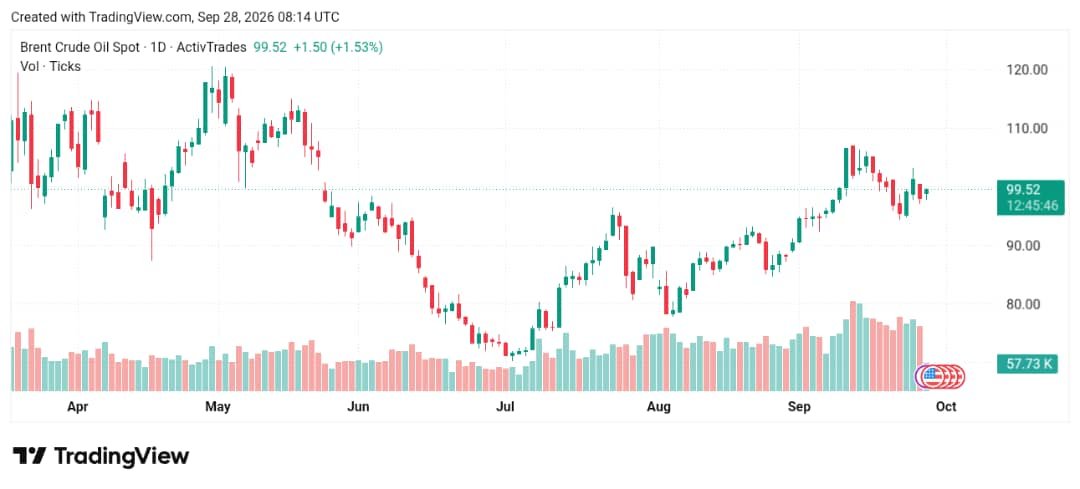
International crude oil prices declined on Friday as easing concerns over potential supply disruptions in the Middle East reduced some of the geopolitical risk premium in the market.
Brent crude futures fell by 1.1% to $103.18 per barrel, while US West Texas Intermediate crude declined by 0.5% to $91.00 per barrel. Prices came under pressure after US President Donald Trump indicated that the United States would not attack Iran before next month’s midterm elections and referred to productive discussions aimed at ending the conflict.
Expectations that China would resume refined fuel exports following a brief suspension during its Golden Week holiday also weighed on prices. As the world’s largest oil importer, China’s fuel demand and export policies remain important factors in determining global energy market dynamics.
Despite Friday’s decline, Brent crude was positioned for a weekly gain following a strong advance in the previous session, while WTI was heading towards a slight weekly decline.
For Nigeria, movements in crude oil prices carry important implications for government revenue, foreign exchange earnings, external reserves and broader macroeconomic stability. Higher oil prices can support public finances and foreign exchange inflows, although the overall benefit depends on domestic production levels, fiscal arrangements and the cost of importing refined petroleum products.
Conversely, a sustained decline in oil prices could moderate expected revenue inflows and influence investor expectations regarding the country’s external position. Developments in the global oil market therefore remain relevant to the outlook for Nigerian equities, particularly energy-related stocks and companies sensitive to changes in foreign exchange conditions and domestic purchasing power.
However, the effect on individual listed companies will vary according to their business models, cost structures, revenue exposure and ability to pass changing costs on to consumers.
Technical Analysis and Market Outlook
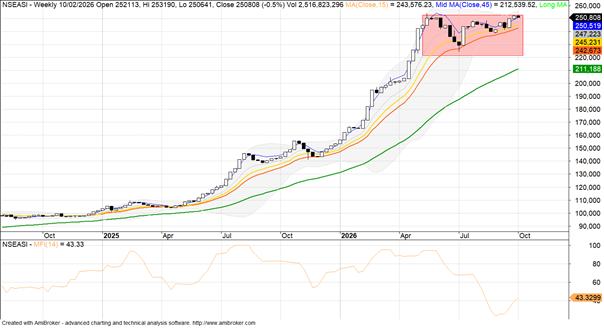
From a technical perspective, the All-Share Index’s 0.13% advance following seven consecutive sessions of losses represents a modest improvement in short-term price momentum. Nevertheless, the relatively small gain and negative market breadth suggest that the market has not yet established a convincing reversal of its recent downward trend.
The 248,000-point region is an important near-term reference level to monitor, as the index’s ability to sustain trading above this area could help support a period of consolidation and potential recovery. Continued buying interest in large-cap stocks may provide further support, although a stronger upward move would require broader participation from other market sectors.
The immediate outlook remains dependent on whether buyers can sustain the recovery in subsequent sessions. An improvement in market breadth, accompanied by rising trading volume and consistent gains in the benchmark index, would strengthen the case for a more durable rebound. Conversely, a return to widespread declines could indicate that Friday’s advance was temporary and that the market remains exposed to further profit-taking.
Investors should also monitor the performance of banking, telecommunications, consumer goods and industrial stocks, given their potential influence on the benchmark index. Stocks with strong earnings visibility, sound financial positions and attractive valuations may offer relatively better opportunities in a market characterised by selective buying and heightened price sensitivity.
The current environment also reinforces the importance of disciplined portfolio management. Investors should avoid making decisions solely on the basis of short-term price movements and instead consider corporate fundamentals, valuation levels, liquidity and individual risk tolerance.
In the near term, the Nigerian equities market is likely to remain selective as investors assess the sustainability of the recent correction and search for stocks offering attractive risk-adjusted returns. Friday’s positive close provides some relief after seven consecutive sessions of losses, but a sustained recovery will depend on stronger market participation and a meaningful reduction in selling pressure.
Market Summary: The NGX All-Share Index (ASI) gained 321.05 points, or 0.13%, to close at 248,363.55 points, while market capitalisation rose by ₦208.46 billion to ₦161.26 trillion. The market’s year-to-date return stood at 59.60%, reflecting its substantial appreciation since the beginning of 2026 despite the recent correction. Total trading volume stood at approximately 322.01 million shares, valued at ₦20.49 billion, across 37,758 deals. Market breadth remained negative, with 34 decliners against 25 gainers, while 87 stocks closed unchanged, indicating that selling pressure persisted across several equities despite the benchmark’s advance. Market movers included CAP, OANDO, UPDCREIT, MTNN and UNILEVER, while Zenith Bank led trading by volume with 31.69 million shares exchanged and also recorded the highest traded value at approximately ₦4.30 billion. Top Gainers: LIVESTOCK (+9.58% to ₦13.15), GUINEAINS (+9.41% to ₦0.93), REGALINS (+8.57% to ₦0.76), CAP (+8.50% to ₦108.50) and UPDC (+7.69% to ₦4.20). Top Losers: REDSTAREX (-9.76% to ₦13.40), AVACAP (-9.48% to ₦5.25), LEGENDINT (-8.22% to ₦3.35), DAARCOMM (-8.00% to ₦1.38) and WAPIC (-7.26% to ₦2.30).