

Market Update For October 14, 2026
The Nigerian equities market returned to positive territory on Wednesday, October 14, 2026, as renewed buying interest in selected stocks lifted the benchmark All-Share Index (ASI), reversing part of the previous session’s losses. Gains in banking, insurance and other listed companies supported the recovery, although continued profit-taking in selected equities and subdued trading activity suggested that investors remained cautious.
The session’s performance reflected a market struggling to establish a firm direction following recent losses. While bargain hunting in selected stocks helped the benchmark recover, the modest appreciation indicated that buying pressure remained insufficient to trigger a broad-based rally. Investors continued to reposition their portfolios around selected counters, balancing opportunities for capital appreciation against prevailing valuation concerns, earnings expectations and the risk of further price corrections.
The NGX All-Share Index advanced by 160.02 points, representing a 0.06% increase, to close at 247,673.65 points from 247,513.63 points recorded in the previous session. The recovery lifted the market’s year-to-date return to 59.16%, reinforcing the substantial gains accumulated by equities investors since the beginning of the year despite intermittent periods of profit-taking.
Market capitalisation increased by ₦103.90 billion to ₦160.81 trillion, reflecting the improvement in the aggregate value of listed equities. Although the gain was relatively modest, the positive close offered some relief following Tuesday’s decline and suggested that investors were willing to accumulate selected stocks at prevailing prices.
However, the market’s performance remained uneven, with gains concentrated in selected counters rather than distributed uniformly across the exchange. This divergence highlighted the importance of stock selection in the current trading environment, as individual company performance and investor positioning continued to influence price movements.
Buying interest in selected banking, insurance and other equities provided support for the market, with AFRIPRUD, MBENEFIT, WEMABANK, TIP, ARADEL, ACCESSCORP, AIICO, GTCO and UBA among the stocks that recorded gains during the session.
AFRIPRUD appreciated by 5.88%, while MBENEFIT advanced by 3.55%. WEMABANK gained 2.65%, TIP rose by 2.37%, and ARADEL increased by 1.67%. These advances reflected renewed demand for selected equities, although the extent to which the gains would be sustained will depend on continued investor participation and the underlying fundamentals of the respective companies.
In the banking sector, ACCESSCORP advanced by 1.43%, AIICO gained 1.02%, GTCO rose by 0.23%, while UBA added 0.12%. The positive performance of these counters helped reinforce the market’s recovery, although the relatively modest gains in GTCO and UBA suggested that investors remained measured in their exposure to some of the market’s prominent banking stocks.
The performance of financial services stocks remains important to the direction of the Nigerian equities market, given their representation among actively traded and closely monitored counters. Movements in these stocks can influence investor sentiment, particularly when market participants are assessing earnings prospects, dividend expectations, asset quality and the potential effects of monetary policy on corporate performance.
Nevertheless, the session’s advances should not be interpreted as confirmation of a sustained bullish trend. The market’s relatively small gain, combined with weaker trading activity, indicates that investors may still be waiting for stronger signals before committing additional funds to equities.
Despite the positive close, selling pressure remained evident in several stocks, reflecting the continued willingness of investors to realise profits and reduce exposure to selected positions.
The declines highlighted the mixed nature of investor sentiment, with demand supporting selected equities while other counters remained under pressure. Such divergence is common in markets where investors are increasingly selective about entry prices, valuation levels and the sustainability of recent gains.
The performance of real estate-related equities was particularly weak, with losses in UPDCREIT and UPDC placing both stocks among the session’s underperformers. However, these price movements alone do not establish the underlying reasons for the declines, which may reflect a combination of profit-taking, stock-specific developments and changing investor preferences.
For investors, the current environment reinforces the need to distinguish between temporary price movements and changes in a company’s underlying financial position. Stocks that experience sharp gains may attract profit-taking, while declining equities require closer assessment of their earnings outlook, balance sheets, liquidity and valuation before any investment decision is made.
Market breadth remained positive, indicating that advancing stocks outnumbered declining equities during the session. A total of 32 stocks advanced, 18 declined, while 96 closed unchanged.
The positive breadth provided additional evidence that buying interest extended beyond the benchmark’s movement, although the large number of unchanged stocks suggested that participation was not sufficiently broad to produce a stronger market-wide advance.
The distribution of gainers and losers suggests that investors continued to pursue opportunities at the individual stock level rather than adopting an indiscriminate buying strategy. For the market to sustain an upward movement, further improvement in breadth, accompanied by stronger trading activity, would provide a more convincing indication of strengthening demand.
Investors are likely to remain attentive to stocks showing consistent price appreciation and improving fundamentals. However, sharp price movements should be evaluated alongside corporate announcements, financial performance and trading liquidity to determine whether they reflect sustainable demand or short-term speculative activity.
Trading activity declined during the session, suggesting that the market’s recovery was not accompanied by stronger transaction volumes. This development warrants attention because a sustainable market advance typically benefits from increased participation and consistent demand across a broader range of stocks.
ACCESSCORP dominated trading by volume, with 99.37 million shares changing hands. The stock accounted for a substantial proportion of the reported volume, underlining its importance to the day’s trading activity. SEPLAT also featured prominently in the value breakdown, reflecting significant transactions in the company’s shares.
The prominence of these stocks illustrates the influence that highly traded counters can have on overall market activity. However, high turnover in individual equities does not necessarily indicate broad-based market strength, particularly when activity remains concentrated in a relatively small number of companies.
Investors will therefore be watching for an improvement in market turnover and wider participation in subsequent sessions. A recovery supported by higher volumes could strengthen confidence in the market’s ability to regain upward momentum, while continued weakness in trading activity may indicate that investors are still waiting for clearer market signals.
The supplied market summaries contain inconsistent figures for total traded volume and transaction value. The closing summary reports 313.90 million shares valued at ₦14.19 billion across 30,922 deals, while the earlier activity breakdown provides different volume and value figures. These discrepancies should be reconciled against the official NGX closing data before publication.
Technical Analysis and Market Outlook
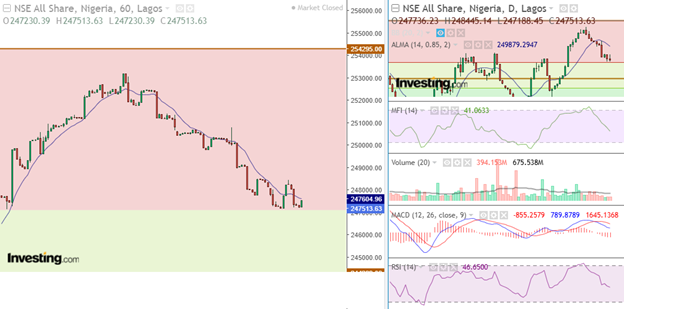
From a technical perspective, the ASI’s recovery to 247,673.65 points suggests an attempt to stabilise after the previous session’s decline. However, the 0.06% gain remains relatively small, indicating that the market has yet to demonstrate sufficient momentum to confirm a decisive reversal.
The 247,000-point region represents an important near-term area to monitor for potential support. A sustained hold above this level could help the index consolidate its recent movements and provide a foundation for another upward attempt. However, a break below this region could increase the risk of further losses, particularly if accompanied by stronger selling pressure.
On the upside, the 250,000-point level remains a key psychological and technical reference point. A sustained recovery towards and above this level, supported by stronger turnover and improving market breadth, would provide a more convincing signal that buying interest is strengthening.
Nevertheless, technical levels should be treated as indicative rather than definitive. The market’s direction will also depend on investor sentiment, corporate earnings releases, liquidity conditions and broader economic developments.
The positive market breadth is encouraging, but the relatively weak index appreciation and lower trading activity suggest that investors remain cautious. The market may therefore continue to experience stock-specific movements, with fundamentally attractive companies attracting demand while other equities face intermittent profit-taking.
In the near term, investors are likely to maintain a selective approach, paying close attention to earnings performance, dividend prospects, balance-sheet strength and valuation. Companies capable of sustaining revenue growth and profitability in the prevailing economic environment may continue to attract interest, although price discipline remains essential amid the possibility of further market volatility.
Oil Market
In the international commodities market, oil prices steadied on Wednesday following gains driven by attacks on the headquarters of Saudi Arabia’s state-owned oil company and concerns over threats to shipping in the Strait of Hormuz.
Brent crude futures rose by 13 cents to $105.56 per barrel, while US West Texas Intermediate crude gained $1.25, or 1.33%, to $95.39. The price movements reflected continued concerns about potential supply disruptions arising from escalating geopolitical tensions in the Middle East.
Market participants remained focused on the security of shipping routes and the possibility that military confrontations could affect crude exports from the region. Although these risks supported prices, the actual impact on supply remained uncertain, with the market continuing to assess whether export flows would be materially disrupted.
For Nigeria, sustained elevated crude oil prices could improve export earnings and support government revenue, particularly if domestic production and export volumes remain resilient. Higher prices may also strengthen foreign-exchange inflows and provide some support for external reserves.
However, the benefits to the domestic economy would depend on production levels, export receipts, fiscal management and the broader effects of expensive energy on global economic activity. Elevated international oil prices can also contribute to inflationary pressures and increase costs across transportation, manufacturing and other energy-dependent sectors.
Developments in the oil market therefore remain relevant to the Nigerian equities market, given the relationship between crude oil earnings, foreign-exchange conditions, investor confidence and the broader economic outlook. Investors will continue to monitor geopolitical developments alongside domestic economic indicators for signals that could influence market direction.
Market Summary: The Nigerian Exchange All-Share Index (ASI) gained 160.02 points, or 0.06%, to close at 247,673.65 points, compared with 247,513.63 points in the previous session, while market capitalisation increased by ₦103.90 billion to ₦160.81 trillion. The market’s year-to-date return stood at 59.16%. Trading activity, according to the supplied closing summary, recorded 313.90 million shares valued at ₦14.19 billion across 30,922 deals, although the reported figures require reconciliation with the alternative trading breakdown. Market performance was positive but modest, supported by selective buying interest amid continued profit-taking in other counters. Market breadth stood at 32 advancers, 18 decliners and 96 unchanged stocks. Market movers included AFRIPRUD (+5.88%), MBENEFIT (+3.55%), WEMABANK (+2.65%), TIP (+2.37%), ARADEL (+1.67%), ACCESSCORP (+1.43%), AIICO (+1.02%), GTCO (+0.23%) and UBA (+0.12%). Top gainers were AUSTINLAZ (+10.00% to ₦2.42), ETRANZACT (+9.76% to ₦15.75), LIVESTOCK (+9.71% to ₦16.95), FTGINSURE (+9.38% to ₦1.75) and NSLTECH (+9.09% to ₦0.72), while top losers were UPDCREIT (-9.96% to ₦23.50), UPDC (-6.02% to ₦3.90), REGALINS (-4.88% to ₦0.78), VERITASKAP (-3.57% to ₦1.08) and RTBRISCOE (-3.14% to ₦9.25).