

Abbey Bank Plc was incorporated on 26 August 1991, licensed as a mortgage bank in January 1992 and commenced operations in March 1992. It became a public limited liability company in 2007 and was listed on the Nigerian Stock Exchange (now Nigerian Exchange Limited) in October 2008. The institution subsequently operated under the name Abbey Mortgage Bank Plc before it recently adopting the Abbey Bank Plc name reflecting its current NGX disclosures.
Current price: N6.80
Rating: Buy
Price projection: N10, N12, and N15
Technical Analysis
In this report, we shall use the following tools and analysis methods:
Elliott’s wave theory to understand the overall market sentiment
Fibonacci tools to determine support and resistance levels
The Relative Strength Index and volume to evaluate the market’s strength
The Money Flow Index to determine the market liquidity
Moving average and MACD to understand the nature of the trend
Top-down analysis to know the best investment position
Elliott wave analysis
Weekly chart: Market overview
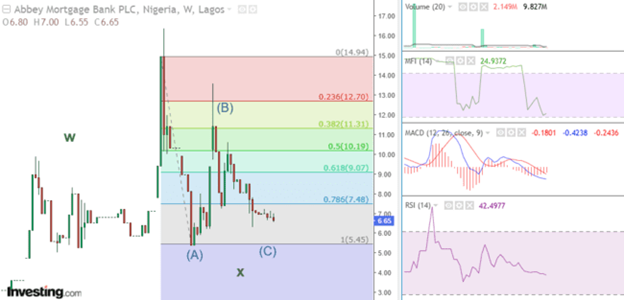
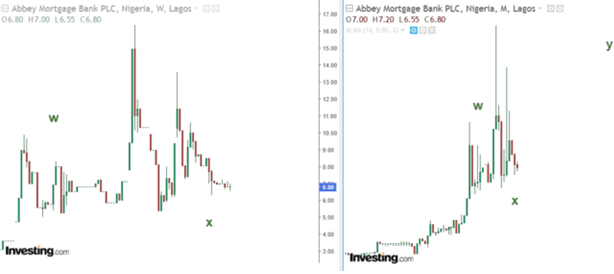
Abbey Bank experienced low selling pressure after completing its regular ABC flat correction with the 1.0 Fibonacci level. Given this sentiment, investors should expect a trend reversal. In line with this sentiment, the stock’s liquidity and momentum gradually improved. MACD also sustained its bearish divergence signal, aligning with the current market sentiment.
Daily chart: Investment opportunity
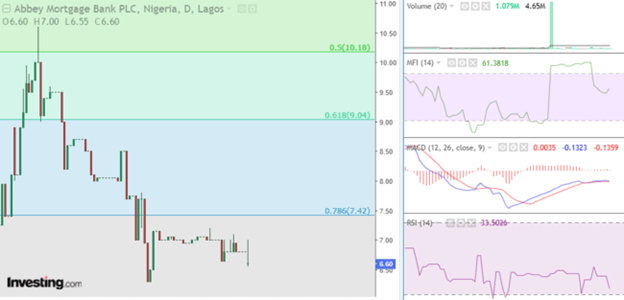
On the daily chart Abbey’s liquidity improved despite low volume and relative strength. This performance suggests sustained investor interest. Thus, market participant should watch N5 and N6 as potential support levels with prices projected at N10, N12, and N15.
SWOT Analysis
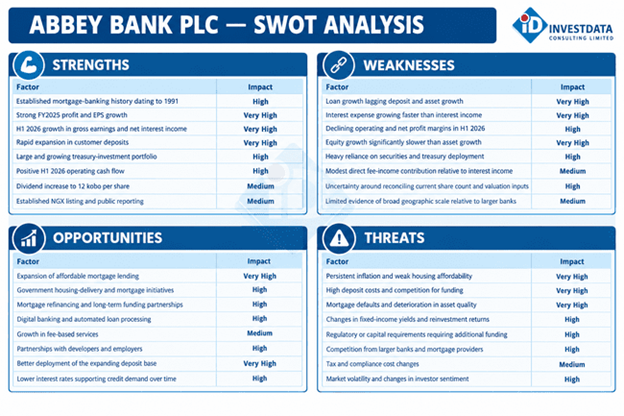
Abbey Bank’s principal strengths are its improving earnings, expanding deposits and growing investment portfolio. Its most material weaknesses are slow loan growth relative to funding, rising interest costs and limited equity growth relative to total assets. Nigeria’s housing-finance needs and government initiatives offer opportunities, but the bank must demonstrate that it can convert these into sustainable, risk-adjusted mortgage earnings. For investors, the central issue is whether its expanding balance sheet will produce stronger long-term returns or remain overly dependent on treasury activities and funding conditions.