
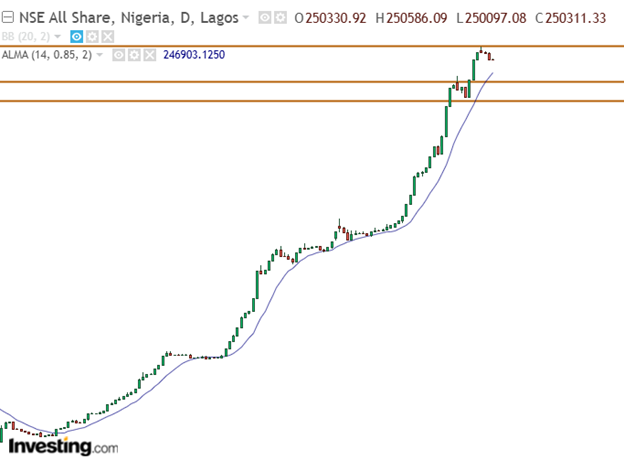
Nigeria’s All-Share Index Performance for 18th May, 2026
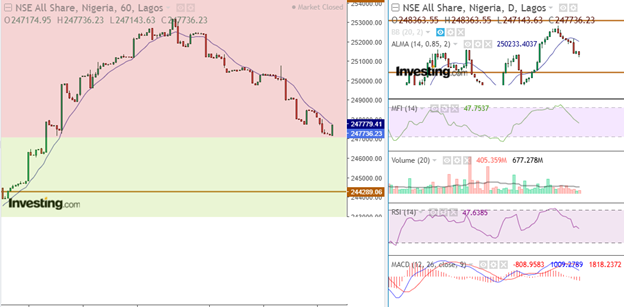
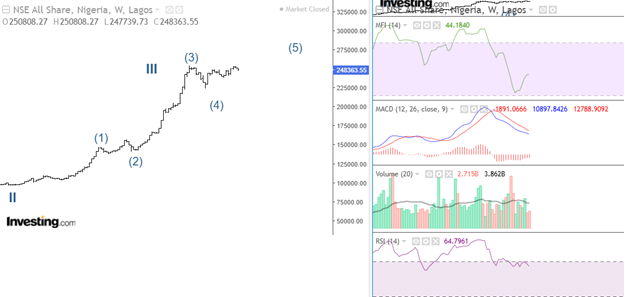
At the end of Monday’s trading session, the NGX composite index shed a seemingly subdued 0.01%, closing at 250,311.33 basis points reflecting the mix of profit-taking and portfolio rebalancing that which prevailed during the session. Also, the bourse is strong in its distribution phase. This report will seek to help investors know which sector to watch.
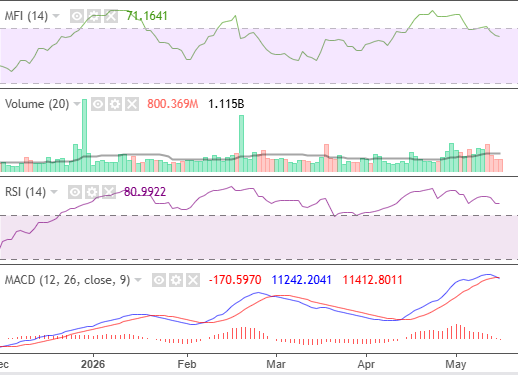
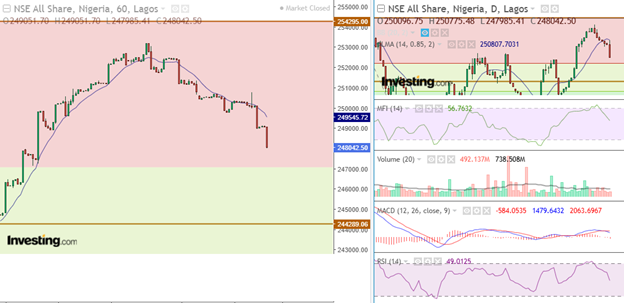
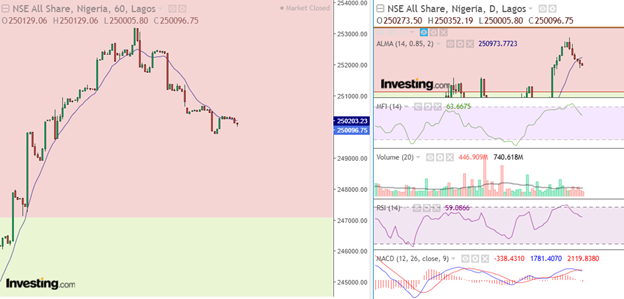
On the daily chart, the NGXASI aligned with the overall market sentiment. Market liquidity and momentum declined, just as the index sustained its bearish volume. In line with this performance, MACD commenced its bearish signal.
Which sectors offer better investment opportunities?
Key Sectoral Index Performance
NGXBNK: Banking Sector Index
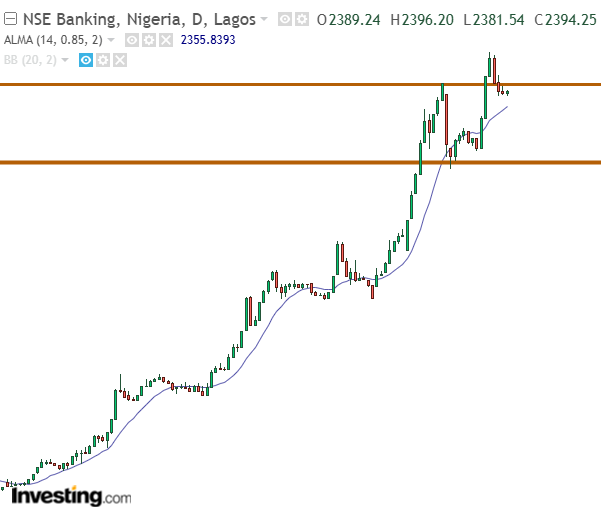
The banking index gained 0.17%, closing at 2,394.25 bps. The bullish sentiment was weak due to the strong resistance level at 2,413.91 bps. Thus, the index remains within its distribution phase. If the bearish sentiment continues, market participants would expect its support level to be between 2,330.35 bps and 2,312.32 bps. Notable contributors included ZENITH (+0.74%), FIDELITY (+0.44%), IBTC (+0.12%), and FIRSTHOLD (0.43%)
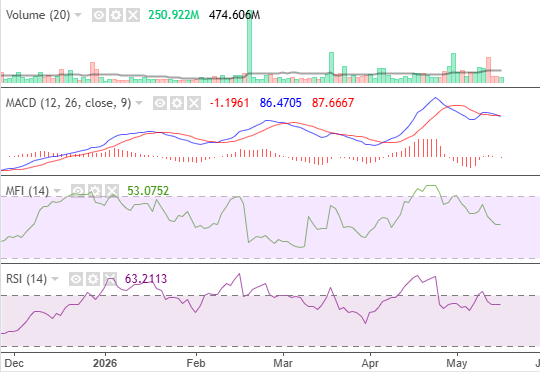
On the daily chart, the NGXBNK market closed with low bullish volume. This was due to the profit-taking that prevailed. MACD’s bearish signal gained momentum, as RSI indicates divergence. These signals offer investors an opportunity to take positions in defensive high-value companies.
NGXCSMG: Consumer Goods Sectors Index
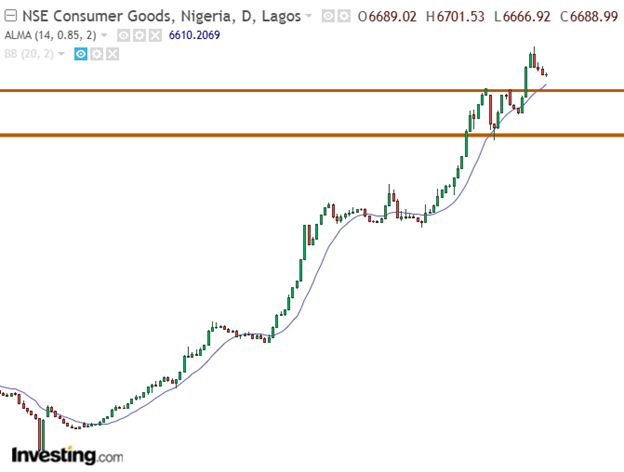
The consumer good index closed at 6,688.99 bps, with a bearish doji candlestick pattern. This candlestick pattern usually indicates a reversal is on the horizon. Given this performance, notable contributors included REDSTAR (-9.87%), JBERGER (-7.94%), BERGER (-9.83%), and AFRIPRUD (-7.05%).
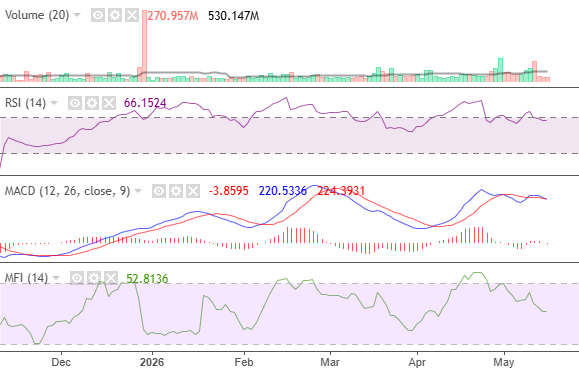
The indicators on the daily chart for the NGXCSMG indicated profit-taking. Although the bearish volume was low – due to the doji candlestick – other indicators aligned with the index decline. RSI indicated divergence, MFI remained solid above its threshold (50), and MACD’s bearish signal gained momentum.
NGXIND: Industrial Sector Index
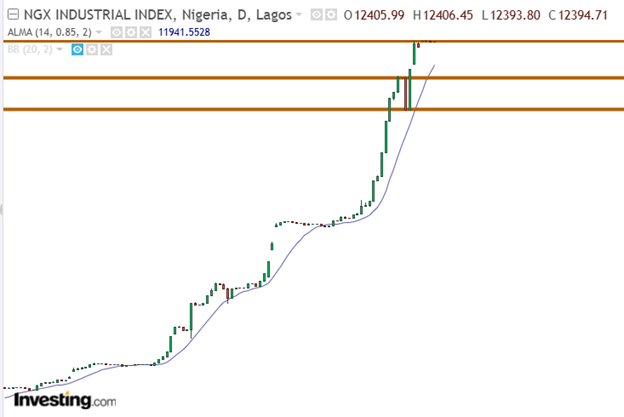
In the industrial index, sellers dominated the market. On the daily chart, the index closed with a flat bearish candlestick, sheding 0.09% above its moving average. Also, the index closed at 12,394.71 bps on its resistance level. Notable contributors included CUTIX (3.13%) and BERGER (2.93%)
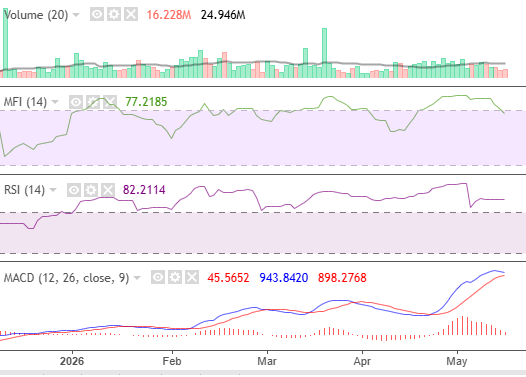
The bearish volume on the NGXIND’s daily chart was low, indicating profit-taking. In line with this performance, money flow declined below 80, while RSI remained resilient. This performance indicated that while profit-taking occurred, investors bought into value. Additionally, MACD’s bullish momentum continues to decline.
NGXOGSE: Oil and Gas Sector Index
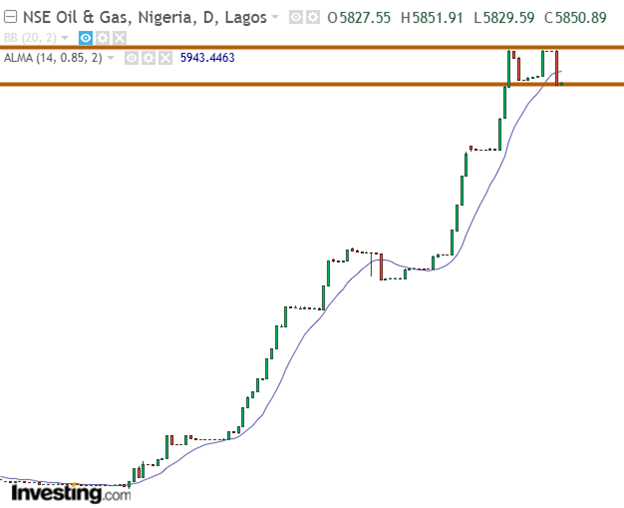
After closing with a strong bearish candle last week, the NGXOGSE gained 0.40%, closing at 5,850.89 bps below its moving average. This performance indicates that the index has started its recovery phase within its distribution phase.
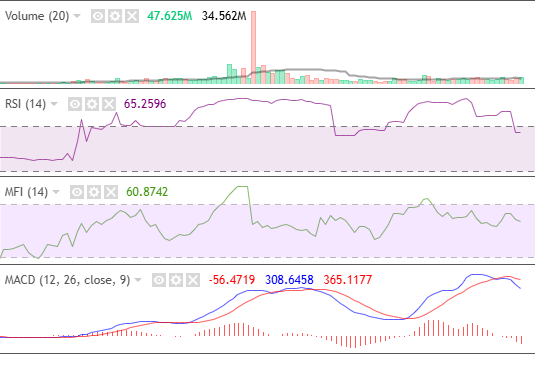
Indicators on the oil index’s daily chart indicated that investors are buying into value amid profit-taking. Money flow and RSI remained solid and resilient, while MACD’S bearish signal gained momentum. This performance offers investment opportunities.
NGXINS: Insurance Sector Index
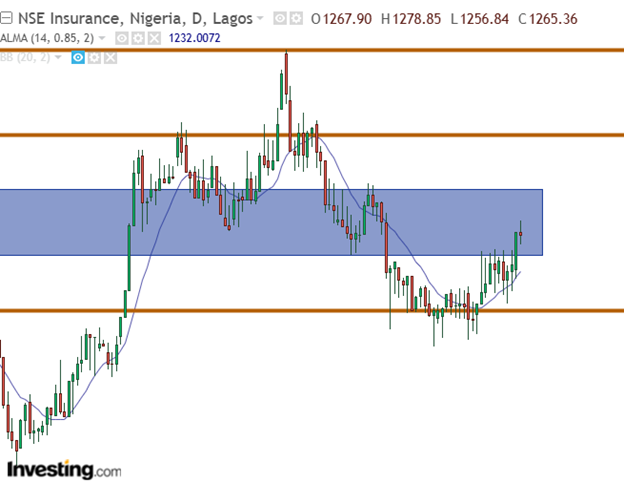
After a brief consolidation above its moving average, the insurance sector broke its strong resistance level at 1,251.87 bps, continuing its recovery phase. The index declined by 0.20%, closing at 1,265.36 bps. Notable contributors included SOVRENI (-9.86%), MBENEFIT (-1.63%), AIICO (-1.26%), and WAPIC (-0.74%)
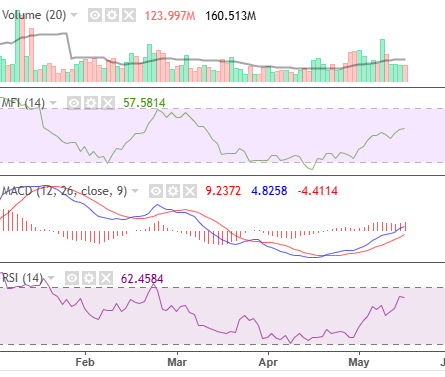
Despite the bearish sentiment, MACD’s bullish signal added momentum. Also, RSI remained solid at 62.46. Additionally, money flow increased. These performances indicated a sustained investor confidence in the sector.
Final Thought
Profit-taking and portfolio rebalancing dominated the sector indices. As these key sectors pull back, it’s ideal for market players to determine the next support level for investment. Overall, the insurance sector continues to lead in this consolidating market.