
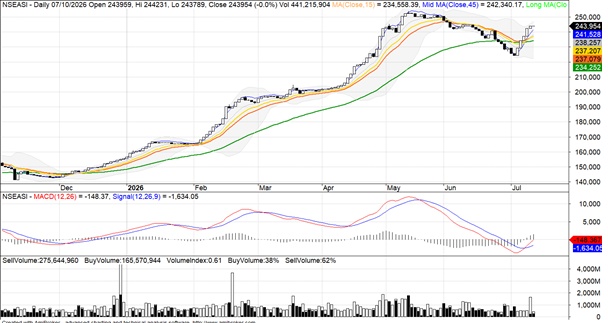
It was a bullish week with the Nigerian Exchange (NGX) extending its rebound in the first full trading week of the month of a new earnings reporting season with listed companies likely to start releasing their numbers any moment from next week. These corporate earnings are expected to give market direction, depending on the colour of the numbers. Trading during the week under review recorded four consecutive sessions of up market and one red day, even as players booked profit from the recent recovery or rally. Below is the daily Index action for the week.
Overall, investors traded 3.648 billion shares worth ₦220.568 billion in 251,861 deals during the week, compared with 3.821 billion shares valued at ₦154.393 billion exchanged in 258,567 deals in the previous week. Although total trading volume declined, the sharp increase in transaction value reflected a stronger demand for higher-priced equities.
Sector analysis showed that the Financial Services industry remained the market’s most active segment, accounting for 2.899 billion shares valued at ₦147.360 billion in 106,603 deals, representing 79.48% of total traded volume and 66.81% of total transaction value. The Services sector followed with 164.914 million shares worth ₦3.615 billion in 16,375 deals, while the Consumer Goods sector recorded 157.451 million shares valued at ₦7.777 billion in 27,950 deals.
Trading was heavily concentrated in First Holdco Plc, Zenith Bank Plc and Fidelity Bank Plc, which jointly accounted for 1.745 billion shares worth ₦121.828 billion in 31,053 deals. Together, the three stocks contributed 47.85% of total market volume and 55.23% of the total value traded during the week.
Across the sectoral indices, market performance remained broadly positive. However, the NGX Growth Index declined 7.43%, while the NGX Sovereign Bond Index eased 0.02%, making them the only benchmarks to close the week in negative territory. All other sectoral indices ended the week with gains, reflecting sustained investor confidence in the equities market.
Week-to-date, the All-Share Index has gained 6.35%, NGX 30 is up by 6.60%, the Banking Index has increased by 4.78%, the Pension Index increased by 6.66%, the Insurance Index inclined by 4.04%, the Consumer Goods Index increased by 3.11%. However, the Oil and Gas Index recorded a positive return of 8.11%. Year-to-date, the All-Share Index has gained 56.67%, NGX 30 is up by 56.34%, the Banking Index has increased by 41.78%, the Pension Index increased by 65.76%, the Insurance Index declined by 4.74%, the Consumer Goods Index increase by 18.02%. However, the Oil and Gas Index recorded a positive return of 96.80%.
NGXASI Dailly Index Action
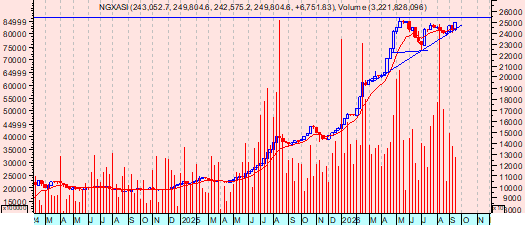
The Nigerian stock market delivered another impressive performance during the week, as sustained buying interests in banking and blue-chip stocks lifted the NGX All-Share Index close higher to 243,798.76 basis points after opening the period at 229,240.19bps. Market capitalisation rose to ₦156.445 trillion, while year-to-date return strengthened to 56.67% despite a slight pullback on the last trading session.
The rally began on Monday, with the benchmark index climbing 2.15% to 234,178.23 points, adding about ₦3.17 trillion to investors’ wealth and pushing the year-to-date return to 50.49%. Buying interest in FIRSTHOLDCO, WEMABANK, ARADEL, NGXGROUP and DANGCEM drove the market higher, as market breadth closed at 55 gainers against 12 losers. Investors traded 454.86 million shares valued at ₦38.69 billion in 63,976 deals, with ZENITHBANK emerging as the most traded stock by both volume and value.
The bullish sentiment persisted on Tuesday, as the ASI advanced 1.24% to 237,083.28 points, increasing investors’ wealth by approximately ₦1.86 trillion and lifting the year-to-date return to 52.35%. The day’s gains were driven by CADBURY, ZICHIS, NAHCO, VITAFOAM and TIP, while market breadth remained strong at 55 gainers against 17 losers. Total turnover stood at 493.42 million shares worth ₦27.84 billion in 49,859 deals, with ZENITHBANK again leading trading by both volume and value.
At the midweek’s session, the market extended its winning streak, recording the strongest daily performance of the week, after the benchmark index gained 2.27%, closing at 242,459.98bps, adding about ₦3.45 trillion to investors’ wealth and raising the year-to-date return to 55.81%. Buying interest in AIRTELAFRI, FIDELITYBK, ZICHIS and ARADEL underpinned the rally, while market breadth settled at 34 gainers against 23 losers. Investors exchanged 518.38 million shares worth ₦22.71 billion in 48,422 deals. LASACO recorded the highest trading volume, while ARADEL led the market by value traded.
Buying momentum moderated on Thursday, July 9, but the market still closed higher with the ASI appreciating 0.62% to 243,958.73 points, adding about ₦961.75 billion to investors’ wealth and pushing the year-to-date return to 56.77%. The advance was supported by gains in FIRSTHOLDCO, HONEYFLOUR, NAHCO, MTNN and ZENITHBANK. Market breadth closed at 29 gainers against 24 losers. Trading activity surged significantly to 1.66 billion shares valued at ₦111.96 billion, with FIRSTHOLDCO accounting for the bulk of market activity.
The final trading session of the week closed on a softer note, after profit-taking in major banking and consumer goods stocks halted the four-day rally. The NGX All-Share Index slipped 0.07% to 243,798.76 points, trimming investors’ wealth by ₦102.65 billion and easing the year-to-date return to 56.67%. Despite the decline, market breadth remained positive with 31 gainers against 28 losers. Trading volume slowed to 441.22 million shares valued at ₦19.36 billion, with ACCESSCORP leading by volume, while ZENITHBANK recorded the highest value traded.
International Brewery Plc
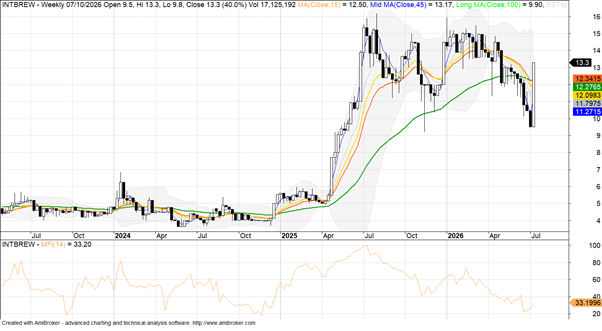
Top Price Gainers for the week: International Breweries Plc led the gainers after climbing ₦3.80 per share, or 40.00%, from ₦9.50 to ₦13.30. RT Briscoe Plc followed with a gain of ₦3.25 (32.02%) to close at ₦13.40 from ₦10.15. Livestock Feeds Plc advanced ₦2.05, representing 28.47%, from ₦7.20 to ₦9.25. First Holdco Plc added ₦14.20 (25.82%) to settle at ₦69.20, up from ₦55.00, while Abbey Bank Plc appreciated ₦1.75 (23.65%) to close at ₦9.15 from ₦7.40.
McNichols Plc
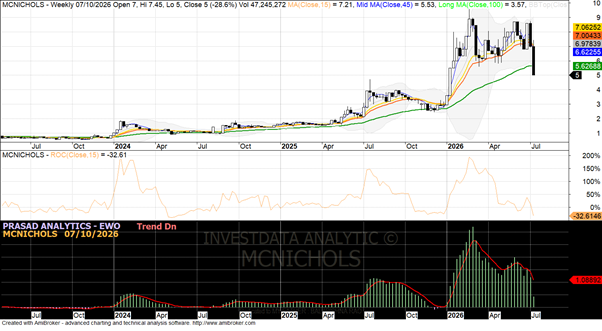
Top Price Losers: McNichols Plc topped the losers’ chart after shedding ₦2.00, or 28.57%, to close at ₦5.00 from ₦7.00. Thomas Wyatt Nigeria Plc declined ₦0.32 (11.64%) to ₦2.43 from ₦2.75. Geregu Power Plc fell ₦91.70, representing 10.00%, to close at ₦825.70 from ₦917.40. CAP Plc lost ₦17.50 (9.99%) to end at ₦157.60 from ₦175.10, while Guinness Nigeria Plc dropped ₦36.50 (9.99%) to close the week at ₦329.00, down from ₦365.50.
Comparative Analysis: Week Ended July 3 vs. Week Ended July 10, 2026
The Nigerian stock market staged a strong recovery in the week ended July 10, 2026, reversing the 1.21% decline recorded in the previous week. The NGX All-Share Index (ASI) rose by 6.35% to close at 243,798.76 points from 229,240.19 points, while market capitalisation increased by ₦9.34 trillion to ₦156.445 trillion from ₦147.103 trillion. Consequently, the year-to-date return improved significantly from 47.31% to 56.67%.
Market activity was mixed. Total trading volume declined by 4.5% to 3.648 billion shares from 3.821 billion shares, while the number of deals eased to 251,861 from 258,567. However, the value of transactions surged by 42.9% to ₦220.568 billion, compared with ₦154.393 billion in the previous week, indicating stronger institutional participation and increased demand for higher-priced banking and blue-chip stocks.
The Financial Services sector remained the market’s dominant driver, with traded volume rising from 2.330 billion shares to 2.899 billion shares, while transaction value jumped sharply from ₦54.606 billion to ₦147.360 billion. Its share of total market volume increased from 60.99% to 79.48%, while its contribution to total market value climbed from 35.37% to 66.81%.
Trading concentration also strengthened during the week. First Holdco, Zenith Bank and Fidelity Bank accounted for 1.745 billion shares worth ₦121.828 billion, representing 47.85% of total market volume and 55.23% of total transaction value. This compares with the previous week’s leading trio of Sterling Financial Holdings, Access Holdings and Ikeja Hotel, which traded 1.405 billion shares valued at ₦28.370 billion, contributing 36.78% of market volume and 18.37% of transaction value.
Investor sentiment overall improved markedly as the market recorded gains in four of the five trading sessions, compared with only one positive session in the previous week. The sharp rise in market value, stronger turnover, improved market breadth and increased participation in banking stocks underscore the return of bullish momentum and renewed investor confidence in the Nigerian equities market.
Technical Analysis View
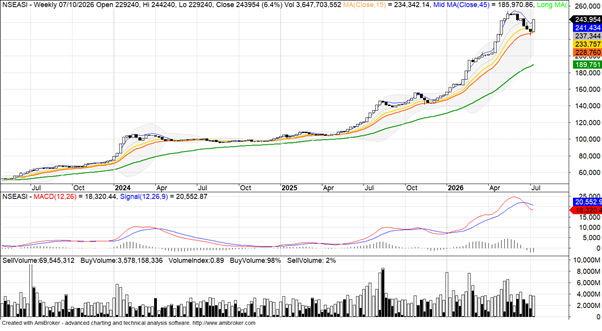
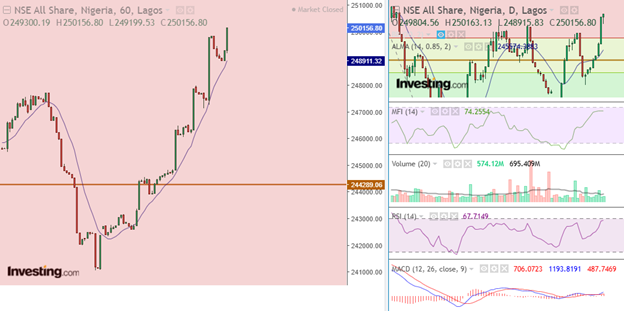
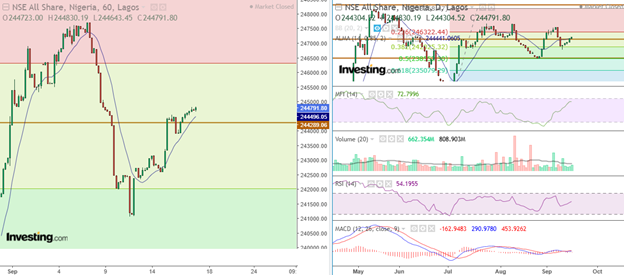
The rally was supported by sustained institutional demand in banking and other heavyweight stocks, while improving market breadth throughout the week, sign of a broad participation rather than isolated gains. The sharp increase in transaction value to ₦220.568 billion, despite a slight decline in traded volume, suggests investors rotated into higher-priced, fundamentally strong stocks.
The market’s ability to maintain a positive breadth of 31 gainers against 28 losers on Friday, even after profit-taking, indicates that selling pressure remained relatively contained. Money Flow stayed elevated, reflecting continued liquidity inflow into equities, while trading above major moving averages reinforces the prevailing bullish trend. However, the market now appears technically overbought following its rapid advance of more than 14,500 basis points during the week, increasing the likelihood of intermittent profit-taking and sector rotation.
Market Outlook
The market is expected to maintain its positive medium-term bias, supported by strong liquidity, renewed institutional positioning, improving corporate earnings expectations, and investors seeking inflation-beating returns. Attention is likely to remain on fundamentally sound banking, energy, industrial, and consumer goods stocks ahead of the half-year earnings season.
Nevertheless, after the recent sharp rally, investors should expect increased volatility as short-term traders lock in profits at elevated price levels. Any pullback is likely to be viewed as a buying opportunity, provided the NGX ASI holds above key psychological support around 240,000 points. Market direction in the coming week will also depend on the sustainability of fund inflows, corporate disclosures, macroeconomic developments, and investor reaction to second-quarter earnings expectations. Overall, the underlying market structure remains bullish, with bargain hunting expected to emerge on price weakness.
Trending in the Economy: Nigeria’s Revenue Service (NRS) collected N21.6 trillion in the first half of 2026, representing a 49% increase over the same period last year. The growth was supported by tax reforms, digitalisation, and stronger oil revenue remittances. Non-oil taxes, for example, contributed 76% of total collections, while the country’s tax-to-GDP ratio improved to 13% from 10.3%. The agency is targeting N40.7 trillion in revenue for the full year.
Meanwhile, the IMF maintained Nigeria’s economic growth forecast at 4.1% for 2026 and 4.3% for 2027 but warned that rising food and energy costs could increase poverty and food insecurity despite improving macroeconomic conditions. The Fund urged targeted support for vulnerable households instead of broad subsidies. Nigeria’s inflation rate rose to 15.93% in May 2026 from 15.69% in April.
Global Market and Oil: Global equity markets ended Friday on a positive note as investors continued to bet on the long-term growth potential of artificial intelligence, brushing aside renewed geopolitical tensions between the United States and Iran. While the deteriorating security situation in the Middle East remained on investors’ radar, market participants focused instead on strong corporate developments, resilient earnings expectations and easing oil prices.
All three major U.S. stock indices closed higher. The Dow Jones Industrial Average rose 0.29%, the S&P 500 gained 0.42%, while the technology-heavy Nasdaq Composite advanced 0.29%. The positive sentiment extended beyond Wall Street, with the MSCI All-Country World Index climbing 0.4%, reflecting broad-based gains across global equities. Markets largely shrugged off the renewed exchange of attacks between the
U.S. and Iran, which further weakened the fragile three-week-old ceasefire between the two countries. Although the latest military actions have reignited concerns over regional stability and the security of global energy supplies, investors have so far avoided a widespread risk-off reaction. Instead, attention remains focused on whether the conflict could disrupt oil exports through the Strait of Hormuz and fuel another wave of global inflation.
A major driver of Friday’s market optimism was the impressive U.S. market debut of South Korean semiconductor giant SK Hynix. The company’s Nasdaq-listed shares surged 14% after raising approximately $26.5 billion in its U.S. listing, highlighting robust investor demand for companies linked to the rapidly expanding artificial intelligence ecosystem.
The funds raised will be used to expand manufacturing capacity, build new production facilities and acquire advanced equipment to meet soaring global demand for AI memory chips. The transaction is expected to become the second-largest share sale in history, behind only SpaceX’s record-breaking initial public offering completed last month, underscoring investors’ continued appetite for AI-related investments.
Despite the renewed geopolitical uncertainty, oil prices moved lower as traders waited for greater clarity on developments in the Middle East. U.S. President Donald Trump said negotiations between Washington and Tehran would continue, although he acknowledged that the June agreement that halted military action was effectively “over.” Both countries have reported fresh military operations in the Gulf, reviving concerns about shipping through the strategically important Strait of Hormuz, a vital route for global crude exports.
Nevertheless, energy markets remained relatively calm. U.S. West Texas Intermediate (WTI) crude declined 0.74% to $71.55 per barrel, while Brent crude slipped 0.41% to $75.99 per barrel. According to Carl Campus, Senior Economist at BMO, oil prices have shown remarkable resilience despite the renewed conflict spreading to neighbouring countries. He noted that while several factors may be limiting price gains, the market’s restrained response likely reflects growing optimism that ongoing diplomatic efforts will prevent a broader regional escalation.
In the foreign exchange market, attention shifted to the Japanese yen after comments from Japan’s Finance Minister, Satsuki Katayama, raised expectations that Japanese investors could begin repatriating overseas investments. The yen strengthened 0.4% to 161.71 per U.S. dollar, recovering modestly after hovering near its weakest level in almost 40 years. Currency traders remain alert for any signs of intervention by Japanese authorities should the yen come under renewed pressure. Elsewhere, movements in the U.S. dollar were relatively subdued as investors awaited fresh economic data and further guidance on the future direction of U.S. monetary policy. The U.S. Dollar Index (DXY), which measures the greenback against a basket of major currencies including the euro and yen, edged up 0.05% to 100.96.
In the bond market, the yield on the benchmark 10-year U.S. Treasury note increased by 2.22 basis points to 4.561%, reflecting cautious positioning ahead of upcoming economic data and expectations for the Federal Reserve’s next interest rate decision.
Overall, investor sentiment remained constructive, supported by strong demand for AI-related assets and resilient equity markets. However, market participants continue to monitor developments in the Middle East, as any significant disruption to global oil supplies or a sharp rise in crude prices could quickly alter the inflation outlook and reshape expectations for global monetary policy.