
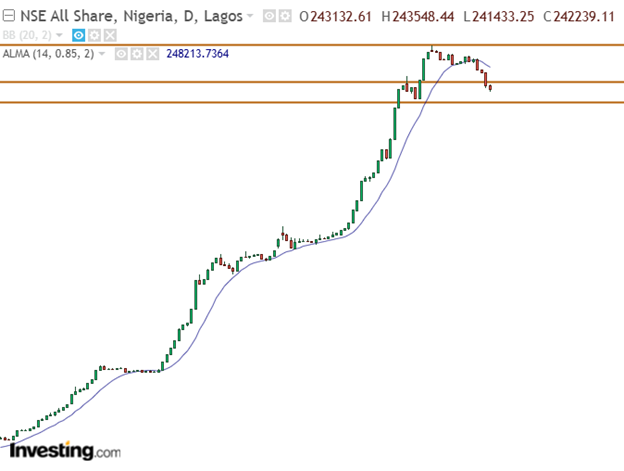
Nigeria’s All-Share Daily Performance for 4th June, 2026
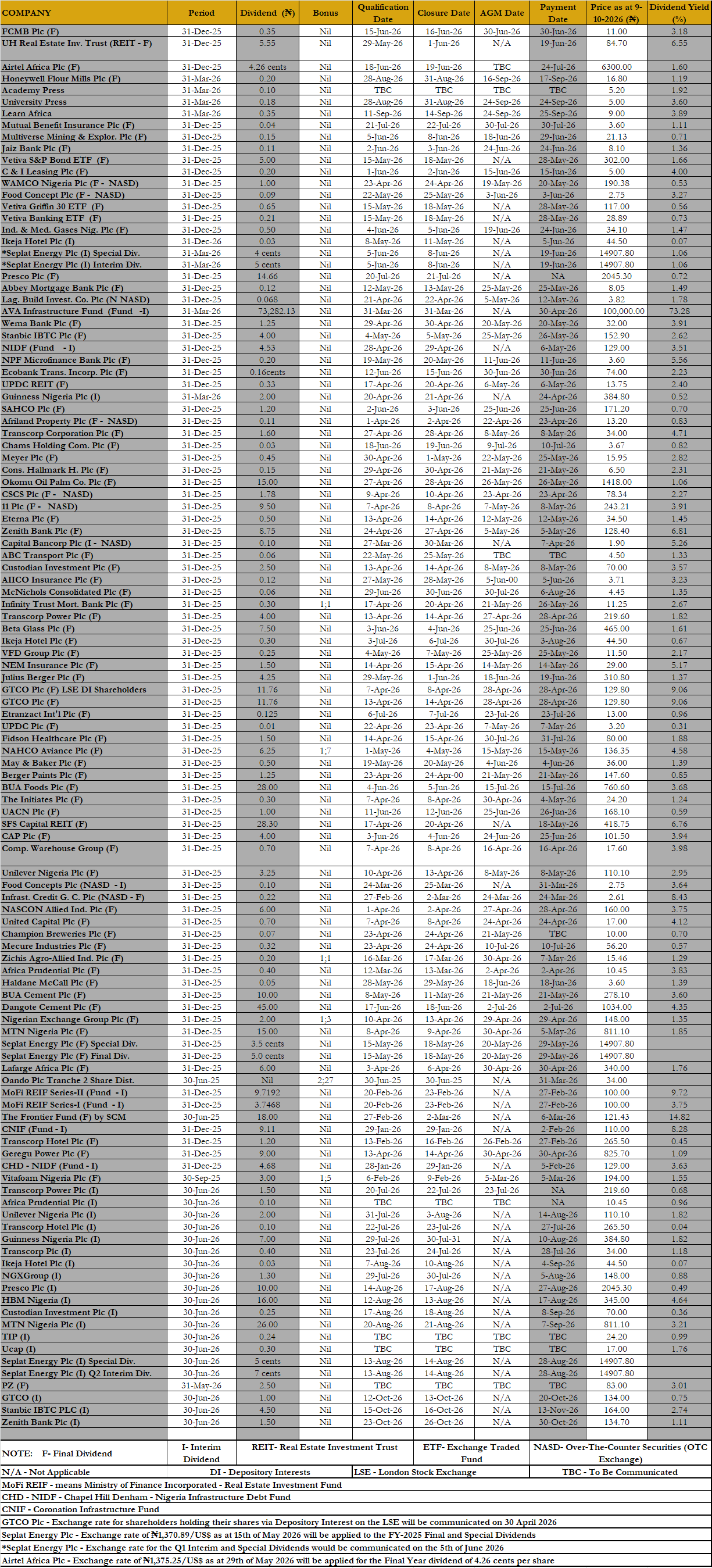
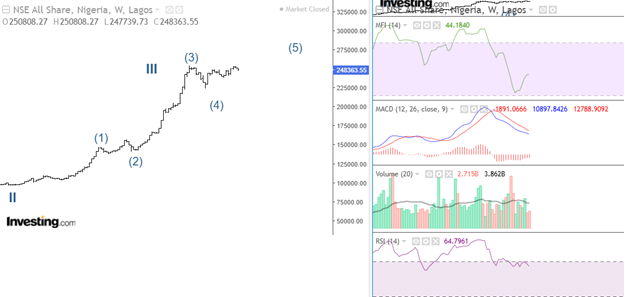
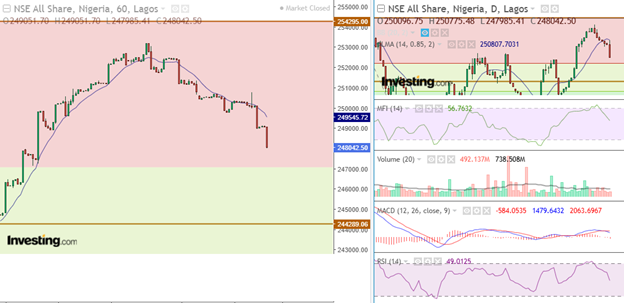
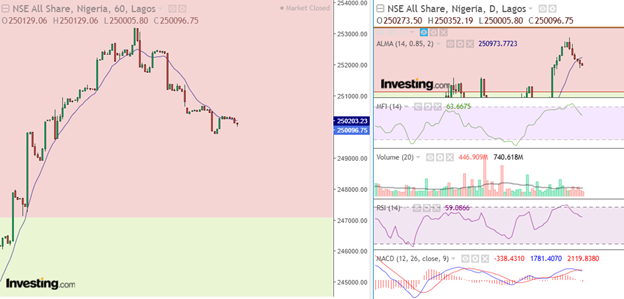
The Nigerian bourse lost 0.37%, closing at 242,239.11 basis points on Thursday, sustaining the benchmark All-Share index’s markdown phase and in the process closing below its moving average. The twin effects of bargain hunting and portfolio rebalancing continue to prevail as key sectors attempt to enter into their distribution phase.
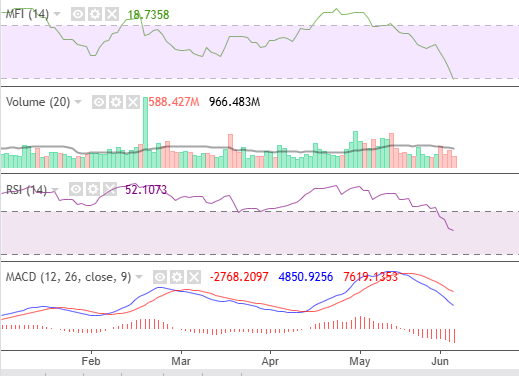
On the daily chart, the NGXASI sustained its downward trajectory even as market volume, liquidity, and momentum remain low, aligning with the overall market sentiment. Are there still investment opportunities?
Key Sectoral Index Performance
NGXBNK: Banking Sector Index
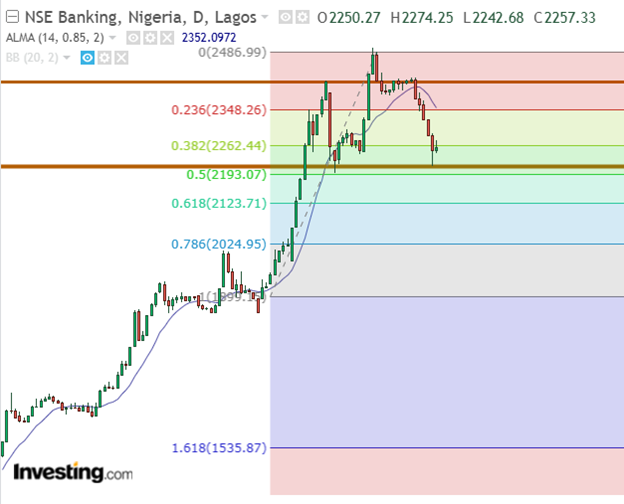
The banking sector index gained 0.31%, closing at 2,257.33 bps. Applying the Fibonacci retracement, the index commenced its distribution phase. At this level, investors are buying into value amid a weak market. Notable contributors included FIRSTHOLD (+6.70%), GTCO (+1.20%), and UBA (+0.46%)
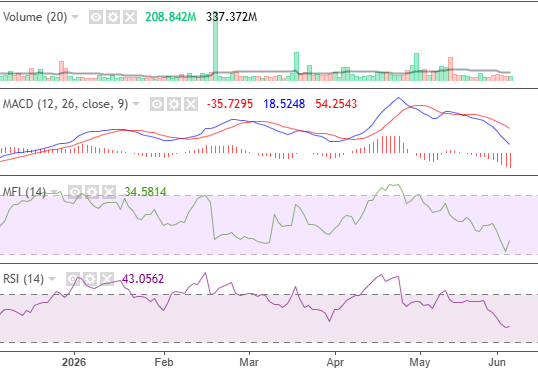
The NGXBNK closed with a low bullish volume as it experienced more losers than winners. Although MFI closed tilting upward, liquidity remained low. This performance signals a potential index recovery and divergence. On the other hand, RSI’s momentum remained low, as MACD’s bearish momentum strengthened. Given these mixed sentiments, the common theme is that the market is weak and investing at this level is highly risky.
NGXCSMG: Consumer Goods Sector Index
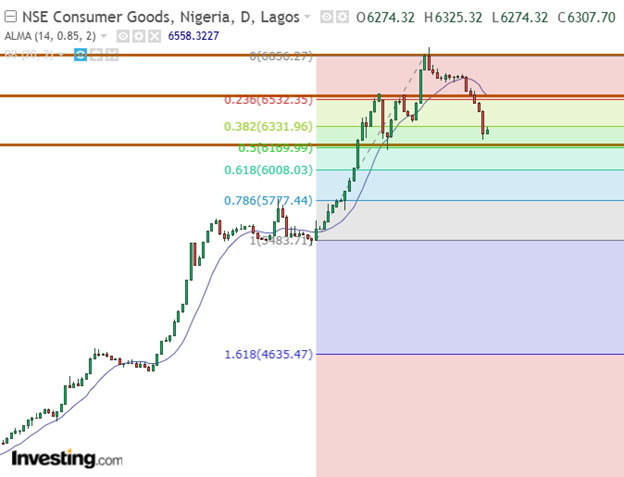
The consumer goods index commenced its distribution phase, gaining 0.53%. Closing at 6,307.70 bps, the index commenced its distribution phase. Thus, the NGXCSMG should consolidate between 0.382 and 0.5 of the Fibonacci retracement sequence. Notable contributors included blue-chip banks, WAPCO (+3.93%), WAPIC (+2.67%), and HONEYFLOUR (+0.82%)
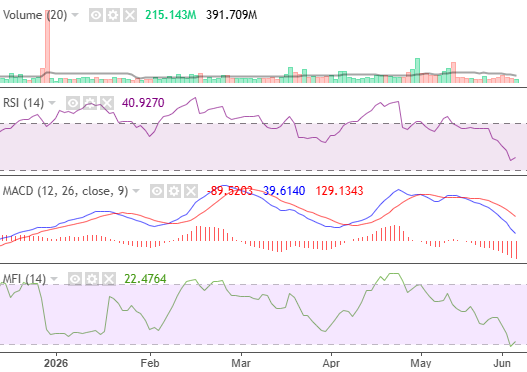
The bullish volume closed weakly below its moving average. However, liquidity and momentum showed signs of recovery. MACD’s bearish momentum remained strong amid bullish sentiment, signifying a continuous bear market.
NGXIND: Industrial Sector Index
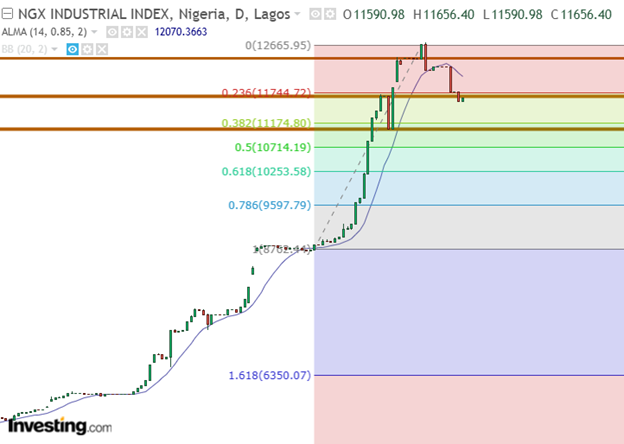
The industrial index gained 0.56%, closing at 11,656.40 bps. This performance should commence another distribution phase as the index closed with its resistance zone at 11,692.15 bps. Notable contributors included CUTIX (+9.31%) and WAPCO (+3.93%).
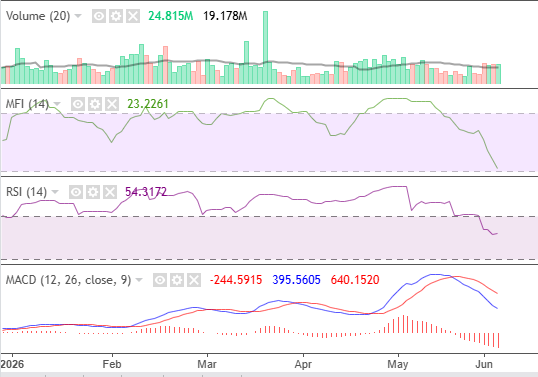
The NGXIND bullish volume closed strongly above its moving average on the daily chart. Despite this sentiment, market liquidity remained weak without a glimpse of recovery. Also, RSI’s momentum remained neutral, as MACD’s bearish signal strengthened. This indicator’s performance signals a continuous bearish market.
NGXOGSE: Oil and Gas Sector Index
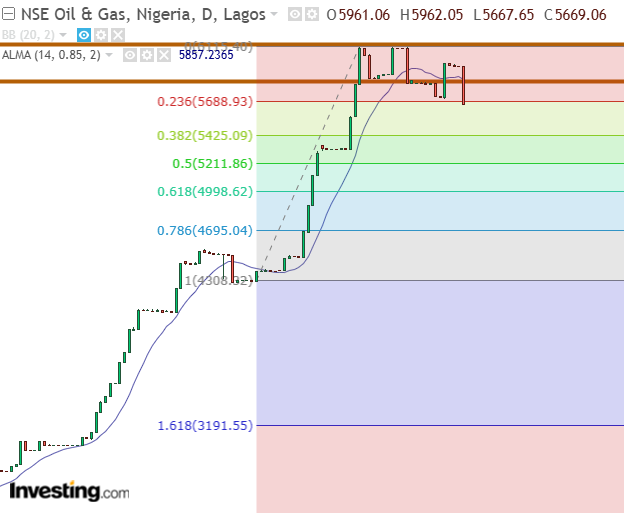
The oil index experienced a strong bearish sentiment with a 4.90% loss. Closing at 5,669.06 bps, the index slightly broke into the Fibonacci retracement zone. This performance signals a continuous bearish sentiment, as the index closed below its moving average.
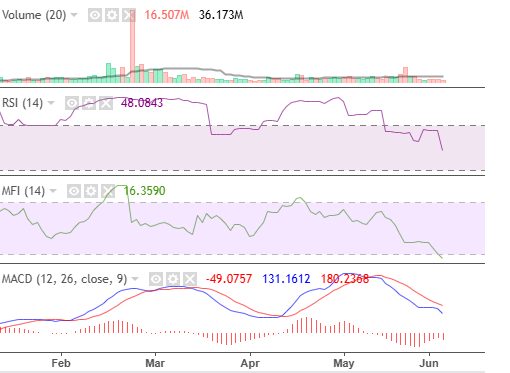
On the daily chart, the NGXOGSE indicators regained their bearish momentum. Also, market liquidity and momentum closed low following the index’s strong sentiment. Given this performance, the oil and gas sector is weak.
NGXINS: Insurance Sector Index
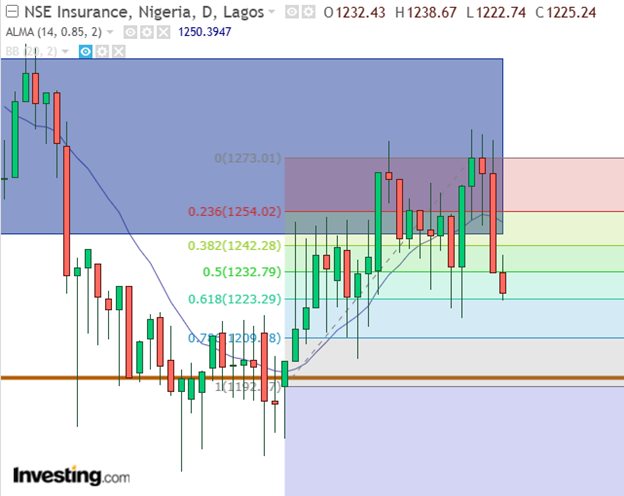
The insurance sector index lost 0.58%, closing at 1,225.24 bps. The index met support at 0.618 of the Fibonacci retracement sequence, which acted as a strong support level for the index recovery trend. Thus, further action is required to determine the strength of the index’s support level at 1,223.29. Notable contributors included SOVRENI (-8.37%), LINKASS (-5.00%), VERITASKAP (-2.44%), MBENEFIT (-1.64%), and AIICO (-1.32%)
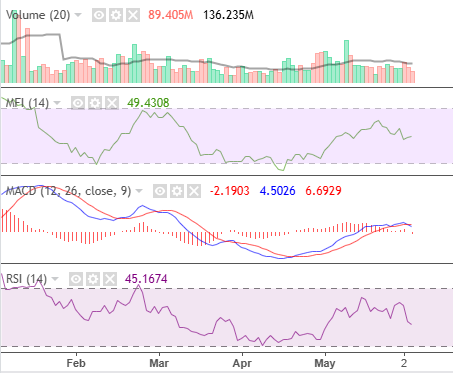
On the daily chart, indicators such as volume, MACD, and RSI aligned with the index’s bearish sentiment. However, MFI maintained its upward trajectory, scaling from 48.26 to 49.43. This performance indicated sustained investor confidence in the sector.
Final Thought
The sectoral indices commenced their distribution phases, reflecting renewed investors’ interest in defensive stocks with good fundamentals. However, the market is weak and still recovering. The sector to watch is the insurance sector as investors sustain their interest in the sector.