
By Victor Ogiemwonyi
Marketconversations.stubstack.com
The Urgency Of Poverty In Nigeria
Poverty in Nigeria is alarmingly high with some estimates suggesting that over 70% of the population lives below the poverty line. This is unacceptable. Something drastic must be done before it is too late.
The economic crisis of 2023 necessitated tough policies such as the fuel subsidy removal and Naira realignment. These reforms are gradually stabilizing the economy. However, the next urgent step must be tailored towards lifting the mass of Nigerians out of poverty. All non-essential programmes should wait until substantial progress is made in this war.
The economy is meant to serve the people and they can no longer wait as poverty is now the next battle. The good news is that this is a winnable war with the right and sincere steps.
Brazil, China, India and lately, Vietnam, for example, have all achieved significant poverty reduction over the last 40 years. Nigeria must learn from their experiences and act decisively.
Beyond Macroeconomic Stability
Macroeconomic stability is important but its benefits trickle down slowly. Double-digit growth which could truly end poverty is still far off. The war against poverty cannot wait. What is needed now is focus, determination, and commitment of all resources to this fight.
Where the Resources Reside
Government waste is the biggest obstacle. Without doubt, resources to fight poverty exist, but they are being squandered.
In recent years, government agencies have grown out of proportion at a time there should be deliberate efforts to merge them to reduce the cost of governance. As a sign of the need to reduce the cost of governance, as every small agency now buys a fleet of SUVs worth hundreds of millions of Naira. For context, Peugeot 504 brand was the standard official car in the 1970s and 1980s. The purpose of cars is simple: to facilitate movement. That has not changed. Why then do we need a ₦160 million SUV to do the same work today?
This is just one example of the runaway waste. Inflated budgets and contracts further drain public resources. Efficiency in public expenditure could save Nigeria billions of Naira that should be redirected to poverty alleviation.
A Department of Government Efficiency (DOGE)
Nigeria urgently needs its own Department of Government Efficiency (DOGE). Every ministry, department, and agency (MDA) should have a DOGE unit working with audit departments to identify and eliminate waste.
These units must publish quarterly reports showing savings achieved. Unlike the ineffective procurement processes currently in place, DOGE would enforce accountability and transparency.
The Youth Crisis
Nigeria’s youth population is often described as an asset, but it becomes a liability when left unengaged. With unemployment over 30% and population growth at nearly 5% in some areas, the situation is dire.
Millions of out-of-school children are fueling insecurity, thuggery, and social unrest. This neglect of the youth is a ticking time bomb that must be addressed urgently.
Food Insecurity: The Most Dangerous Threat
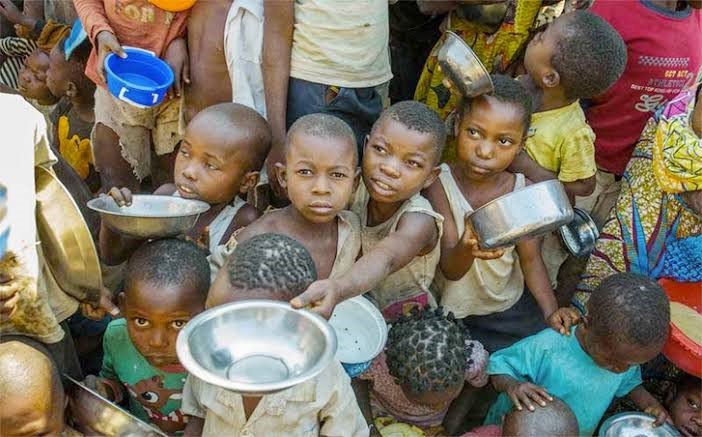
The most immediate and dangerous manifestation of poverty is hunger. There is no worse suffering than being unable to find food. Tackling food insecurity must be the first step in this war.
Mobilizing food for vulnerable populations can be done quickly and effectively if properly organized.
Food Banks in Every Community
Creating food banks nationwide may seem impossible, but it is achievable. Communities already organize large-scale events daily; the same effort can be applied to food distribution.
Federal, state, and local governments should allocate budgets for food banks, while private corporate institutions and elites donate to the course. During COVID-19, similar programmes were implemented. Political parties, instead of distributing commodities to loyalists during campaigns, should establish food banks accessible to all.
Each community should register the poor and vulnerable households and appoint committees to manage distribution. Even if results vary, the effort will pay off.
In wealthy societies, food programmes exist because hunger threatens everyone — rich and poor alike.
Food security must go past this immediate step of Food Banks, now needed as emergency measure.
We must continue to focus our attention on developing our vast agriculture potentials. It is a pity, that with all the arable lands in Nigeria, we still import a large part of our food. We must urgently ban GMO foods and rely on how we have produced food for centuries. Note that using fertilizers to support growing our agriculture is not what we are talking about here. The fight to have food security is a war that must be won.
Avoiding Past Mistakes
This war must not resemble past government giveaways or palliative programmes, which worsened the situation.
Party Contractors bought up essential commodities in the markets purportedly to distribute to the poor, driving prices higher. Distribution was hijacked by insiders, turning relief items into resalable goods that fueled inflation.
Nigeria must take poverty reduction seriously, with genuine programmes that deliver results. We are on the path to gradual economic recovery. The next priority must be a full-scale war on poverty. This is not optional, it is an existential necessity.
Government waste must be cut, the nation’s youth must be engaged, food insecurity must be tackled, and efficiency must be enforced. Poverty is the greatest threat to Nigeria’s stability, and fighting it is the only way forward.
Ogiemwonyi is a retired Investment Banker, and writes from Ikoyi, Lagos.