
Market Update For August 4, 2026
The Nigerian Exchange (NGX) resumed its downward trend on Tuesday, August 4, 2026, as investors locked in profits across several heavyweight stocks following the market’s strong performance in recent weeks. The session was characterised by widespread selling pressure, particularly across major banking, consumer goods and industrial counters, pushing the broader market lower despite a significant increase in trading activity.
The decline reflected a cautious shift in investor sentiment as market participants reassessed positions after the substantial gains recorded on the exchange this year. While the overall medium-term outlook for Nigerian equities remains supported by strong year-to-date gains, the latest session showed that investors are increasingly willing to take profits from stocks that have appreciated significantly. This resulted in a broad selloff that affected several of the market’s most influential counters.
The weakness in large-cap stocks was particularly important because of their considerable influence on the benchmark index. Stocks such as FIRSTHOLDCO, UBA, GTCO, ZENITHBANK, ACCESSCORP, NESTLE, NB and NGXGROUP are among the major names capable of significantly influencing overall market direction. Their simultaneous declines therefore placed considerable pressure on the ASI and reinforced the bearish tone of the session.
The financial services sector was among the notable areas of weakness, with several major banking stocks recording losses. FIRSTHOLDCO declined 2.99%, while WEMABANK fell 2.95% and UBA dropped 2.17%. FIDELITYBK also lost 1.15%, while GTCO and ZENITHBANK declined 0.76% and 0.48%, respectively. ACCESSCORP recorded a more moderate decline of 0.19%. The broad weakness across banking counters suggests that profit-taking was not limited to a single institution but extended across different segments of the sector.
The consumer and industrial segments were also affected. NESTLE declined 2.76%, while NB fell 2.08%, reflecting selling pressure in major consumer-facing stocks. NGXGROUP declined 2.52%, while ETERNA suffered the most significant decline among the major market movers, dropping 9.09%. NAHCO also came under substantial pressure, falling 4.03%, while NEM and TIP declined 3.51% and 3.40%, respectively.
The breadth of the selloff indicates that the weakness was relatively widespread rather than being driven by isolated declines in a few counters. Investors appeared to be reducing exposure across several sectors, with the number of declining stocks substantially exceeding those that advanced. This typically points to a cautious market environment in which investors are prioritising capital preservation and profit realisation over aggressive accumulation.
However, the increase in trading activity suggests that the market remained liquid despite the negative performance. The high level of turnover indicates that investors were actively repositioning portfolios rather than staying completely on the sidelines. The concentration of activity in JAPAULGOLD also provided a major boost to overall volume during the session, with the stock accounting for more than half of all shares traded.
JAPAULGOLD’s dominance of volume is particularly notable because its 904.42 million shares represented 57.89% of total market volume. This level of concentration suggests that the stock was responsible for a significant portion of the day’s liquidity and helped drive the substantial increase in aggregate turnover. Meanwhile, MTNN remained the most valuable stock by transaction value, attracting ₦3.25 billion worth of trades during the session.
The difference between volume and value leaders also highlights the varying nature of investor activity across the market. While JAPAULGOLD attracted exceptionally high share turnover, MTNN commanded greater monetary value due to the relatively higher price of its shares. FIRSTHOLDCO and JAPAULGOLD also featured prominently among the stocks with significant value traded, while STERLINGNG and FCMB were among the leading contributors to total volume.
The increased market activity comes at an important point in the NGX’s performance cycle. After delivering substantial gains in 2026, the market is increasingly exposed to profit-taking as investors reassess valuations and lock in accumulated gains. The latest decline should therefore be viewed within the context of the market’s broader performance rather than as an immediate indication of a fundamental deterioration in Nigerian equities.
The strong year-to-date return means that some investors may be willing to realise gains even when the underlying fundamentals of individual companies remain intact. This could result in intermittent bouts of selling pressure, particularly in stocks that have experienced rapid price appreciation. Such corrections can also provide opportunities for investors with longer-term horizons to accumulate fundamentally sound counters at more attractive entry levels.
Technical Analysis and Outlook
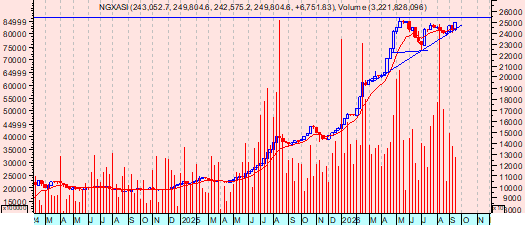
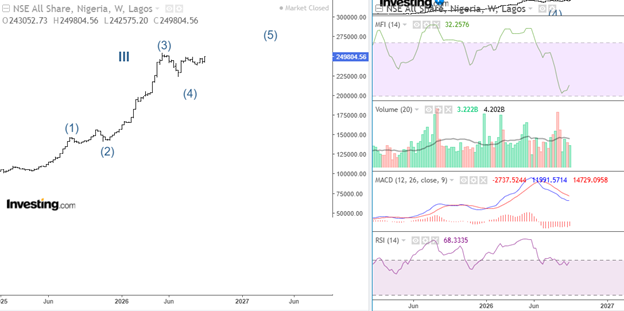
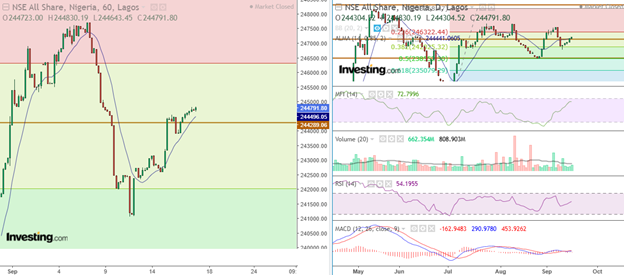
From a technical perspective, the ASI’s retreat points to a continuation of short-term corrective pressure after the market’s recent advance. The benchmark is now trading around the 244,000–245,000 region, making this area an important support zone for the next phase of market direction.
A successful defence of the current support area could encourage bargain hunters to return to the market, particularly if selling pressure begins to ease in the large-cap banking and consumer stocks. In such a scenario, the index could attempt a recovery towards the 246,000 level, with a sustained break above that resistance potentially reopening the path towards 248,000 points.
However, a decisive break below the 244,000 area would weaken the short-term technical structure and could expose the index to additional downside towards the 242,000–240,000 region. Such a move could encourage further profit-taking, especially among short-term traders who have benefited from the market’s strong year-to-date rally.
The market’s negative breadth is also an important technical consideration. With 40 decliners against only 13 gainers, the decline was broad enough to suggest that selling pressure had spread across multiple counters. For the market to regain stronger bullish momentum, investors would likely need to see improved breadth alongside renewed buying interest in the heavyweight stocks that exert the greatest influence on the ASI.
The sharp increase in volume adds another dimension to the technical picture. Higher volume accompanying a market decline can indicate strong distribution, particularly when large-cap stocks are responsible for a significant portion of the losses. Investors should therefore watch subsequent sessions closely to determine whether the elevated activity represents continued distribution or the early stages of accumulation at lower prices.
The direction of the market in the coming sessions will also depend on how investors respond to corporate earnings, dividend expectations, macroeconomic developments and prevailing fixed-income yields. With the market already delivering a substantial return this year, investors are likely to become increasingly selective, favouring companies with strong earnings growth, solid balance sheets, sustainable dividends and attractive valuations.
The current environment could therefore produce greater divergence between individual stocks. Rather than a broad-based rally lifting most counters, investors may increasingly rotate towards companies with stronger fundamentals while reducing exposure to stocks considered expensive after their recent appreciation. This could create opportunities for stock pickers even if the broader index remains volatile.
Oil Market
Developments in the international oil market also added another layer to the market outlook on Tuesday. Crude prices declined sharply as investors responded to growing expectations of a diplomatic resolution to the conflict involving Iran, which could improve the movement of oil through the Strait of Hormuz.
Brent crude declined 3.9% to $80.47 per barrel, while U.S. West Texas Intermediate fell 4.6% to $76.67 per barrel. Both contracts had earlier fallen by more than 5% to their lowest levels since July 13, highlighting the strength of the selloff in the energy market.
The decline followed comments from U.S. officials suggesting progress in discussions involving Iran and Oman over the movement of ships through the Strait of Hormuz. U.S. Secretary of State Marco Rubio indicated that discussions were making progress, although a final agreement had not yet been reached. Treasury Secretary Scott Bessent also suggested that an agreement to reopen the waterway could potentially be reached within days.
Qatar also indicated that diplomatic efforts aimed at resolving the conflict were continuing. The prospect of an agreement has reduced some of the geopolitical risk premium that had previously supported oil prices following the escalation of tensions in the Middle East.
For Nigeria, oil prices remain a key external variable because of the commodity’s importance to foreign exchange earnings, government revenue and overall economic stability. A prolonged decline in crude prices could create pressure on investor expectations regarding Nigeria’s external position and fiscal outlook, particularly if prices fall materially below current levels.
However, the impact is not necessarily one-directional. Lower energy prices could reduce some cost pressures for businesses and consumers if the decline is sustained, potentially providing relief to companies exposed to transportation and energy costs. The overall impact on the Nigerian equity market will therefore depend on the extent and duration of the decline, as well as developments in domestic oil production and government revenue.
The oil market will consequently remain an important variable for investors tracking Nigerian equities. A stable crude price environment could provide greater predictability for the country’s external accounts, while renewed geopolitical tensions that restrict global oil supply could push prices higher and alter expectations across energy-related assets.
Investor Sentiment Remains Cautious
Overall, Tuesday’s session highlighted the fragile balance between the strong medium-term performance of the NGX and the growing potential for short-term profit-taking. Investors have enjoyed significant gains this year, but the latest selloff shows that the market is entering a phase where valuation considerations and profit realisation could become increasingly important.
The breadth of the decline across major stocks suggests that investors are not simply rotating out of one particular counter but are reassessing positions across the market. This could lead to increased volatility in the short term, particularly if investors continue to lock in gains ahead of new corporate and macroeconomic catalysts.
Nevertheless, the stronger trading activity indicates that liquidity remains available within the market. If the ASI stabilises around its current support zone and buying interest returns to fundamentally strong counters, the latest decline could prove to be a temporary correction rather than the beginning of a sustained bearish trend.
Investors are therefore likely to remain selective, with attention focused on earnings quality, valuation, dividend prospects and the ability of companies to withstand the prevailing macroeconomic environment. Stocks that continue to deliver strong financial performance may attract fresh demand during periods of market weakness, while counters with stretched valuations could remain vulnerable to further profit-taking.
In the immediate term, the market’s ability to defend the 244,000–245,000 region will be crucial. A rebound from this area would provide some reassurance that the current weakness is largely profit-taking, while a decisive break below it would increase the probability of a deeper correction. The next few sessions should therefore provide clearer signals on whether buyers are prepared to absorb the increased supply or whether sellers will maintain control.
Market Summary: The NGX All-Share Index (ASI) declined 0.38% to 244,802.83 points from 245,730.53 points, while market capitalisation fell by approximately ₦598.83 billion. The market’s performance moderated to a 57.32% year-to-date return. Total value traded stood at ₦28.73 billion, with 1.56 billion shares exchanged in 54,160 deals, representing a 69.25% increase in volume. Market breadth remained bearish at 13 gainers against 40 decliners. Key market movers on the downside included ETERNA (-9.09%), NAHCO (-4.03%), NEM (-3.51%), TIP (-3.40%), FIRSTHOLDCO (-2.99%), WEMABANK (-2.95%), NESTLE (-2.76%), NGXGROUP (-2.52%), UBA (-2.17%), NB (-2.08%), FIDELITYBK (-1.15%), GTCO (-0.76%), ZENITHBANK (-0.48%) and ACCESSCORP (-0.19%). AVACAP emerged as the top gainer, while LIVINGTRUST recorded the top loser. In trading activity, JAPAULGOLD led volume with 904.42 million shares, representing 57.89% of total volume, while MTNN recorded the highest value traded at ₦3.25 billion, accounting for 11.31% of total value traded. STERLINGNG and FCMB contributed 3.46% and 3.17% of total volume, respectively, while FIRSTHOLDCO and JAPAULGOLD followed MTNN among the leading stocks by traded value.