

Period Under Preview: YEAR ENDED DECEMBER 2025
Current Share Price: N50.60
Price At Release Date: N50.60
Latest Final Dividend: N2.40
Latest Interim Dividend: N
Estimated Beta Value: 0.42x
Estimated Intrinsic Value: 127.45
Rating: BUY (with caution)
Analyst: Jeariogbe Tunde Segun
The Company
Ecobank Transnational Incorporated (ETI), formerly referred to as Ecobank PLC on some trading platforms, traces its origin to a private sector initiative in West Africa aimed at establishing a regionally owned financial institution. The idea was championed by the Federation of West African Chambers of Commerce and Industry with support from the Economic Community of West African States (ECOWAS), in response to the dominance of foreign and state-owned banks in the early 1980s. The company was formally incorporated in October 1985 in Lomé, Togo, with an authorised capital of $100 million, and an initial paid-up capital of about $32 million raised from over 1,500 investors across the region.
Following its incorporation, ETI established its first subsidiary in Togo in 1988, marking the commencement of operations. The group rapidly expanded across West Africa, opening subsidiaries in countries such as Nigeria, Côte d’Ivoire, Ghana, and Benin by the late 1980s and early 1990s. Through the 1990s and early 2000s, the bank deepened its regional footprint by entering additional markets in Central and East Africa, while also introducing innovative banking products and forming strategic partnerships. This expansion phase transformed Ecobank into a truly pan-African financial institution, driven by its founding vision of providing integrated banking services across multiple jurisdictions.
In terms of its line of business, ETI operates as a financial services holding company providing a broad range of banking and financial solutions through its subsidiaries. Its core business segments include retail banking (serving individuals and small businesses), corporate and investment banking (serving large corporates, governments, and financial institutions), and commercial banking (serving medium-sized enterprises). In addition, the group offers treasury services, trade finance, payments and remittances, digital banking solutions, and other financial advisory services. A major milestone in its corporate evolution occurred in 2006 when ETI was listed on multiple African stock exchanges, enhancing its capital base and investor visibility. Today, ETI remains one of Africa’s most geographically diversified banking groups, with operations in over 30 countries and shares traded under the ticker “ETI” on major regional exchanges.
Released Numbers
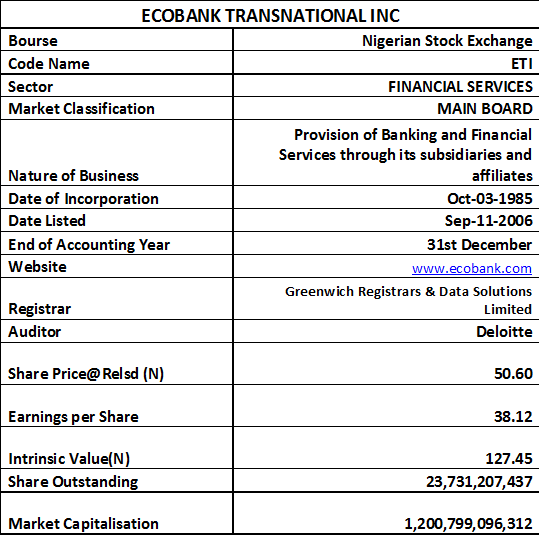
Ecobank Transnational Incorporated (ETI) recorded a strong financial performance in the 2025 financial year ended December 31, with Gross Earnings increasing by 15.97% to ₦4.77 trillion, driven largely by the 15.75% growth in Interest Income to ₦3.19 trillion. The growth reflects improved yields on earning assets and expansion in interest-generating activities. Notably, interest expenses grew at a much slower rate of 3.75%, indicating effective funding cost management, resulting in a significant 22.64% increase in Net Interest Income to ₦2.15 trillion, highlighting improved profitability in its core banking activities and a likely expansion in Net Interest Margin.
On the cost side, operating expenses rose by 9.58% to ₦1.68 trillion, reflecting inflationary pressures and ongoing investments in operations and digital infrastructure. However, the growth in OPEX remained below the growth in net interest income, indicating the positive operating leverage.
Depreciation increased by a marginal 3.60%, while no amortization expense was recorded, suggesting a relatively stable fixed asset cost structure. Overall, ETI maintained a reasonable balance between cost growth and revenue expansion, supporting improved operating efficiency during the period.
Profitability strengthened significantly, with Profit Before Tax rising by 24.36% to ₦1.22 trillion, driven by an equally strong revenue growth, while the group was able to constrain costs. Profit After Tax grew by 22.94% to ₦904.71 billion, despite a corresponding increase in tax expenses. Additionally, total comprehensive income increased by 22.98% to ₦1.51 trillion, indicating a solid overall performance, including gains from other income components. In summary, ETI demonstrated strong earnings growth, improved efficiency, and resilient profitability, reinforcing its position as a leading pan-African banking group.
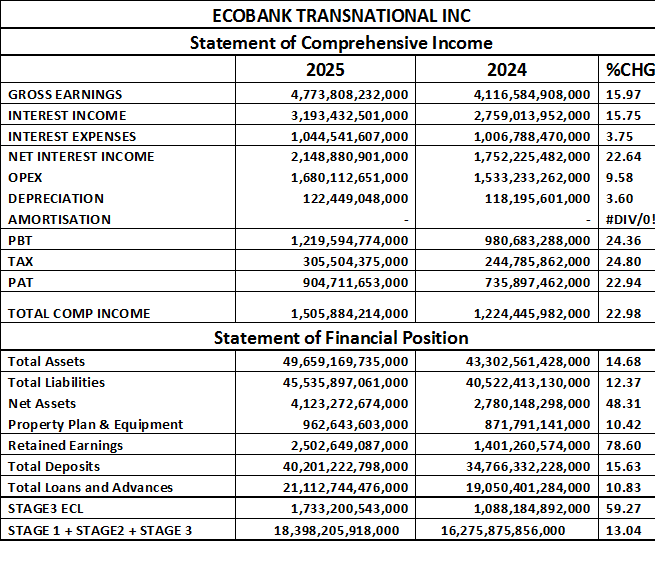
Ecobank Transnational Incorporated (ETI) showed a solid balance sheet expansion in 2025, with total assets increasing by 14.68% to ₦49.66 trillion from ₦43.30 trillion in 2024. This growth was largely supported by the 15.63% rise in total deposits at ₦40.20 trillion, confirming the strong customer confidence and funding base stability. In addition, total loans and advances grew by 10.83% to ₦21.11 trillion, indicating continued credit expansion, though at a slightly slower pace than deposit growth, which suggests a cautious lending approach amid the prevailing economic uncertainties.
On the liability and capital side, total liabilities rose by 12.37% to ₦45.54 trillion, broadly in line with asset growth. However, net assets (shareholders’ funds) increased significantly by 48.31% to ₦4.12 trillion, driven largely by a sharp 78.60% growth in retained earnings. This indicates strong profit retention and internal capital generation, enhancing the bank’s capital base and loss absorption capacity. Furthermore, property, plant and equipment value grew modestly by 10.42%, reflecting continued but controlled investment in infrastructure and operational capacity.
Asset quality, however, presents a mixed outlook. While total performing loan exposure (Stage 1–3) increased by 13.04%, Stage 3 Expected Credit Loss (ECL) surged by 59.27% to ₦1.73 trillion, signaling a notable rise in impaired loans and credit risk. This sharp increase in non-performing exposures may reflect macroeconomic pressures across its key operational markets, and could weigh on future earnings through higher provisioning costs. Overall, ETI demonstrates a robust balance sheet growth and improved capital strength, but the unhealthy growth in credit risk remains a key area to monitor.
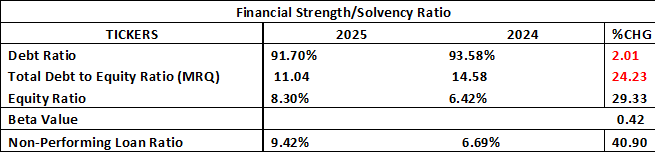
Financial Strength/ Solvency Ratios
In the period under review, ETI showed a modest improvement in its solvency position, as reflected in the decline in debt ratio to 91.70% from 93.58% in 2024. This indicates a slight reduction in the proportion of assets financed by liabilities, suggesting improved balance sheet stability. Similarly, the debt-to-equity ratio declined significantly to 11.04x from 14.58x, pointing to a strengthening equity base relative to debt. This is further supported by the increase in equity ratio to 8.30% from 6.42%, highlighting enhanced capitalisation and improved capacity to absorb financial shocks.
Despite the improvement in capital structure, ETI remains highly leveraged, which is typical for banking institutions but still requires careful monitoring. The relatively high debt ratio reflects the bank’s dependence on customer deposits and other liabilities for funding its operations. However, the positive shift in leverage metrics suggests that the bank is gradually strengthening its capital base, likely driven by the enhanced retained earnings growth and profit accumulation during the period.
On the risk side, asset quality deteriorated as non-performing loan (NPL) ratio increased sharply to 9.42% from 6.69%, representing a significant 40.90% rise, far above the regulatory threshold. This indicates growing credit risk exposure and potential pressure on future earnings that would arise from higher impairment charges. Although the bank’s solvency position improved, the rising NPL ratio signals the need for stronger credit risk management and loan recovery strategies. Overall, ETI demonstrates improving capital strength, but elevated credit risk remains a key concern.
Profitability Ratios
Ecobank Group maintained a solid profitability in 2025, although with mixed margin performance. The EBIT margin declined slightly to 49.99% from 51.15%, indicating mild pressure on operating profitability, possibly due to rising operating costs. However, the pre-tax margin improved to 25.55% from 23.82%, reflecting the bank’s ability to translate revenue into profit more efficiently at the pre-tax level. This suggests that despite some cost pressures, overall earnings growth remained robust and well-supported by core income expansion.
Efficiency improved during the period, as seen in the interest expense to gross earnings ratio (IE to GE) that declined to 21.88% from 24.46, indicating better funding, cost management and improved margin optimization. The effective tax rate remained relatively stable at 25.05%, showing consistency in tax obligations without significant distortions to net earnings. However, Return on Equity (ROE) declined to 21.94% from 26.47%, suggesting that the rapid growth in equity—driven by retained earnings—outpaced profit growth, thereby diluting returns to shareholders.
On the other hand, Return on Assets (ROA) improved slightly to 1.82% from 1.70%, indicating better utilization of the bank’s asset base to generate earnings. This reflects improved operational efficiency at the asset level despite the decline in ROE. Overall, ETI demonstrated solid profitability with improved efficiency and asset utilization, though the slight decline in margins and shareholder returns suggests the need to balance growth in equity with stronger profit expansion going forward.
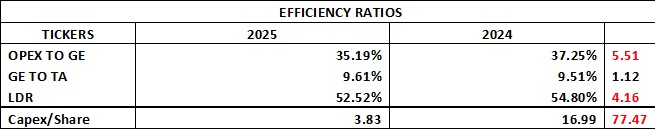
Efficiency Ratios
Ecobank demonstrated improved operating efficiency in the 2025 full year, as reflected in the decline in the OPEX to Gross Earnings ratio to 35.19% from 37.25% in 2024. This indicates that the bank managed its operating costs more effectively relative to its revenue base, achieving better cost discipline despite the inflationary pressures. The improvement suggests positive operating leverage, where revenue growth outpaced the increase in operating expenses, thereby enhancing overall efficiency.
The group’s asset utilization remained relatively stable, with the Gross Earnings to Total Assets ratio (GE to TA) slightly increasing to 9.61% from 9.51%. This marginal improvement indicates that it was able to generate slightly higher income from its asset base, reflecting the steady earning capacity. Meanwhile, Loan-to-Deposit Ratio (LDR) fell to 52.52% from 54.80%, suggesting a more conservative lending stance. This indicates that a smaller proportion of deposits was converted into loans, which may reflect cautious risk management amid rising credit risk, but could also imply underutilization of available funds.
A notable development in the group during the period is the sharp decline in Capex per Share to 3.83 from 16.99, representing a significant reduction of 77.47%. This suggests that the bank scaled back its capital expenditure during the period, possibly after prior heavy investments or as part of cost optimization efforts. While this supports short-term efficiency and cash flow preservation, sustained underinvestment could impact long-term growth if not balanced properly. Overall, ETI shows improved cost efficiency and stable asset utilization, though its conservative lending approach and reduced capital expenditure require close monitoring.
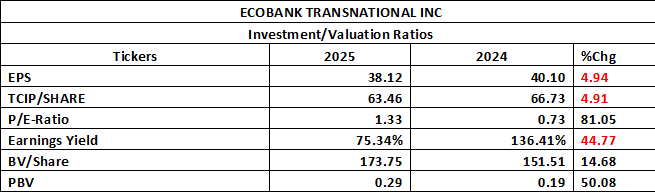
Investment Ratios
Ecobank Transnational Incorporated (ETI) presented mixed signals in its investment and valuation profile for 2025. Earnings Per Share (EPS) declined by 4.94% to N38.12, while Total Comprehensive Income per share also fell by 4.91%, indicating a slight dilution in per-share performance despite the improvement in absolute profit growth which may be attributed to an expanded share base or retained earnings accumulation. However, Book Value per Share (BVPS) increased by 14.68% to N173.75, reflecting strengthened shareholders’ equity and improved intrinsic value of the bank.
Valuation metrics suggest that the stock became relatively more expensive compared to the previous year, after Price-to-Earnings (P/E) ratio rose significantly to 1.33x from 0.73x, indicating that the market is now pricing ETI at a higher multiple of its earnings. Correspondingly, earnings yield declined sharply to 75.34% from 136.41%, reinforcing the view of reduced earnings return relative to market price. Despite this, the valuation remains generally low in absolute terms, suggesting that the stock may still be undervalued compared to global banking peers.
Further supporting this undervaluation argument is the Price-to-Book Value (PBV) ratio, which increased to 0.29x from 0.19x, yet remains well below 1.0x. This indicates that the stock is still trading significantly below its book value, presenting potential upside if market perception improves. Overall, while per-share earnings weakened slightly and valuation multiples expanded, ETI remains fundamentally undervalued, supported by strong book value growth and improving investor confidence.
Dividend Details
For the purpose of this analysis, we therefore convert the reported 61cents dividend per share to naira, translating to N2.40 at the rate of N1,500/Dollar (this may change based on the rate at payment date and the bank’s style of conversion). Our analysis is as stated below.
Ecobank Transnational Incorporated (ETI) recorded a notable improvement in shareholder returns in 2025, declaring a final dividend of ₦2.40 per share compared to zero dividend in 2024. This resulted in a final dividend payout ratio of 6.30%, indicating a conservative distribution policy that retains a significant portion of earnings for growth and capital strengthening. Additionally, the dividend yield stood at 4.74%, providing moderate income return to investors. Overall, the reintroduction of dividend payments reflects improved profitability and confidence in earnings sustainability, while the relatively low payout ratio suggests a balanced approach between rewarding shareholders and reinvesting in the business.

Opinion/Findings: Ecobank Transnational Incorporated (ETI) delivered a strong overall financial performance in 2025, supported by robust earnings growth, improved net interest income, and better cost efficiency. The bank also strengthened its capital base significantly, as seen in the growth in equity and retained earnings, while maintaining positive operating leverage. However, this performance is somewhat tempered by rising credit risk, evidenced by the increase in non-performing loans and Stage 3 exposures, as well as a slight decline in key profitability metrics such as ROE and EBIT margin. Nonetheless, the reintroduction of dividend payments signals management confidence and improved earnings stability.
From a valuation standpoint, ETI remains undervalued, trading at low P/E and PBV multiples despite recent upward adjustments. The strong growth in book value per share and improving investor sentiment suggest potential upside. However, the decline in earnings yield and slight dilution in EPS indicate that market expectations are beginning to adjust. The bank’s conservative lending stance and reduced capital expenditure also reflect a cautious approach, which may limit aggressive growth but supports stability in the near term.
Final Verdict: Fundamentally strong with improving efficiency and capital strength, but with elevated credit risk concerns.
Investment Recommendation: BUY (with caution) – suitable for medium to long-term investors.