
Period Under Preview: YEAR ENDED DECEMBER 2025
Current Share Price: N134:00
Price At Release Date: N117.00
Latest Final Dividend: N11.76
Latest Interim Dividend: N1.00
Estimated Beta Value: 0.75x
Estimated Intrinsic Value: N149.36
Rating: HOLD (with Accumulate Bias)
Analyst: Jeariogbe Tunde Segun
The Company
Guaranty Trust Holding Company Plc was established as Guaranty Trust Bank Plc, in 1990 and commenced full banking operations in February 1991, by a group of young professionals: Fola Adeola, Tayo Aderinokun and Olusegun Agbaje, the current Group Managing Director, after obtaining a banking license from the Central Bank of Nigeria (CBN).
The founder had a vision a bank that would revolutionize the industry through professionalism, strong corporate governance, and customer-focused service delivery. Over the years, it experienced rapid growth, becoming one of the first Nigerian banks to achieve major milestones such as listing on London Stock Exchange, after also listing on the then Nigerian Stock Exchange, and expanding its footprint across Africa and the United Kingdom.
As part of its strategic evolution, the institution transitioned in 2021 from a traditional commercial bank into a financial holding company structure, now known as Guaranty Trust Holding Company Plc (GTCO). The restructuring was to enable the group diversify beyond core banking and unlock new growth opportunities across the financial services value chain.
Today, GTCO operates as a leading multinational financial services group headquartered in Lagos, with subsidiaries across several African countries and the UK, while maintaining a reputation for innovation, digital banking leadership, and consistent financial performance.
GTCO’s line of business is structured into multiple segments and service areas. Its core banking operations are divided into Corporate Banking, Commercial Banking, Business Banking, Retail Banking, SME Banking, and Public Sector services. Beyond traditional banking, the Group has expanded into broader financial service areas including payments (via fintech solutions), funds management, and pension management.
Across these segments, GTCO provides products such as deposits, loans, investment services, cards, digital banking solutions, and advisory services to individuals, businesses, and government institutions, reflecting its transition into a diversified financial services ecosystem.
The Numbers
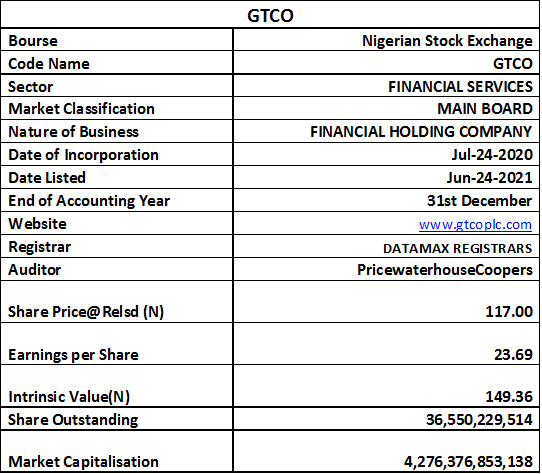
The statement of comprehensive income for GTCO Plc shows that gross earnings remained relatively flat year-on-year, increasing marginally to ₦2.15 trillion in 2025 from ₦2.15 trillion in 2024 (0.09% growth). However, the composition of earnings changed significantly, as interest income rose strongly by 23.20% to ₦1.65 trillion, reflecting improved asset yields. This growth was offset by a sharper increase in interest expenses, which grew by 38.61% to ₦392.58 billion, indicating a higher cost of funds. Despite this pressure, net interest income still recorded a solid growth of 19.08% to ₦1.26 trillion. Operating expenses also increased moderately by 11.84%, while depreciation surged by 54.26%, suggesting higher investment in fixed assets or technology infrastructure.
Profitability, however, declined marginally during the period, with profit before tax (PBT) dropping by 2.78% to ₦1.23 trillion, largely due to rising operating and funding costs. This was made worse by the significantly 47.05% rise in tax expense which further impacted the bottom line. Consequently, profit after tax (PAT) fell by 14.94% to ₦865.75 billion. Total comprehensive income also declined sharply by 23.15% to ₦875.58 billion, indicating weaker overall returns to shareholders compared to the previous year. Generally, while GTCO demonstrated resilience in revenue generation and core banking income, profit was pressured by higher costs and the increased tax burden.
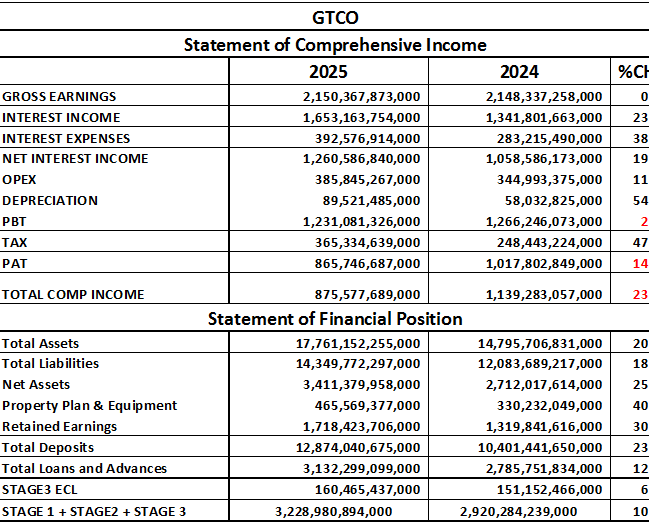
The statement of financial position for GTCO Plc reflects a strong balance sheet expansion in 2025, with total assets increasing by 20.04% to ₦17.76 trillion from ₦14.80 trillion in 2024. This growth was largely supported by a significant rise in total deposits, which grew by 23.77% to ₦12.87 trillion, indicating improved customer confidence and a stronger funding base. Total liabilities also increased by 18.75% to ₦14.35 trillion, though at a slower pace than assets, resulting in a 25.79% growth in net assets to ₦3.41 trillion. Additionally, property, plant and equipment valuation rose sharply by 40.98%, suggesting continued investment in infrastructure and operational capacity, while retained earnings increased by 30.20%, reflecting cumulative profitability over time.
On the asset quality side, total loans and advances grew moderately by 12.44% to ₦3.13 trillion, indicating a cautious lending approach relative to deposit growth. However, credit risk indicators showed a slight deterioration, as Stage 3 expected credit losses increased by 6.16% to ₦160.47 billion, and total expected credit losses (Stage 1, 2, and 3) rose by 10.57% to ₦3.23 trillion. This suggests a marginal increase in impaired or higher-risk exposures.
Overall, GTCO maintained a solid financial position with strong capital growth and liquidity, although the rise in credit risk metrics calls for careful monitoring.
Financial Strength
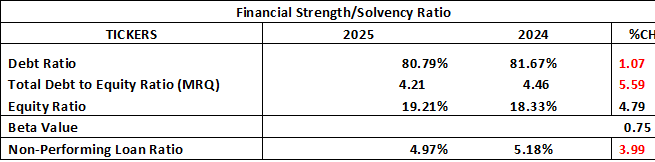
GTCO Plc’s financial strength and solvency ratios for 2025 indicate a slight improvement in its capital structure and risk profile. The debt ratio declined marginally to 80.79% from 81.67% in 2024, suggesting a modest reduction in reliance on liabilities to finance assets. Similarly, the total debt-to-equity ratio improved to 4.21 from 4.46, indicating better balance between borrowed funds and shareholders’ equity. Correspondingly, the equity ratio increased to 19.21% from 18.33%, reflecting a stronger capital base and improved capacity to absorb financial shocks. These movements collectively point to a gradual strengthening of the bank’s solvency position.
In terms of risk indicators, the non-performing loan (NPL) ratio declined to 4.97% from 5.18%, signaling an improvement in asset quality and credit risk management. Additionally, the Beta value of 0.75 suggests that GTCO’s stock is relatively less volatile, compared to the overall market, making it potentially more stable for investors. Overall, the bank demonstrates a solid and improving solvency position, supported by better capital ratios and reduced credit risk exposure, which enhances its resilience in the face of economic uncertainties.
Profitability Ratios
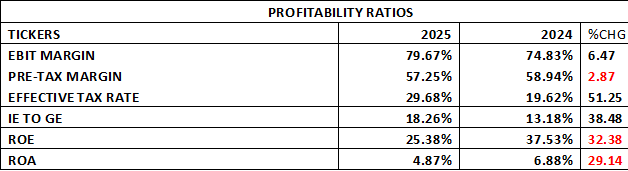
GTCO Plc’s profitability ratios for 2025 reflect mixed performance, with improvements in operating efficiency but pressure on overall returns. The EBIT margin increased to 79.67% from 74.83% in 2024, indicating stronger core earnings relative to revenue. Similarly, the pre-tax margin rose to 57.25%, suggesting improved cost management before taxation. However, the effective tax rate declined slightly to 29.68% from 19.62%, reflecting a significantly higher tax burden during the period. Interest expense to gross earnings also increased to 18.26% from 13.18%, highlighting rising funding costs which partially offset gains in operating performance.
Despite improvements at the operating level, overall profitability weakened. Return on equity (ROE) declined sharply to 25.38% from 37.53%, indicating reduced returns to shareholders. Likewise, return on assets (ROA) fell to 4.87% from 6.88%, suggesting less efficient utilization of assets in generating profit. These declines are consistent with the earlier observed drop in profit after tax, driven by higher costs and taxation. Overall, while GTCO maintained strong operating margins, its bottom-line profitability and efficiency ratios weakened, signaling pressure on shareholder returns.
Efficiency Ratios
GTCO Plc’s efficiency ratios for 2025 continue to show mixed performance, reflecting both cost pressures and cautious balance sheet utilization. The operating expense to gross earnings ratio (OPEX to GE) increased to 17.94% from 16.06% in 2024, indicating that operating costs grew faster than earnings, thereby reducing cost efficiency. In addition, the gross earnings to total assets ratio (GE to TA) declined to 12.11% from 14.52%, suggesting weaker asset utilization and a lower ability to generate income from its asset base.
On the liquidity and investment side, the loan-to-deposit ratio (LDR) decreased to 24.33% from 26.78%, reinforcing a conservative lending stance and strong liquidity position, though it may also imply underutilization of available funds for income generation.
Meanwhile, capital expenditure per share increased to 3.70 from 3.10, reflecting a 19.32% growth, which indicates continued investment in infrastructure and future capacity. Overall, GTCO shows rising cost pressure and reduced asset efficiency, balanced by prudent liquidity management and sustained investment in long-term growth.

Investment Ratios
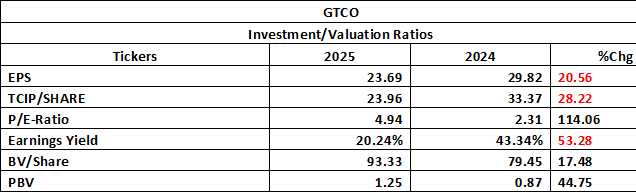
GTCO Plc’s investment and valuation ratios for 2025 reflect a decline in earnings performance, but an improvement in market valuation metrics. Earnings per share (EPS) dropped to 23.69 from 29.82 in 2024, while total comprehensive income per share also declined significantly, indicating reduced profitability attributable to shareholders. This is further supported by the sharp fall in earnings yield from 43.34% to 20.24%, showing that investors are now earning less return per unit of its share price. However, despite the weaker earnings, the price-to-earnings (P/E) ratio more than doubled to 4.94, suggesting that the market is pricing the stock higher relative to its earnings, possibly due to investor confidence or expectations of future growth.
On the other hand, balance sheet strength is reflected in the increase in Book Value Per Share, which rose by 17.48% to N93.33 each, indicating growth in shareholders’ equity. The Price-to-Book Value (PBV) ratio also increased to 1.25 from 0.87, implying that the market now values the company above its book value, unlike in the previous year. Overall, while GTCO experienced a decline in earnings-based metrics, its improved valuation ratios and stronger Book Value suggest sustained investor confidence and a positive outlook on the bank’s long-term fundamentals.
Dividend Information
GTCO Plc’s dividend information for 2025 shows a significant improvement in shareholder payouts despite the decline in profitability. The latest final dividend increased substantially to 12.76 from 8.03 in 2024, representing a strong growth of 58.90%. This indicates management’s commitment to rewarding shareholders even in a period of earnings pressure. In line with this, the dividend payout ratio rose sharply to 53.87% from 26.93%, meaning a larger portion of earnings was distributed rather than retained, which may appeal to income-focused investors.
However, the final Dividend Yield declined slightly to 10.91% from 11.67%, reflecting either a higher market price of the stock, or a relatively slower growth in dividends compared to share price appreciation. This suggests that while absolute dividend payments increased, the return relative to market value weakened marginally. Overall, GTCO demonstrates a strong dividend policy with increased payouts, though the sustainability of this approach may depend on future earnings recovery.

Final Verdict
GTCO Plc presents a fundamentally strong but pressured performance in 2025. The Group demonstrated solid growth in assets, deposits, and net interest income, alongside improvements in capital adequacy and asset quality (lower NPL ratio). However, profitability weakened due to rising interest expenses, higher operating costs, and a significantly increased tax burden, which led to declines in PAT, ROE, and ROA. Efficiency ratios also showed signs of strain, particularly in cost management and asset utilization. Despite this, investor confidence remains relatively strong, as reflected in improved valuation metrics and increased dividend payouts.
Recommendations
GTCO remains a good long-term investment, especially for those seeking stability and consistent dividend income. However, the group needs to address key pressure points to sustain growth. Management should focus on cost control, particularly operating and funding costs, while also improving asset utilization by optimizing its loan-to-deposit ratio. Additionally, maintaining credit quality and managing tax exposure will be critical. Investors should consider a hold/accumulate strategy, especially on price dips, while monitoring future earnings recovery and margin sustainability.
Investment Rating: HOLD (with Accumulate Bias)
GTCO Plc is best rated as a HOLD, meaning investors who already own the stock should retain their position, while new investors can gradually accumulate on price dips rather than aggressively buying at current levels.
The rationale is straightforward: the company has strong fundamentals (capital, deposits, asset quality, dividends), but profitability is currently under pressure due to rising costs and taxes. This creates a balanced outlook, not weak enough to sell, but not strong enough either for a full “BUY” conviction yet. In other words, existing investors should -Hold, new investors are to accumulate gradually. All categories are to upgrade to BUY if profitability (ROE, PAT) rebounds, and cost pressures ease.