
Market Update For October 13, 2026
The Nigerian equities market extended its decline on Tuesday, October 13, 2026, as profit-taking in selected large-cap stocks, particularly banking equities, continued to weigh on the benchmark NGX All-Share Index (ASI). The market’s performance reflected cautious investor positioning following the substantial gains recorded earlier in the year, with losses in key stocks offsetting buying interest in selected counters.
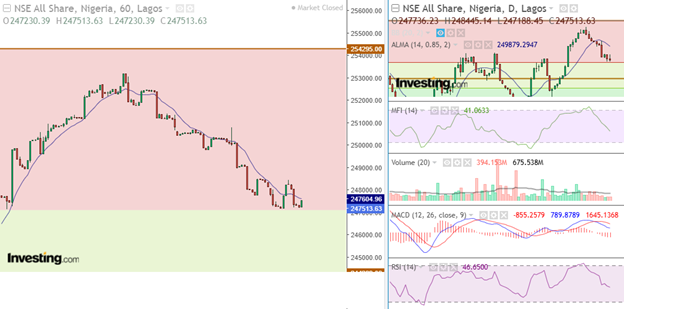
The ASI shed 222.61 points to close at 247,513.63 points, representing a 0.09% decline from the previous session’s close of 247,736.24 points. The latest decline moderated the market’s year-to-date return to 59.06%, although the benchmark remains significantly higher than its level at the beginning of the year.
Tuesday’s performance highlights the growing influence of profit-taking on market direction as investors reassess their positions after an extended period of appreciation. While the Nigerian stock market has maintained substantial year-to-date gains, recent weakness suggests that some participants are becoming more cautious about extending exposure at prevailing price levels. This has encouraged selective selling, particularly in stocks that have attracted considerable investor interest during the market’s rally.
The decline also reflects the sensitivity of the benchmark index to movements in heavyweight stocks. Banking equities, which account for a significant portion of market activity and investor portfolios, remained under pressure during the session. Selling in selected financial services stocks contributed to the weakness in the broader market, highlighting the influence of the banking sector on overall market direction.
The weakness in banking equities is particularly relevant given the sector’s importance to the Nigerian capital market. Banks remain central to market liquidity, corporate earnings expectations and investor sentiment, making their share-price movements an important indicator of the market’s broader direction. Consequently, sustained selling in major banking stocks could limit the benchmark’s ability to recover, even when other sectors record positive performances.
Beyond the banking sector, pressure on consumer-related and property investment stocks also contributed to the negative sentiment. This suggests that profit-taking extended beyond financial services, although the overall decline remained relatively modest.
The performance of these sectors indicates that investors are continuing to differentiate between individual companies and their growth prospects rather than making uniform portfolio adjustments. In such an environment, stocks with attractive valuations, stronger earnings prospects or favourable corporate developments may continue to attract buying interest even as other equities experience profit-taking.
Nevertheless, the market’s decline should be considered within the context of its strong year-to-date performance. Following substantial gains earlier in the year, some investors may be inclined to secure profits and reduce exposure to stocks that have appreciated considerably. This process can generate intermittent corrections without necessarily signalling a complete reversal of the broader market trend.
The immediate challenge for the market is therefore to establish a stronger support base capable of absorbing selling pressure while encouraging fresh demand. Whether this happens will depend partly on the performance of heavyweight stocks, the availability of liquidity and investors’ assessment of prevailing valuations.
Despite the decline in the benchmark index, trading activity revealed continued interest in selected equities, highlighting the divergence between the performance of the broader market and individual stocks.
Market breadth was balanced, with 27 stocks advancing against 27 decliners, while 92 equities closed unchanged. The equal number of gainers and losers suggests that Tuesday’s decline was not accompanied by a broad-based sell-off across the entire market. Instead, weakness in selected large-cap stocks weighed on the index despite continued appreciation in other counters.
This divergence is important because the ASI is influenced by the performance of listed equities with varying market capitalisations. A relatively small number of heavyweight stocks can exert considerable influence on the index, even when several other companies record gains. Consequently, a decline in the benchmark does not necessarily mean that most actively traded stocks are experiencing the same degree of weakness.
The gains recorded across selected equities indicate that investors remain willing to take positions where they identify potential opportunities. However, the sustainability of this demand will depend on the underlying factors supporting individual share prices, including corporate earnings, dividend expectations, business prospects and prevailing valuations.
The broader implication is that stock-specific opportunities remain available despite the pressure on the benchmark index. Investors may therefore continue to adopt a selective approach, paying closer attention to company-level developments rather than relying solely on the direction of the ASI.
However, strong daily price movements should be assessed alongside trading liquidity, corporate fundamentals and the sustainability of demand. A significant percentage gain in a single session does not, on its own, establish that a stock is undervalued or that its upward movement will continue.
A stock reaching a new 52-week high may attract attention from momentum-driven investors, although the continuation of such a trend depends on whether demand remains strong and the price movement is supported by the company’s underlying prospects.
Trading activity weakened during Tuesday’s session, indicating a modest reduction in market participation as investors adjusted their positions.
Approximately 394.16 million shares valued at ₦21.35 billion were exchanged in 38,660 deals. ACCESSCORP dominated trading volume, with 57.02 million shares changing hands, while GTCO led in transaction value at ₦3.13 billion.
The concentration of trading activity in major banking stocks highlights the sector’s continued importance to liquidity on the Nigerian Exchange. Trading patterns in these stocks can provide useful insight into investor positioning, particularly when the market is experiencing profit-taking or uncertainty about its near-term direction.
High trading volume does not necessarily indicate a bullish or bearish outlook on its own. The interpretation depends on the relationship between price movements, trading activity and the direction of demand. Heavy volume accompanying falling prices may indicate active distribution, while rising prices supported by increased volume can suggest stronger buying conviction.
Similarly, a decline in trading activity during a market downturn may indicate that investors are becoming less willing to initiate large positions until clearer signals emerge. It may also reflect a temporary pause in transactions as participants reassess valuations and wait for new information.
For Tuesday’s session, the combination of a modest decline in the ASI and substantial turnover suggests that the market remained active, although the benchmark’s performance reflected continued pressure on selected heavyweight stocks.
The concentration of transaction value in major banking equities also demonstrates the importance of institutional and high-value transactions in determining market turnover. Investors will continue to monitor activity in these stocks for indications of whether demand is strengthening or selling pressure is likely to persist.
Going forward, a recovery supported by stronger trading activity and broad participation would provide a more convincing indication of improving sentiment. Conversely, a rebound driven by limited activity may prove less durable if demand does not expand across the broader market.
The Nigerian equities market continues to operate against a backdrop of strong year-to-date appreciation, changing monetary conditions and ongoing adjustments in investor expectations.
The market’s substantial gains have strengthened the appeal of equities as an investment option, but they have also increased the importance of valuation discipline. As prices rise, investors must consider whether prevailing valuations remain justified by earnings prospects, dividend expectations and the broader economic environment.
Profit-taking is a normal feature of an advancing market, particularly after sustained rallies. Investors who have accumulated gains may decide to reduce exposure, while new participants may become more selective about entry prices. These decisions can create short-term weakness even when the longer-term outlook remains constructive.
For the Nigerian market, the performance of banking stocks is likely to remain an important factor in determining whether the benchmark can regain upward momentum. The sector’s influence on market liquidity and investor sentiment means that a sustained recovery in major banking equities could help stabilise the ASI.
Conversely, continued weakness among these stocks may place additional pressure on the benchmark, especially if selling spreads to other sectors. A broader improvement in market breadth would therefore be important in confirming that the market is regaining strength.
Investors will also need to consider corporate earnings and the outlook for listed companies. Businesses capable of sustaining revenue growth, managing operating costs and maintaining profitability may remain attractive in an environment where investors are increasingly selective.
Dividend expectations could also influence portfolio decisions, particularly among investors seeking a combination of income and capital appreciation. However, dividend prospects should be assessed alongside earnings quality, cash flow and the sustainability of distributions rather than relying on historical payments alone.
The market’s direction will also depend on broader economic conditions, including interest rates, inflation, exchange-rate developments and liquidity within the financial system. These factors influence both the cost of capital and the relative attractiveness of equities compared with alternative investment opportunities.
A sustained improvement in investor confidence could support renewed demand for equities, while uncertainty or unfavourable developments may encourage further portfolio adjustments.
Consequently, the near-term outlook remains dependent on the interaction between stock-specific opportunities and broader market sentiment. Although the latest decline was relatively modest, investors will be watching closely for signs that the benchmark has stabilised and that buying interest is returning to heavyweight stocks.
Technical Analysis and Market Outlook
The NGX All-Share Index closed at 247,513.63 points on Tuesday, extending its downward movement as profit-taking continued in selected large-cap equities. The decline placed the benchmark below the 250,000-point psychological threshold, making the ability of the market to establish support around current levels an important consideration for the next trading sessions.
From a technical perspective, the 247,000-point region represents a key near-term support area. The market’s ability to remain above this level could help limit further losses and encourage buyers to return to selected stocks. However, a sustained break below support may expose the benchmark to additional selling pressure as short-term investors reassess their positions.
The next important consideration is the market’s ability to regain upward momentum. A recovery above 250,000 points would represent an initial improvement in sentiment, although a more convincing bullish signal would require sustained buying interest and stronger participation across heavyweight stocks.
The 252,000-point region represents a further resistance area to monitor. A decisive move towards this level would suggest that demand is strengthening, particularly if the advance is supported by improving trading activity and a wider range of advancing equities.
Market breadth will remain an important indicator. Although Tuesday’s session recorded equal numbers of gainers and decliners, the benchmark still closed lower, reflecting the influence of selected heavyweight stocks. A more sustained recovery would ideally be accompanied by an increase in the number of advancing stocks, stronger turnover and improved performance across major sectors.
The behaviour of banking equities will be especially important. Renewed demand for major banking stocks could support the benchmark, while further declines in these counters may limit any recovery.
Nevertheless, technical levels should be treated as reference points rather than guaranteed turning points. Actual market movements will depend on liquidity, investor positioning, corporate developments and broader economic conditions.
In the near term, the market could remain volatile as investors balance profit-taking against opportunities for further appreciation. A sustained hold above the 247,000-point region may support consolidation, while a recovery above 250,000 points could improve the technical outlook. A break below support, however, would raise the risk of further weakness.
The broader outlook remains cautiously mixed. Nigeria’s equities market continues to record a substantial year-to-date gain, but maintaining the upward trend will require renewed demand, particularly in large-cap stocks. Investors may therefore benefit from a disciplined approach that prioritises fundamental analysis, valuation and liquidity while avoiding decisions based solely on short-term price movements.
Oil Market
International crude oil prices moved lower on Tuesday as expectations surrounding a potential diesel export arrangement involving the United States and Russia offset concerns about supply disruptions arising from attacks in Saudi Arabia and Yemen.
Brent crude futures declined by 0.6%, or 67 cents, to $105.98 per barrel, while US West Texas Intermediate crude held steady at $93.74. The movements followed a strong session on Monday, when Brent settled at its highest level since September 15 and WTI recorded its highest close since September 24.
The market’s reaction reflected competing forces on the supply side. Expectations that a potential arrangement involving Russian diesel exports could increase the availability of refined products placed downward pressure on prices. At the same time, geopolitical tensions continued to raise concerns about the potential disruption of energy supplies and the security of important regional production and transportation infrastructure.
The Kremlin stated that it did not see a direct connection between the reported diesel export arrangement and Moscow’s position on negotiations concerning the war in Ukraine. This clarification highlighted the complexity of the diplomatic and geopolitical considerations influencing energy markets.
For Nigeria, international crude oil prices remain an important determinant of export earnings, government revenue and foreign exchange inflows. Higher oil prices can improve revenue prospects when production levels are supportive, but the overall benefit depends on domestic output, fiscal arrangements and the cost of meeting domestic energy requirements.
Conversely, a sustained decline in crude prices could place pressure on revenue expectations, particularly if domestic production does not compensate for weaker international prices. This makes the relationship between oil prices and production levels an important consideration for investors assessing Nigeria’s fiscal and external outlook.
The oil market’s movements may also influence expectations regarding inflation, energy costs and broader economic activity. Changes in crude prices can affect transportation, production and distribution costs, with potential implications for businesses across several sectors.
However, the implications for individual companies will vary according to their exposure to energy prices, operating structures and ability to pass higher costs on to customers. Investors should therefore assess the potential impact of oil-price movements within the context of individual company fundamentals and the wider economic environment.
In the near term, crude oil prices are likely to remain sensitive to geopolitical developments, supply expectations and changes in market positioning. The balance between the possibility of increased product availability and the risk of further supply disruptions will remain important in determining the direction of prices.
Market Summary: The Nigerian Exchange closed lower on Tuesday, October 13, 2026, as the NGX All-Share Index declined by 0.09% to 247,513.63 points, from 247,736.24 points in the previous session, while market capitalisation stood at ₦160.71 trillion. Trading activity amounted to approximately 394.16 million shares valued at ₦21.35 billion in 38,660 deals, as the market’s year-to-date return moderated to 59.06%. Market breadth was balanced, with 27 gainers, 27 decliners and 92 unchanged stocks, reflecting mixed investor sentiment amid continued profit-taking in selected heavyweight equities. ACCESSCORP led trading volume with 57.02 million shares, while GTCO recorded the highest transaction value at ₦3.13 billion. Among the major market movers, WEMABANK (-2.58%), GTCO (-1.77%), DANGSUGAR (-1.30%), UPDCREIT (-1.14%), ACCESSCORP (-0.89%), ZENITHBANK (-0.78%) and FIDELITYBK (-0.49%) weighed on market performance. The top gainers were ETRANZACT, up 9.96% to ₦14.35; WAPIC, up 7.83% to ₦2.48; LIVESTOCK, up 6.92% to ₦15.45; CHAMS, up 5.88% to ₦3.60; and ETI, up 5.22% to ₦70.50. The top losers were LEGENDINT, down 9.59% to ₦3.30; OMATEK, down 6.43% to ₦1.31; NSLTECH, down 5.71% to ₦0.66; MBENEFIT, down 5.49% to ₦3.10; and AIICO, down 4.39% to ₦3.92.
Compose: