
Market Update For November 3, 2026
The Nigerian equities market returned to positive territory on Tuesday, November 3, 2026, reversing the previous session’s loss on renewed buying interests, after selected heavyweights provided support for the benchmark NGX All-Share index.
However, the recovery remained marginal, reflecting cautious investor sentiment, continued profit-taking and uneven participation across the market.
Tuesday’performance highlighted the divergence between the movement of the benchmark index and the broader market. While selected large-cap stocks attracted renewed demand, selling pressure remained evident across several equities, leaving the overall market breadth in negative territory. This suggests that the market’s recovery was largely supported by gains in a limited number of stocks rather than a broad-based improvement in investor sentiment.
The trading pattern also points to continued portfolio repositioning as investors assess prevailing share prices, corporate earnings prospects and developments in the domestic and global economic environment. Following the substantial appreciation recorded by Nigerian equities market so far this year some investors appear increasingly inclined to take profits on stocks that have recorded significant price increases, while others continue to identify opportunities in counters with relatively attractive valuations.
Trading activities improved during the session, with total volume exchanged increasing by 1.58% to 525.44 million shares, valued at ₦22.61 billion, executed in 39,078 deals. The improvement in turnover suggests that market participation remained active despite the relatively weak performance of the benchmark index.
Measured by volume, ZICHIS dominated trading with 127.48 million shares, representing 24.26% of the day’s total transactions, reflecting concentrated activity in the stock. ACCESSCORP and CHAMS followed with 8.04% and 7.94% of total traded volume, respectively. The concentration of trading in these counters indicates that investor activity remained selective, with market participants directing significant attention towards particular equities.
In terms of transaction value, ARADEL emerged as the most actively traded judging by its transactions worth ₦2.95 billion, equivalent to 13.04% of total market value. MTNN, ZICHIS and DANGCEM also featured prominently among the stocks attracting significant trading value. Their activity underscores the continued importance of selected heavyweight and actively traded stocks in shaping daily market turnover.
The improvement in both trading volume and value provides some indication that investors remained engaged in the market despite the subdued index performance. Nevertheless, higher turnover does not necessarily translate into stronger bullish sentiment, particularly when market breadth remains negative. The balance between buying and selling activities across individual stocks will therefore remain important in determining whether the market can sustain its recovery in subsequent sessions.
Global Oil Market: Crude Prices Retreat as Geopolitical Developments Reshape Market Sentiment
International crude oil prices experienced significant downward pressure on Tuesday as developments surrounding the Middle East conflict and changing geopolitical signals influenced market sentiment. The decline followed comments by US President Donald Trump indicating that Washington would end billions of dollars in annual military support to Israel, triggering a reassessment of geopolitical risks and their potential implications for global energy supply.
Earlier in the session, crude prices had moved higher following comments from an Iranian official indicating that Tehran and Washington remained far apart in negotiations aimed at ending their war. Concerns over the possibility of further military escalation were heightened by reports of US strikes on Iran’s Qeshm Island, adding to uncertainty surrounding the security of regional energy infrastructure and shipping routes.
These developments initially reinforced concerns about potential supply disruptions, particularly given the strategic importance of the Middle East to global crude oil production and international energy transportation. However, prices subsequently reversed direction, suggesting that investors were adjusting their positions as new political signals emerged.
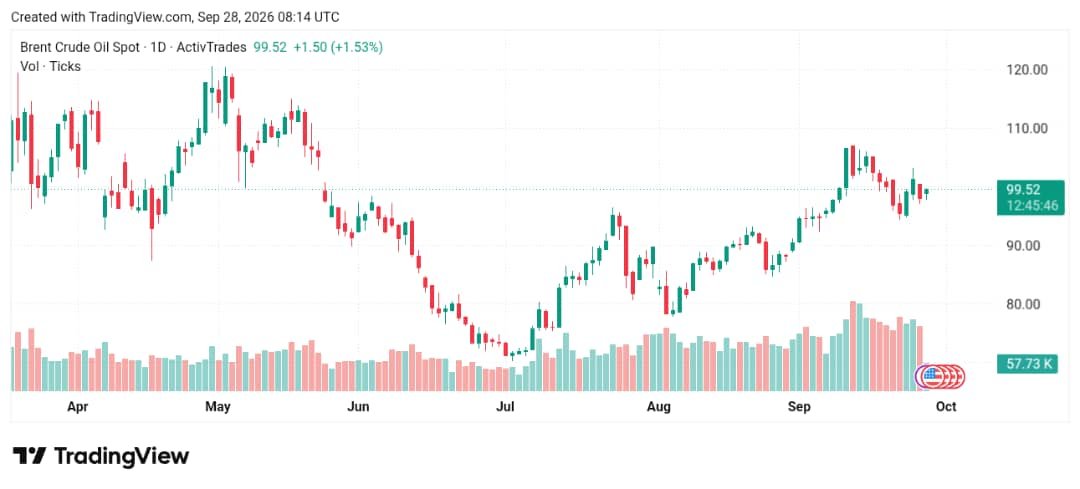
Brent crude futures declined by $3.45 to $101.32 per barrel, representing a 3.3% loss, at 1350 GMT. The benchmark had earlier traded above $107 per barrel before falling to its lowest level since October 8. The decline reflected a substantial intraday reversal as traders reassessed the balance between geopolitical supply risks and the possibility of changing diplomatic and military dynamics.
Similarly, US West Texas Intermediate (WTI) crude futures fell by $2.16, or 2.2%, to $94.30 per barrel after touching their lowest level since October 15. The movement in both benchmarks demonstrated the sensitivity of international oil prices to developments surrounding the conflict, with investors continuing to react to reports of military activity, diplomatic negotiations and potential changes in regional security arrangements.
Despite Tuesday’s decline, crude prices remained above the $100 mark in the case of Brent, indicating that geopolitical uncertainties continued to support a relatively elevated price environment. The possibility of further escalation remains a major concern for energy market participants, particularly if the conflict threatens crude production facilities, export terminals or critical shipping routes.
The Strait of Hormuz and other strategic energy corridors remain important considerations in the global oil market because disruptions to transportation through these routes could affect the movement of substantial volumes of crude oil and petroleum products. Consequently, even the possibility of supply interruptions can influence market pricing before any actual reduction in global production occurs.
For the Nigerian economy, developments in international crude prices remain particularly important given the country’s dependence on petroleum exports for foreign exchange earnings and government revenue. Higher crude prices can improve export receipts and fiscal inflows, provided domestic production and export volumes remain supportive. However, the benefits may be limited where production challenges, operational disruptions, oil theft and other structural constraints prevent the country from fully capitalising on favourable international prices.
Conversely, a sustained decline in crude prices could moderate Nigeria’s expected oil revenue and potentially place additional pressure on fiscal planning and foreign exchange inflows. The relationship between crude prices and government revenue, however, also depends on domestic production levels, export performance, production costs and the country’s ability to meet its oil output targets.
Going forward, developments in the US-Iran conflict, the direction of diplomatic negotiations and the security of regional energy infrastructure are likely to remain major drivers of crude oil price movements. Any further escalation could restore the geopolitical risk premium and support another upward movement in prices, while signs of de-escalation could encourage additional selling and weaken the current price structure.
Technical Analysis and Market Outlook
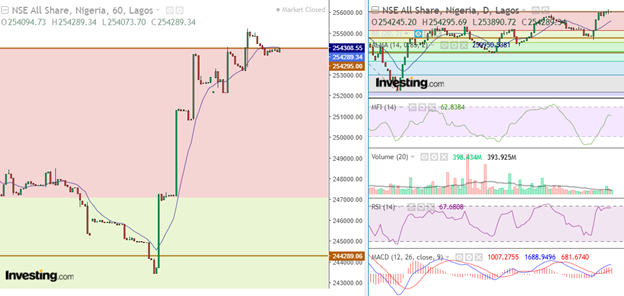
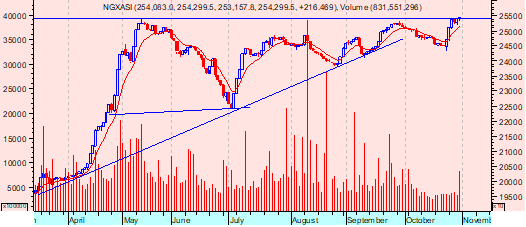
From a technical standpoint, the Nigerian equities market continues to trade around the 254,000-point psychological region, with Tuesday’s marginal appreciation indicating that buyers remain active but have yet to establish sufficient momentum for a stronger upward movement.
The market’s ability to recover from the previous session’s decline suggests that the underlying bullish structure has not completely weakened. However, the narrow advance in the ASI, combined with the higher number of declining stocks, indicates that the recovery lacks sufficient breadth. This creates a mixed technical picture in which the benchmark index remains relatively resilient while individual stocks continue to experience selling pressure.
The 254,000-point region remains an important immediate support area to monitor, while 255,000 points represents the next psychological resistance level. A sustained movement above this resistance could strengthen positive sentiment and encourage renewed buying interest, particularly if heavyweight stocks continue to attract demand. Such a development could provide the market with an opportunity to extend its upward movement towards higher resistance levels.
On the downside, a decisive break below the 254,000-point support region could increase the possibility of further consolidation, especially if profit-taking spreads across the banking, industrial goods, consumer goods and other actively traded sectors. The negative market breadth suggests that investors should not interpret the marginal index appreciation as confirmation of a broad-based recovery.
The behaviour of market volume will also be important in determining the sustainability of any upward movement. A stronger advance accompanied by improved participation across different sectors would provide a more convincing indication of renewed demand. Conversely, an index recovery driven mainly by a handful of heavyweight stocks could remain vulnerable to reversals if selling pressure persists elsewhere.
The oil market also remains an important external variable for the Nigerian investment environment. Changes in international crude prices could influence expectations around government revenue, foreign exchange supply, inflationary pressures and the country’s external balance. These developments may, in turn, affect investor sentiment towards oil and gas stocks, banking equities and other sectors exposed to movements in the domestic macroeconomic environment.
In the near term, investors are expected to remain selective, with greater attention on corporate earnings, valuation levels, dividend prospects, liquidity conditions and the broader economic outlook. Companies demonstrating earnings resilience, sound balance sheets and sustainable cash flows could remain attractive, particularly as investors become more cautious about chasing stocks that have already recorded substantial price appreciation.
Overall, the market retains a positive year-to-date performance profile, but the latest trading pattern suggests that investors are becoming more discerning. The ability of the ASI to sustain its position above the 254,000-point region, alongside an improvement in market breadth, will be important in determining the direction of the next trading sessions.
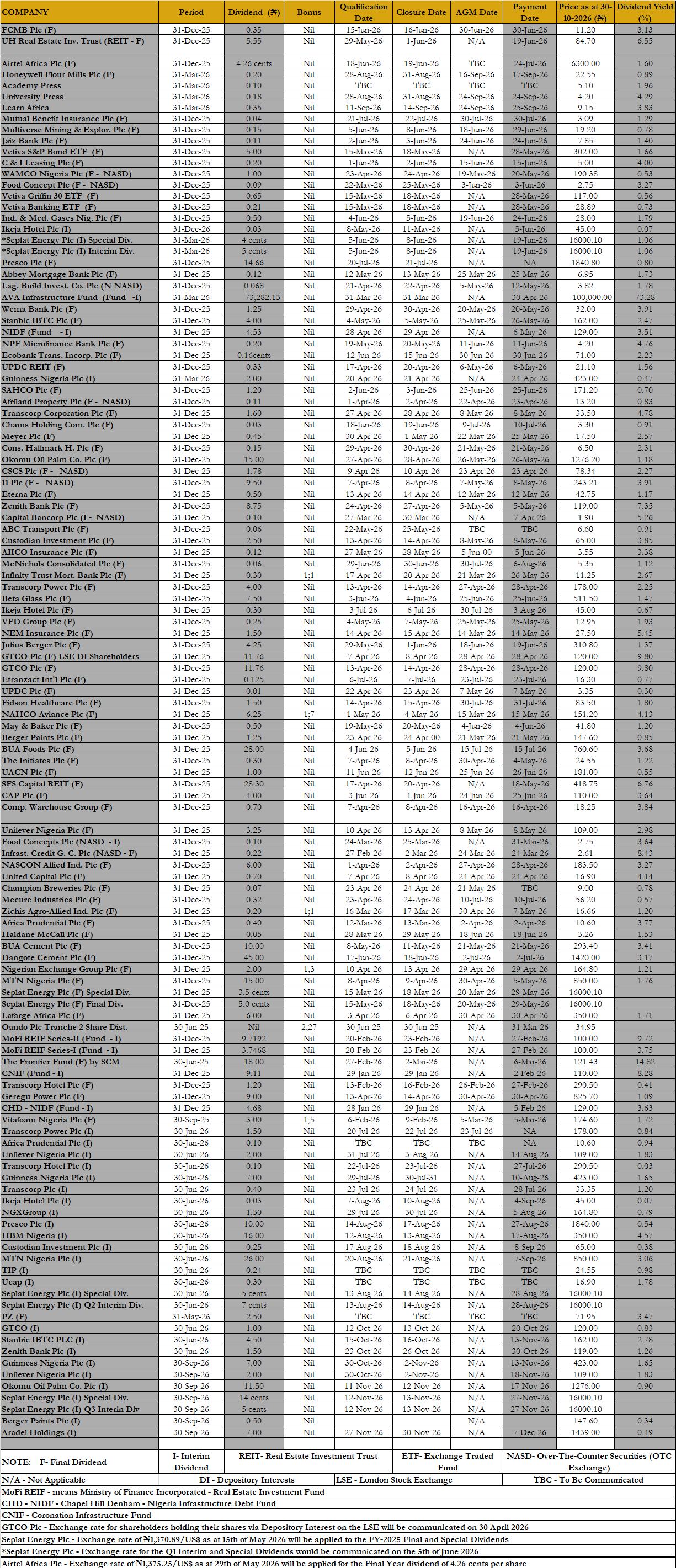
At the close of trading on Tuesday, November 3, 2026, the NGX All-Share Index (ASI) advanced by 0.02% to 254,289.35 points from 254,245.21 points in the previous session, adding approximately ₦28.65 billion to market capitalisation, which stood at ₦165.14 trillion, while the year-to-date return settled at 63.41%. Total traded volume increased by 1.58% to 525.44 million shares, valued at ₦22.61 billion across 39,078 deals. Market breadth remained negative, with 20 stocks advancing against 32 decliners, reflecting persistent selling pressure despite the positive index performance. Among the major market movers, TRANSPOWER gained 3.71%, ACCESSCORP advanced 1.89%, STANBIC rose 1.17%, OANDO added 0.79%, ZENITHBANK appreciated 0.78%, while FIDELITYBK and NGXGROUP recorded gains of 0.43% and 0.12%, respectively. UPL led the gainers’ chart with a 9.52% appreciation to close at ₦4.60, followed by OMATEK, which gained 8.59% to ₦1.39, and INTBREW, which advanced 6.47% to ₦9.05. ROYALEX and GUINEAINS completed the top five gainers, appreciating by 5.26% each to close at ₦1.00 and ₦0.80, respectively. On the losers’ chart, FTGINSURE recorded the steepest decline, shedding 10.00% to close at ₦1.53, while VITAFOAM lost 9.99% to ₦141.50 and UPDCREIT declined 9.95% to ₦19.00. ABBEYBANK and CAVERTON also depreciated by 8.73% and 7.58%, respectively. Further market developments saw CAVERTON and INTENEGINS trade at new 52-week lows of ₦3.05 and ₦1.65, respectively, while AFRIPRUD reached a fresh 52-week high of ₦10.00.