
Market Update For July 7, 2026
The Nigerian Exchange (NGX) maintained its remarkable bullish trajectory on Tuesday, July 7, extending its winning streak as investors continued to accumulate fundamentally strong equities across the banking, industrial goods, consumer goods, oil and gas, telecommunications and services sectors. The broad-based rally reflected sustained investor confidence in the market’s medium-term outlook, supported by improving macroeconomic expectations, anticipated half-year corporate earnings, resilient institutional participation and favourable developments in the global energy market.
The market’s positive tone has remained intact over recent weeks despite elevated valuations, as both domestic and foreign investors continue to rebalance portfolios toward fundamentally sound companies with resilient earnings potential and attractive dividend prospects. Demand remained concentrated in blue-chip and mid-cap stocks, particularly those expected to deliver strong second-quarter and half-year financial results.
Investor sentiment also benefited from the rebound in international crude oil prices, which has positive implications for Nigeria’s oil-dependent economy. Higher crude prices are expected to strengthen government revenue, improve foreign exchange earnings, enhance fiscal stability and support listed upstream energy companies. These expectations continue to reinforce confidence in the domestic equities market despite lingering inflationary pressures and relatively high interest rates.
The international oil market traded firmly higher after fresh geopolitical tensions emerged in the Middle East. Brent crude futures rose 76 cents, or 1.1%, to $72.75 per barrel, while U.S. West Texas Intermediate (WTI) advanced 73 cents, or 1.1%, to $69.28 per barrel.
The rally followed reports that several commercial vessels operating close to the Strait of Hormuz came under attack, reviving concerns about potential disruptions to one of the world’s most important energy transit routes. Market reports indicated that a Qatari LNG tanker and a Saudi-flagged crude oil tanker sustained damage following overnight missile attacks allegedly launched by Iran’s Revolutionary Guards. The Strait of Hormuz previously handled nearly one-fifth of global crude oil and liquefied natural gas exports, making any disruption a major concern for global energy markets.
Further adding to market uncertainty were renewed diplomatic tensions between the United States and Iran. Iranian officials maintained that negotiations over a comprehensive agreement would remain stalled if Washington continued issuing military threats. The renewed uncertainty restored a geopolitical premium to crude prices after weeks of relatively stable trading.
Although some global investment banks expect the oil market to gradually move into surplus toward late 2026 and throughout 2027 as production growth outpaces slower demand, short-term market sentiment continues to be driven primarily by geopolitical developments. Consequently, investors maintained a cautious but positive outlook on oil prices, which remains supportive of Nigeria’s macroeconomic outlook and listed energy companies.
Back home, investors remained focused on the ongoing earnings season. Expectations of stronger half-year financial results continued to drive portfolio reallocation into fundamentally strong companies, particularly in the banking sector where robust profitability and attractive dividend expectations have continued to attract institutional funds.
The industrial goods sector also witnessed renewed buying interest as investors increased exposure to major cement producers, while selective buying in consumer goods reflected confidence in companies with strong pricing power and improving operating margins. Telecom and energy stocks equally attracted institutional demand, reinforcing the broad-based nature of the ongoing market rally.
The resilience of the market despite profit-taking in a handful of stocks demonstrates that liquidity remains strong and investor confidence continues to improve. Market participants are increasingly looking beyond short-term macroeconomic challenges and focusing on corporate fundamentals, earnings resilience and long-term value creation.
Technical Analysis & Outlook
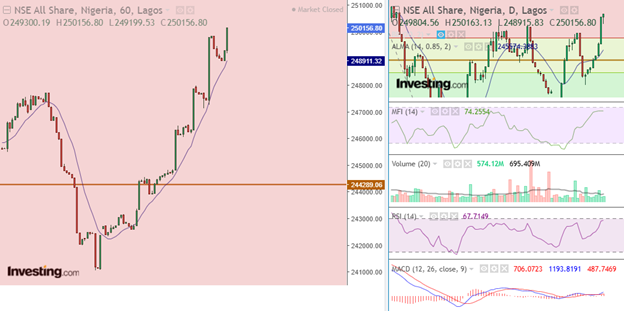
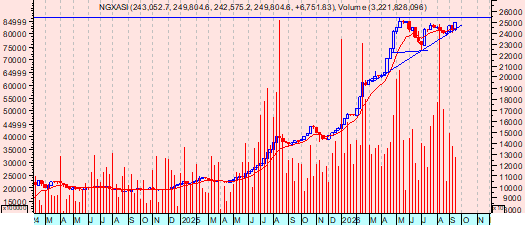
Technically, the Nigerian equities market remains firmly bullish after successfully extending its upward trend and closing above the key 237,000-point psychological level. The market continues to record higher highs and higher lows, confirming that buyers remain firmly in control of price action.
The bullish breakout above previous resistance levels further strengthens the prevailing uptrend and indicates sustained institutional accumulation across major sectors of the market. Although trading volume declined during the session, the combination of strong market breadth and positive price action suggests that the lower volume reflects selective accumulation rather than weakening demand.
Momentum indicators remain supportive of additional upside. The Relative Strength Index (RSI) and other momentum oscillators continue to trend positively, although they are gradually approaching overbought territory. This increases the probability of intermittent profit-taking in the near term, particularly after the recent extended rally. However, any pullback is expected to be temporary as long as institutional investors continue accumulating fundamentally strong stocks.
The banking sector remains the market’s leadership group, supported by expectations of strong earnings growth, improved asset quality and resilient profitability. Cement manufacturers, telecom operators and upstream energy companies are also expected to remain key beneficiaries of ongoing institutional positioning.
Liquidity conditions remain favourable, while sustained foreign portfolio interest and improving domestic participation continue to provide additional support for the market.
Going forward, investor attention will remain focused on corporate earnings releases, macroeconomic data, developments in the foreign exchange market, monetary policy expectations and movements in international crude oil prices. Positive surprises in these areas could provide further catalysts for another leg of the ongoing bull market.
The immediate support zone is expected between 233,000 and 235,000 points, while the next major resistance remains the 240,000-point psychological level. A decisive breakout above this level could pave the way for another significant upward move over the medium term.
The NGX All-Share Index (ASI) advanced by 1.24%, gaining 2,905.05 basis points to close at 237,083.28 points, compared with 234,178.23 points recorded in the previous session. Investors’ wealth increased by approximately N1.86 trillion, lifting total market capitalisation accordingly, while the market’s year-to-date return improved to 52.35%, highlighting the exceptional performance of Nigerian equities in 2026. Market breadth remained overwhelmingly positive with 55 gainers against 17 decliners, reflecting widespread buying interest across the market. Leading the gainers’ chart were Cadbury (+10.00%), Zichis (+10.00%), NAHCO (+9.99%), Vitafoam (+8.17%), TIP (+8.10%), Transcorp (+6.13%), NGX Group (+5.59%), Dangote Cement (+5.40%), WAPCO (+4.83%), FCMB (+4.50%), First HoldCo (+4.38%), United Capital (+2.88%), MTNN (+2.62%), Chams (+2.18%), UBA (+1.89%), Aradel Holdings (+1.62%), Access Holdings (+1.49%), Dangote Sugar (+1.41%) and Wema Bank (+1.01%), alongside 36 other advancing stocks, while CMFC led the 17 decliners. Market activity moderated as total traded volume declined by 8.39% to 493.42 million shares valued at N27.84 billion in 49,859 deals. Zenith Bank remained the most actively traded stock by both volume and value for the third straight session, exchanging 94.29 million shares, representing 19.11% of total market volume, worth N9.91 billion, accounting for 35.60% of total traded value. Fidelity Bank and SterlingNG accounted for 6.61% and 5.79% of market volume respectively, while Aradel Holdings and MTNN ranked behind Zenith Bank in traded value, underscoring sustained institutional demand for large-cap, fundamentally strong equities.