
Quarter Under Review: -THIRD QUARTER 2026
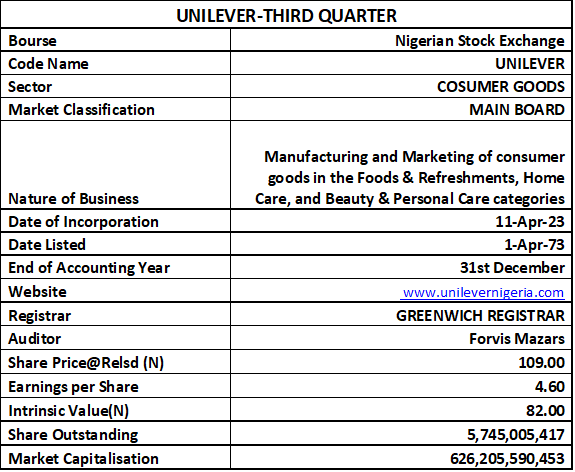
Current Share Price: N109:00
Latest Final Dividend: N
Latest Interim Dividend: N2.00
Estimated Beta Value: 0.68x
Estimated Intrinsic Value: N82.00
Ratings: Hold
Analyst: Jeariogbe Tunde Segun
The Company
Unilever Nigeria Plc traces its origins to 1923, when it was established as the West Africa Soap Company, initially focusing on the manufacture of soap. The company later became known as Lever Brothers Nigeria Limited and established its first major manufacturing facility in Apapa, Lagos, in 1924. It subsequently expanded its manufacturing footprint, including the commissioning of a factory in Aba in 1958, followed by facilities in Oregun, Lagos, in 1980 and Agbara, Ogun State, in 1983.
The company gradually moved beyond its original soap-manufacturing activities and diversified into food, home-care and personal-care products. This expansion was strengthened through a series of mergers and acquisitions, notably the absorption of Lipton Nigeria Limited in 1985, Cheesebrough Industries Limited in 1988 and Unilever Nigeria Limited in 1996. The company was listed on the Nigerian Stock Exchange in 1973, making it one of the long-standing quoted manufacturing companies in Nigeria.
In 2001, the company changed its name from Lever Brothers Nigeria Plc to Unilever Nigeria Plc, reflecting its closer alignment with the global Unilever Group. Over the years, it has built a strong portfolio of well-known consumer brands across Foods & Refreshments, Home Care, and Beauty & Personal Care, including brands such as Knorr, Lipton, OMO, Sunlight, Close-Up, Pepsodent and Vaseline. Unilever Nigeria celebrated its centenary in 2023, reinforcing its position as one of Nigeria’s oldest surviving manufacturing organisations and an important player in the country’s fast-moving consumer goods sector.
Statement of Comprehensive Income
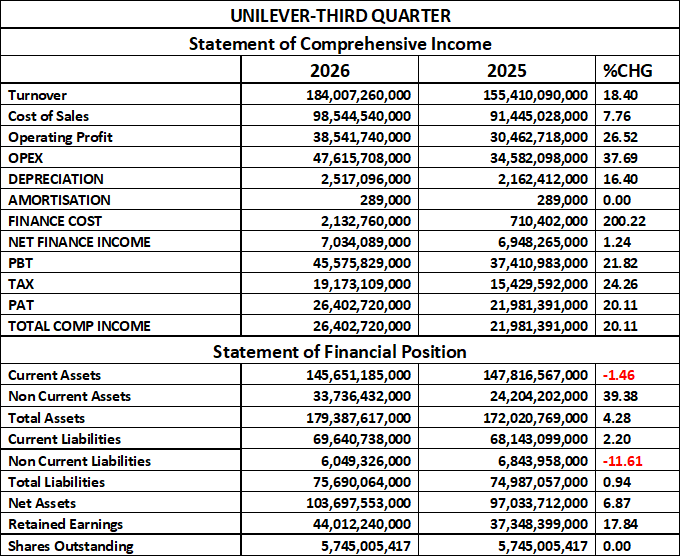
Unilever Nigeria Plc recorded a strong improvement in revenue in the third quarter of 2026, with turnover rising by 18.40% to ₦184.01 billion from ₦155.41 billion in the corresponding period of 2025. Cost of sales increased by a relatively modest 7.76% to ₦98.54 billion, indicating an improvement in gross margin and stronger cost absorption. Operating profit consequently increased by 26.52% to ₦38.54 billion from ₦30.46 billion, despite operating expenses rising by 37.69% to ₦47.62 billion. Depreciation increased by 16.40% to ₦2.52 billion, while amortization remained unchanged at ₦289 million.
The company also recorded a significant improvement in its financial position during the period. Finance cost increased sharply by 200.22% from ₦710.40 million to ₦2.13 billion, but this was more than offset by the net finance income of ₦7.03 billion, compared with ₦6.95 billion in 2025, representing a marginal 1.24% increase. Consequently, profit before tax rose by 21.82% to ₦45.58 billion from ₦37.41 billion. This indicates that, beyond the improvement in operating performance, non-operating income continued to make a meaningful contribution to the company’s overall profitability.
Profit after tax increased by 20.11% to ₦26.40 billion from ₦21.98 billion, while total comprehensive income was also reported at ₦26.40 billion. Although taxation increased by 24.26% to ₦19.17 billion, the company still delivered substantial growth in its bottom-line earnings. Overall, Unilever Nigeria’s third-quarter 2026 performance was positive, characterized by strong turnover increased, improved operating profit and double-digit growth in both profit before tax and profit after tax. The key areas requiring attention are the sharp increase in operating expenses and finance costs, which could moderate future earnings growth if they continue to rise faster than revenue.
Statement of Financial Position
Unilever Nigeria Plc’s statement of financial position shows a relatively stable asset base as at the third quarter of 2026. Current assets declined marginally by 1.46% to ₦145.65 billion from ₦147.82 billion in the corresponding period of 2025. However, non-current assets increased significantly by 39.38% to ₦33.74 billion from ₦24.20 billion, resulting in total assets rising by 4.28% to ₦179.39 billion from ₦172.02 billion. The increase in non-current assets suggests higher investment in longer-term assets during the period.
On the liabilities side, current liabilities increased moderately by 2.20% to ₦69.64 billion from ₦68.14 billion, while non-current liabilities declined by 11.61% to ₦6.05 billion from ₦6.84 billion. Consequently, total liabilities increased only marginally by 0.94% to ₦75.69 billion from ₦74.99 billion. The relatively slower growth in total liabilities compared with total assets resulted in an improvement in net assets, which rose by 6.87% to ₦103.70 billion from ₦97.03 billion.
Shareholders’ funds also strengthened during the period, with retained earnings increasing by 17.84% to ₦44.01 billion from ₦37.35 billion, indicating continued accumulation of earnings within the business. Shares outstanding remained unchanged at 5.745 billion, suggesting that the growth in net assets was not driven by an increase in the number of shares. Overall, the statement reflects moderate balance-sheet growth, improved net assets and lower non-current liabilities, although the slight decline in current assets alongside the increase in current liabilities warrants monitoring of the company’s short-term liquidity position.
Financial Strength/Solvency Ratio
Unilever Nigeria Plc’s financial strength improved moderately in the third quarter of 2026, with debt ratio declining by 3.21% to 42.19% from 43.59% in 2025, while the total debt-to-equity ratio fell from 0.77 to 0.73, representing a 5.55% reduction. At the same time, the equity ratio increased by 2.48% from 56.41% to 57.81%, indicating a slightly stronger equity funding base and reduced reliance on debt financing. The company’s beta of 0.68 suggests relatively lower share-price volatility compared with the broader market. Overall, the ratios point to an improvement in solvency and financial stability, although the company continues to maintain a meaningful level of debt within its capital structure.

Profitability Ratios
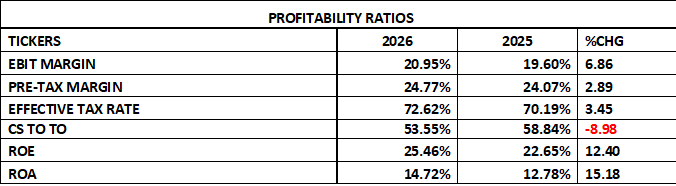
The company recorded an improvement in its profitability during the third quarter of 2026. EBIT margin increased to 20.95% from 19.60% in 2025, representing a 6.86% increase, while pre-tax margin rose from 24.07% to 24.77%, a 2.89% improvement. The rise in these margins indicates that the company generated stronger operating and pre-tax earnings relative to turnover. However, the effective tax rate increased from 70.19% to 72.62%, representing a 3.45% rise, which indicates that a larger proportion of pre-tax profit was absorbed by taxation.
Return-based measures also strengthened during the period. Return on equity (ROE) increased by 12.40% from 22.65% to 25.46%, while return on assets (ROA) rose by 15.18% from 12.78% to 14.72%, reflecting improved utilization of both shareholders’ funds and the company’s asset base in generating earnings. The cost-to-turnover ratio (CS to TO) declined by 8.98% from 58.84% to 53.55%, which is positive as it indicates a lower proportion of turnover was consumed by the cost measured. Overall, the profitability ratios point to improved operating efficiency and stronger returns in 2026, although the elevated effective tax rate remains a significant drag on the company’s bottom-line profitability.
Efficiency Ratios
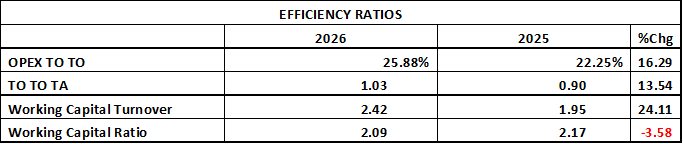
Unilever Nigeria Plc recorded mixed movements in its efficiency ratios in the third quarter of 2026. Operating expenses to turnover increased by 16.29% to 25.88% from 22.25% in 2025, indicating that operating expenses consumed a larger proportion of revenue during the period. However, turnover to total assets improved from 0.90 to 1.03, representing a 13.54% increase. This indicates that the company generated more revenue from each naira invested in its asset base, pointing to improved asset utilization.
Working capital efficiency also strengthened, with working capital turnover rising by 24.11% from 1.95 to 2.42. This suggests that the company generated more turnover relative to its working capital investment. However, the working capital ratio declined slightly from 2.17 to 2.09, a 3.58% decrease, although the ratio remains above 2.0 and indicates that current assets continue to provide substantial coverage for current liabilities. Overall, the efficiency performance was positive, supported by stronger asset utilization and working capital turnover, but the rise in operating expenses relative to turnover remains a key area requiring monitoring.
Investment/Valuation Ratios
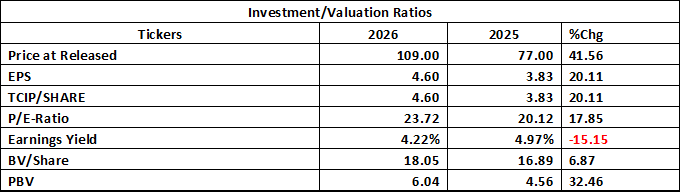
Unilever Nigeria Plc’s investment and valuation metrics show a significant improvement in earnings performance in the third quarter of 2026, although the share price has also risen considerably. The price at release increased by 41.56% from ₦77.00 in 2025 to ₦109.00 in 2026, while earnings per share (EPS) and total comprehensive income per share (TCIP/share) both increased by 20.11% from ₦3.83 to ₦4.60. The growth in EPS is positive and reflects the company’s improved profitability during the period. However, the price appreciation has outpaced earnings growth, resulting in the P/E ratio rising from 20.12x to 23.72x, an increase of 17.85%.
The earnings yield correspondingly declined by 15.15% from 4.97% to 4.22%, suggesting that investors are paying a higher price for each naira of earnings. Meanwhile, book value per share increased by 6.87% from ₦16.89 to ₦18.05, reflecting growth in shareholders’ net asset value. However, the price-to-book (P/BV) ratio increased substantially from 4.56x to 6.04x, representing a 32.46% rise, indicating a higher market valuation relative to the company’s underlying book value. Overall, the company’s stronger earnings and book value are positive fundamentals, but the sharp increase in the share price and valuation multiples suggest that the stock has become more highly valued, leaving less room for valuation upside at the current price.
Dividend Information
Unilever Nigeria Plc declared a total dividend of ₦2.00 per share in 2026, representing a return to dividend distribution compared with the nil dividend recorded in 2025. In addition, the company had already paid an interim dividend of ₦2.00 per share in the first half of 2026, bringing the total dividend paid during the 2026 financial year to ₦4.00 per share. The reported payout ratio of 43.52% and dividend yield of 1.83% indicate that the company is distributing a meaningful portion of its earnings to shareholders, although the yield remains relatively modest at the current share price of ₦109 per share.

FINAL VERDICT
Unilever Nigeria Plc delivered a positive third-quarter 2026 performance, with turnover rising by 18.40% to ₦184.01 billion, operating profit increasing by 26.52% to ₦38.54 billion and profit after tax growing by 20.11% to ₦26.40 billion. The company also recorded improvements in ROE, ROA, asset utilisation, working-capital turnover and solvency ratios. The return to dividend payments is another positive development, with ₦2.00 per share paid as interim dividend in the first half of 2026 and a further ₦2.00 per share reflected in the dividend information, implying total 2026 dividends of ₦4.00 per share.
However, the improvement in fundamentals has been accompanied by a substantial increase in the share price from ₦77.00 to ₦109.00. At ₦109.00, the stock trades at a P/E ratio of 23.72x and a P/BV of 6.04x, while earnings yield has declined to 4.22%. The valuation therefore appears demanding relative to the current earnings and book value, despite the company’s improving profitability. Based on the earnings outlook, book value and a conservative growth assumption, an estimated intrinsic value of approximately ₦82.00 per share, with a reasonable fair-value range of ₦75.00–₦90.00, is considered appropriate. We therefore rated this stock a Hold and watch for improvement and other economic moves that may affect the sector.
At the prevailing price of ₦109.00, the shares appear overvalued relative to the estimated intrinsic value. The recommendation is primarily valuation-driven rather than a reflection of weak business fundamentals. The underlying operating performance is improving, but the current market price provides limited margin of safety.